
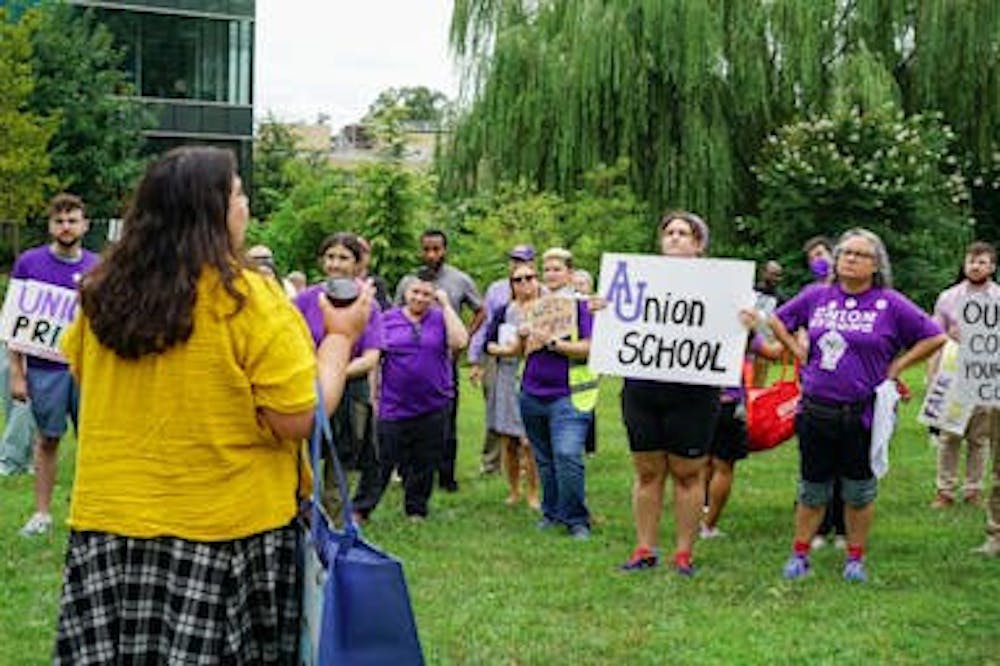
AU Staff Union continues to press University administration on contract bargaining, with members expressing their grievances with the contract bargaining process. The administration’s recent updates to the labor contract, staff said, left them feeling unable to focus on the success of their students.
On Oct. 10, University President Jonathan Alger announced that a tentative agreement with AU’s Staff Union had been reached after previous bargaining rounds. In September 2025, President Alger announced some of the concerns this new contract aims to address, such as procedures to counteract bullying in the workplace, tuition remission benefits and a proposal for a new compensation framework.
The contract includes a two percent increase in compensation for employees earning less than $60,000 per year and a one-time 1 percent payment for those who make $60,000 to $64,000 per year. Additionally, it includes two guaranteed remote work weeks per year and maintains current tuition remission benefits through June 2027.
Yet, Sam Sadow, visual resources curator in the Department of Art and one of the University’s Staff Union representatives, wants more for his community. Sadow said he has continued to press management for more flexibility in working modality, better working conditions and more protections against layoffs.
Sadow has been working with the Staff Union since 2019. Since being elected Union Representative in fall 2022, he has been responsible for ensuring that concerns from members across schools and disciplines are brought to the bargaining table. He’s been on the bargaining team through all three iterations of the contract.
“It’s justice for AU workers,” he said. “It is increasing the power of myself and my colleagues on campus to have a say.”
The Staff Union has been bargaining on contracts since March, and the primary concern remains the same: increased wages. Sadow said many faculty members are commuters from outside of central D.C. and things like parking passes, longer hours and lack of modality flexibility affect their ability to justify coming to work.
According to the Living Wage Calculator, a data site from the Massachusetts Institute of Technology, the approximate living wage for a single adult with no children in D.C. is $54,034 before taxes. Elizabeth Deal, assistant vice president and deputy chief communications officer, said they could not disclose the new scale for wages due to “privacy laws.”

“It approaches a non-living wage,” Sadow said. “For the associate vice presidents and vice presidents who are making these decisions, who make hundreds of thousands of dollars; I think there’s a disconnect.”
Sadow expressed that union members felt that management prolonged addressing their concerns about wages.
“They’re offering peanuts, pennies, for the people who do the lion’s share of the work,” Sadow said.
Diane Roznowski, assistant director for career events and operations in the Kogod School of Business, MA/School of Public Affairs ‘25 and BA/SPA ‘18,, respects the dedication union members have to each other.
The Staff Union helped her battle to receive her paycheck when the American University Human Resources office refused to pay her during the first few months working in Kogod. She said this was her first experience with the disregard management show for staff and their issues.
“The union is the staff of this University,” Roznowski said. “I’ve seen so many times my colleagues being willing to not get what we want to make sure the students have a better experience. There’s just no recognition of that.”
Following President Alger’s announcement on Oct. 10, the University Staff Union emailed The Eagle with the following comment:
“Despite the numerous violations of the National Labor Relations Act that management committed during the course of negotiations, we look forward to the successful completion of our contract cycle once ratification is complete and to working with AU’s leadership to enforce the ratified contract in the two years to come.”
The University responded with the following statement:
“We are pleased that the good faith negotiations with the Provost and Enrollment Division staff union and SEIU Local 500 produced a comprehensive and fair new collective bargaining agreement. AU complies with all NLRA requirements in the bargaining process. Our team is deeply experienced in collective bargaining, bargained in good faith throughout the negotiation process and followed all applicable laws and regulations,” Deal said.
While the recent labor negotiations may show progress on paper, for adjunct professors at American University, the fight towards equal pay is far from over. David Jacobs, an adjunct professor with Kogod, has been working closely with the staff and labor union to fight for adjunct faculty.
“Adjuncts get paid $5,400 a course. So, $5,400 times six is much less than $70,000, and there’s no guarantee that adjuncts will continue in those roles,” Jacobs said.
This uncertainty continues to shape much of adjunct life at AU with many adjuncts only being hired per semester, often just days before classes start, Jacobs said.
“Limited to a 2:1 schedule, which means if we rely heavily on our adjunct income, our income drops by 50 percent the second term,” Jacobs said.
The policy is placed on adjuncts who are hired during the start of the school year, where they can teach two courses during the first semester, and then they must drop to one course the second semester of that school year.
Beyond this, adjunct professors’ main concern lies in their students. Mary Catherine Stoumbus, an adjunct professor teaching at the College of Arts & Sciences, said campus policies for adjunct professors have harmful impacts on students, in particular because adjunct professors don’t have offices to hold office hours in. Many adjunct professors have also voiced concerns about the lack of resources that the University provides.
“Adjuncts don’t have offices. We don’t have a community. We don’t see many people other than the students in our classrooms, which makes it harder for them to hold office hours,” Stoumbus said.
Early this June, American University laid off 40 staff members without any prior notice. One of them was Stoumbus, who has now been rehired to teach two courses this semester.
“Instead of valuing the two years I spent there, they let us go, and they cut off our access to our emails. We couldn’t communicate with students anymore,” Stoumbus recalled. “Students come back years later asking for letters of recommendation, and if they don’t have our emails, there’s no way to connect with them.”
For Stoumbus, she felt that it didn’t just hurt adjunct faculty but students as well. Especially those who are trying to find the support that they need. This concern was echoed by Jacobs who noted the limited access that mentors have for students.
“It’s harder for students to reach out and connect. This ties into enrollment and retention issues … there’s nowhere to connect. No place for a private conversation if a student is having difficulties,” Jacobs said.
Rather than being protected as vital members of the University community, adjunct professors feel as if their value doesn’t extend past the classroom.
“It kind of shows the devalued status of adjuncts, and the misunderstanding that we aren’t essential to the community,” Stoumbus said.
David Kaib, assistant director of institutional research and assessment, said higher management’s approach lacked proper acknowledgement of the types of issues staff workers are forced to deal with. Kaib knows that this is a start, but hopes for more breadth in giving autonomy back to his colleagues.
“University processes were not protecting people,” Kaib said. “We wanted to both change those processes, and make sure they were in the contract — we have more ability as a union to ensure compliance.”
AU Staff Union members are concerned that management doesn’t understand how essential protections for job security and increased salaries are to their day-to-day operations. Kaib spoke about the tension between management and the union members.
“There are concerns around top-down decision-making, which are not unique to staff. So many of the things that we care about are things that other communities — folks on campus — care about as well,” Kaib said.
Kaib, like other staff members, felt their problems and concerns were disrespected by the administration. During bargaining sessions, Diane Roznowski experienced a negative experience, quoting how members from the other party dismissed her emotions.
“Our team engaged in these important discussions with professionalism and a commitment to reaching a fair resolution, which was the outcome,” Deal said in a statement to The Eagle.
For Jacobs, this trend points to a deeper issue in University culture.
“It feels terrible to have your entire career devalued just so a bad budget plan can be put in place,” Jacobs said. “Universities act as if they think you are disposable for budget protection under almost any circumstances.”
Outside of advocating for flexibility in modality, wage protections and more explicit processes to combat bullying, the AU Staff Union is also concerned with protecting academic freedom for staff and faculty members on campus. Academic freedom is the freedom for educators and students to discuss, teach and research subjects without censorship or retaliation from administrators.
Amid executive orders from the White House targeting diversity, equity and inclusion initiatives and LGBTQ+ issues, staff workers said they fear consequences for contributing to these conversations.
“When management sort of emphasized, ‘This is a workplace,’ we said, ‘Yes, but it’s also a college campus. It’s also a community,’” Kaib said.
Last year, there were several protests and teach-ins by student-led political advocacy organizations that rallied together. Sadow said he wants students to continue those efforts.
“Students are an extremely powerful group on campus. You can wield that power in ways to make your campus a better, more democratic, place where the people who do that work can stay and thrive,” he said.
This article was edited by Cara Halford, Abigail Hatting and Walker Whalen. Copy editing done by Sabine Kanter-Huchting, Avery Grossman and Ava Stuzin. Fact-checking done by Aidan Crowe
