
The Eagle’s editorial board is composed of its staff but does not represent every individual staffer’s views. Rather, it provides an insight into how The Eagle, as an editorially independent institution, responds to issues on campus.
The D.C. Attorney General’s $260,000 settlement with American University for wage theft violations was a long time coming for an administration that has consistently prioritized cutting costs over its employees’ well-being. The agreement, which covers failures to compensate non-exempt employees for off-the-clock work from 2020 to 2024, shows a larger pattern of labor exploitation.
The settlement reveals that employees across the School of Public Affairs, School of International Service, Washington College of Law, WAMU and the Academic Support and Access Center regularly performed unpaid work in direct violation of D.C.’s Minimum Wage Revision Act and Wage Payment and Collection Law. This practice appears to have been ongoing for years, with one former employee reporting that she was given explicit instructions to falsify her timesheets.
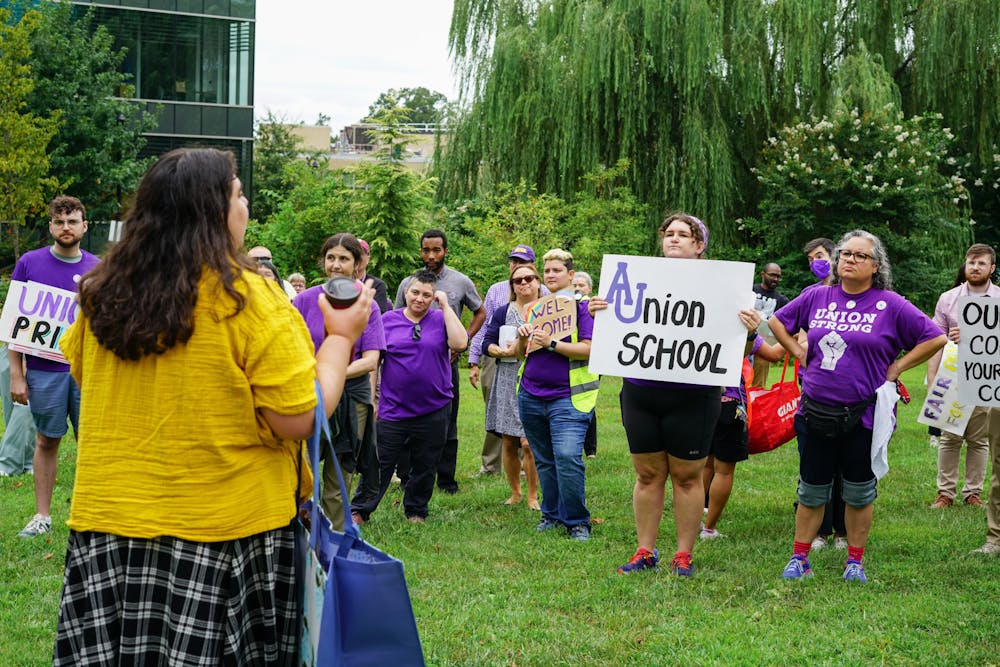
This systemic wage theft has occurred while AU simultaneously engages in contract negotiations with the AU Staff Union, whose members are demanding fair compensation and basic workplace protections. These negotiations have been occurring since February, and the union has been without a contract since June. Staff are fighting for living wages from their employer, which has been denying some of its employees legally mandated compensation for over a decade.
The University's response to both the settlement and ongoing labor disputes has been characteristically inadequate. Despite agreeing to pay the $260,000 in restitution and penalties, the University formally denies any wrongdoing in the settlement agreement. Meanwhile, President Jonathan Alger’s recent communications about ongoing union negotiations emphasize “25 extensive bargaining sessions” as evidence of good faith externally, but internally, as the settlement shows, the University has been violating labor laws for years.
The exploitation staff face goes beyond wage theft. Some have reported workplace bullying that remains unaddressed by human resources, including supervisors making inappropriate comments about employees’ appearances and capabilities. This creates an unhealthy work environment where legal violations are normalized and workers are discouraged from asserting their rights.
AU’s financial constraints, which are often used as a catch-all excuse by the administration for any problem it faces, do not excuse illegal conduct. Given the University’s financial constraints, transparency about priorities and decision-making processes in resource allocation would be far more appropriate than compensating for budget shortfalls through unlawful wage practices. The settlement costs could have been avoided entirely through compliance with the law.
The University needs to take immediate action to address these failures. While the settlement requires AU to provide training on external complaint processes, the University has not committed to establishing transparent internal reporting channels. Given AU’s track record, it is unclear whether any training or external resources will be given meaningful support.


The University should create a direct reporting system that allows workers to report supervisors’ violations directly to senior management, bypassing HR when necessary. This could include options like QR codes that connect workers immediately to the president’s office, ensuring that when HR fails to address problems, workers have a clear path to escalate the issue.
AU should provide comprehensive education about workers’ rights, as required by the settlement. Both supervisors and employees should receive training on what constitutes wage theft and workers’ legal protections. Too many workers fail to recognize when their rights are violated, and supervisors require clear guidance that falsifying timesheets or demanding unpaid work constitutes a fireable offense that is illegal.
Additionally, AU must work to resolve union negotiations quickly and fairly. Staff deserve compensation that reflects D.C.’s cost of living, work arrangements that correspond to actual job requirements and enforceable protections against workplace bullying and harassment. AU’s current negotiating positions need to improve substantially. AU must pay its staff fairly.
Students also have a responsibility to support fair labor practices on campus, especially as they recognize that action from the University alone is not enough. The staff who support us every day, from advisors to facilities personnel, deserve economic security and workplace protections so they can perform their duties effectively.
The Staff Union should actively recruit student support through tabling, educational events and direct outreach, and the University should allow them to do so. Students have significant influence on campus, and many are already sympathetic to workers’ rights when they understand the issues. The union should leverage this to put additional pressure on the administration.
These efforts, however, are most powerful when labor rights advocacy is streamlined rather than bundled with a multitude of other issues. Keeping the message clear ensures students know what’s at stake and engage accordingly while supporting staff.
The University cannot continue the pattern of exploitation and needs to fully commit to the values it claims to espouse. As the Staff Union says, AU is a union school, even when AU administrators work against it. Now is the time for the University to honor its staff members with the respect and fair treatment they have long demanded and deserved.
This piece was written by Alana Parker and Quinn Volpe and edited by Walker Whalen. Copy editing done by Sabine Kanter-Huchting and Emma Brown.
