

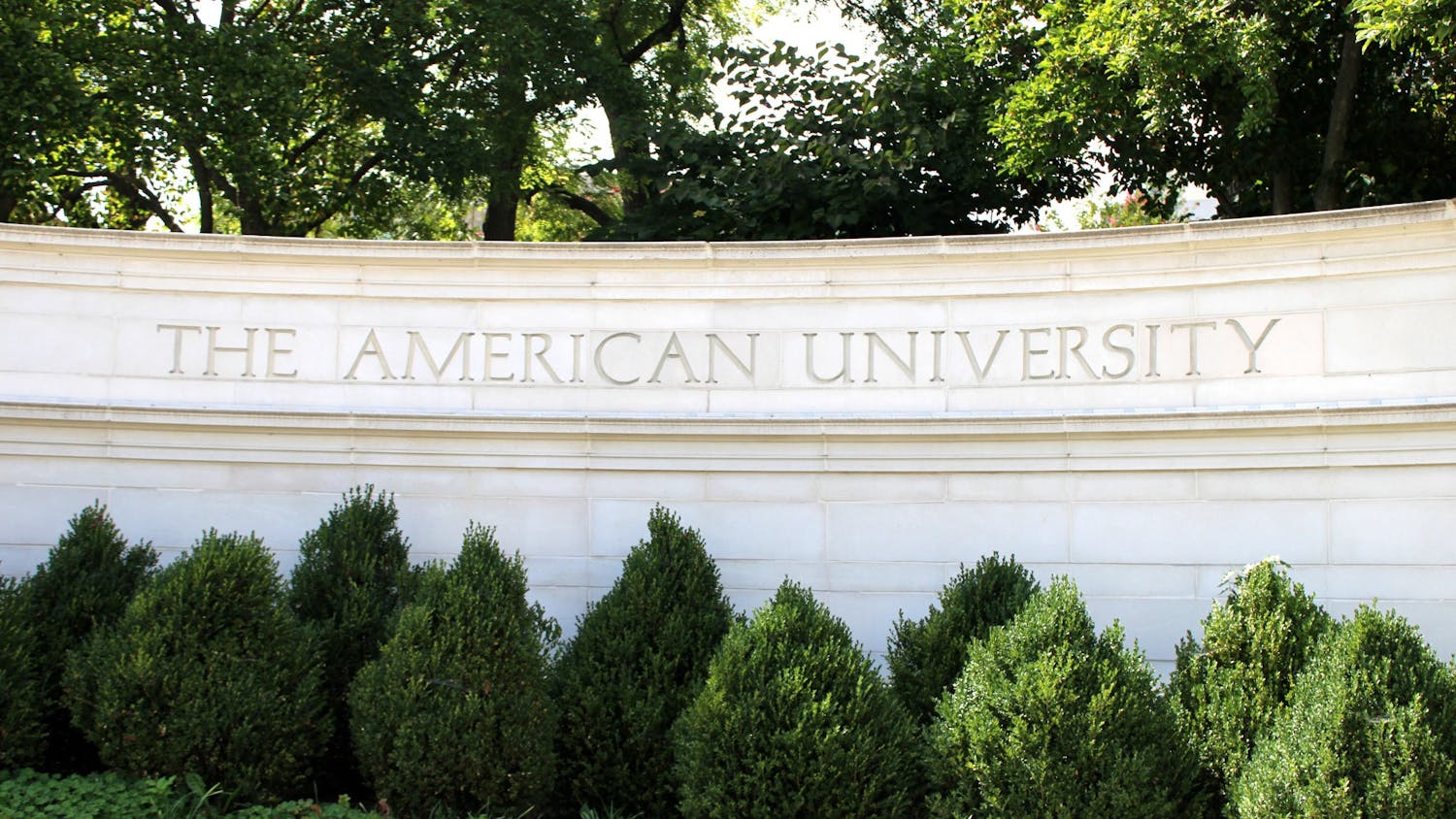
The American University Staff Union had a message for new students during move-in on Aug. 18 and 19: “AU is a union school.”
The union, part of the Service Employees International Union Local 500, held a two-day “informational picket” to share with students their frustrations from negotiating a new contract with the University and administrative inaction when reporting supervisor “bullying.”
“We love our students, we need fair pay,” picketers repeatedly chanted. They marched on Aug. 18 from Kay Spiritual Life Center through Kerwin Hall, across the Quad to the School of International Service, School of Communication, Mary Graydon Student Center and eventually the lawn between the Hall of Science and McKinley Building — affectionately known by students as “The Beach.”
The next day demonstrators met in front of Kay and marched to Massachusetts Avenue to wave signs and chant across the street from the Katzen Arts Center, ending with a rally in front of MGSC. Participants handed out flyers to students with a link to send letters to the AU administration. As of publication, the website shows that more than 3,600 letters have been sent.
Union concerns
Union members have been working without a contract, formally known as a collective bargaining agreement, since June 30. However, they have been negotiating the terms of a new contract since February, according to union representatives David Kaib, the assistant director of the Office of Institutional Research and Assessment, and Sydney Henry, communications and events coordinator for the AU Library.
Increased wages, more flexible hybrid work modalities, healthier workplace environments and recent layoffs were among the top concerns that Staff Union members voiced at the picket.
“We have been making a friendly, reasonable demand but AU is telling us they cannot give anyone a raise at all,” one speaker told picketers Aug. 18. “We can barely afford to stay here and help these students. We are here for the students because we love them.”

University President Jonathan Alger said in an Aug. 14 statement he was committed to ensuring a safe and healthy work environment, but union members repeatedly called out inaction by administrators when they say they reported “bullying” by supervisors.
“I’ve been asked if I’ve lost weight,” said one union representative. “I’ve been asked if I’m pregnant. I have been told that I look like a sorority girl with nothing behind my eyes. I come in and I work my ass off every day.”
Union members told The Eagle that they reported interactions like those to the Office of Human Resources, but felt like they were being pushed out as the administrators faced no disciplinary action.
Some employees spoke to The Eagle under the condition of anonymity out of fears they may face retaliation for speaking out. All the union members interviewed for this story spoke to The Eagle on their own behalf, not in their capacities as University employees.
The Staff Union wants stronger bullying-prevention language to be added to the new contract. Assistant Vice President and Deputy Chief Communications Officer Elizabeth Deal said in an emailed statement that “topics of concern have been addressed in the bargaining session” and the University would “continue to negotiate in good faith on outstanding items.” She declined to elaborate.
New student reactions
Incoming freshman Lillian Ulfer said she was initially confused as to what was going on. After being handed a pamphlet and learning more, she thought that the situation was unfair and said it was good that the staff were picketing.
Ulfer’s home state of Tennessee is a “right-to-work” state, which makes unionizing difficult in a lot of places due to laws prohibiting union security agreements.
Davis Wallace and Zoe Feldman-Roy, both incoming freshmen in SIS, were watching the staff union demonstration outside of MGSC on Aug. 19. They expressed support for the union and their “endeavors for fair wages.”
“It’s inspiring to see such an immediate display of progressive voice[s] and people fighting for fair wages and their ability to live in dignity,” Feldman-Roy said. “AU, like most American colleges are, is a capitalist institution and as such, labor exploitation is kind of inherent to that system of capitalism.”
Wallace said one of the reasons he came to D.C. was because of the political atmosphere and he is happy to see that it's alive and well.
“It’s disappointing to find out that they’re not being paid enough,” Makayla DeLay, a freshman in the School of Public Affairs said. DeLay, who attended AU in part for its history of political activism, stopped to take a union flyer during move-in on Aug. 18.
“I definitely think it’s good that they’re making a change, speaking up about it,” DeLay said.
“And they didn’t give you any financial aid,” DeLay’s mom chimed in. “This is the most expensive school on the planet. I assumed the [staff] were making a lot of money.”
Administration's presence at the picket

A flock of University administrators followed the demonstrators from building to building on Aug. 18 and congregated in front of the Letts-Anderson-Centennial complex while picketers shared stories, chanted and greeted new students and families walking past the lawn.
As the demonstration walked from SIS past McKinley, two members of the AU Police Department in plainclothes stopped one picketer who was chanting through a megaphone.
Senior AUPD Investigator Stephen McClary, who was accompanied by then-interim Police Chief and Assistant Director of Physical Security and Police Technology Doug Pierce, asked the picketer if she was affiliated with the University and then asked her to produce her AUID. After union leaders spoke with officers for a moment, the picketer handed McClary her AUID, which he photographed and handed back to her.
Vice President and Chief Communications Officer Matt Bennett, who watched the confrontation unfold, declined to answer specific questions about the interaction.
“As with any situation on campus, if there is a potential policy violation, it is addressed through our normal channels including, if appropriate, AUPD speaking to people and identifying themselves and asking for identification of the individual,” Bennett told The Eagle immediately after the confrontation on Aug. 18.
“They were informed that certain areas were off-limits,” he said. “That’s what I can tell you.” When asked what those areas were, Bennett replied, “Certain areas.”
Union leader Jack Anthony said the staff union was given specific places where they could demonstrate and were given a map with X’ed out locations from University administration.
“They told us totally reasonable things, by the way. ‘Don't get in the way of the operations of the University,’ ‘don't make it hard for students to do their move-in stuff,’ all of that we agree with,” Anthony said.
In the Aug. 14 email, Alger updated the community on labor negotiations in anticipation of the picket. He wrote that the University would be “taking measures” to ensure the picketing wouldn’t impact move-in.
Part of the National Labor Relations Act makes it an unfair labor practice for employers to “Photograph or videotape employees engaged in peaceful union or other protected activities.” It is also prohibited to spy on union activities, but only if supervisors are “doing something out of the ordinary to observe the activity.”
There have been five unfair labor practice claims filed against AU since 2020, according to a search of the NLRB’s website.
Economic struggles for AU employees
Anthony calls himself a “triple Eagle.” His mother is an AU professor, he got his master's at the University and he now works in academic technology.
“The reason I work at this university is because I love this university. My mom loves this university,” Anthony said. “I grew up on this campus. I grew up going to the child daycare center. I love this place. I studied here. I've really devoted a lot of my life to it.”
Anthony said some of the benefits that made his mother’s life work, such as the daycare center, are vanishing. He’s asking AU for recognition of the increased cost of living in the D.C. area. By not getting raises to meet inflation, Anthony said staff members are taking a pay cut by staying at the University.
The union picked this high-visibility action to build coalitions with students and new community members, according to Anthony. He said he thinks once students hear what is going on, they are “totally on board.”
“They want the best for us. We want the best for them,” Anthony said. “That’s been one of the most inspiring parts of, frankly, a pretty disappointing contract cycle with management, is the student support. The student support is crazy.”
Transportation is another costly issue for the Staff Union. In January, all AU employees were told to return to the office a minimum of three days a week, according to union members.
Some union members like Jessica Meagher, a study abroad advisor in the School of International Service, regularly hold meetings with students who aren’t physically on campus — or even in the country. However, Meagher said she’s still required to be in the office three days a week.
“I currently commute 100 miles round trip,” Meagher told her fellow cardholders in the SIS atrium. “It costs over $20 every single time I come in to American University. Coming in three days a week, even, is a significant challenge.”
Meagher said she’s on calls until 8 or 9 p.m. with students on the other side of the world. She and the Staff Union are calling for “reasonable work modalities that reflect what our jobs actually are.”
“We want to meet our students where they are,” she said.
For Meagher, that two-hour commute means the difference between picking her son up from the daycare 10 minutes from her home, or not seeing him until he’s already in bed.
In the Aug. 14 email, Alger outlined constructive dialogue and progress on “more than 25 extensive bargaining sessions.” He also emphasized the financial struggles that AU and universities across the country are currently facing.
“The government is not going to save us. This economy is not designed to save us, but workers can save each other,” Anthony said. “I'm proud to be a part of the AU union, and I’m hopeful. That would be my message.”
This article was edited by Payton Anderson, Cara Halford and Walker Whalen. Copy editing done by Sabine Kanter-Huchting, Emma Brown and Ariana Kavoossi.
