
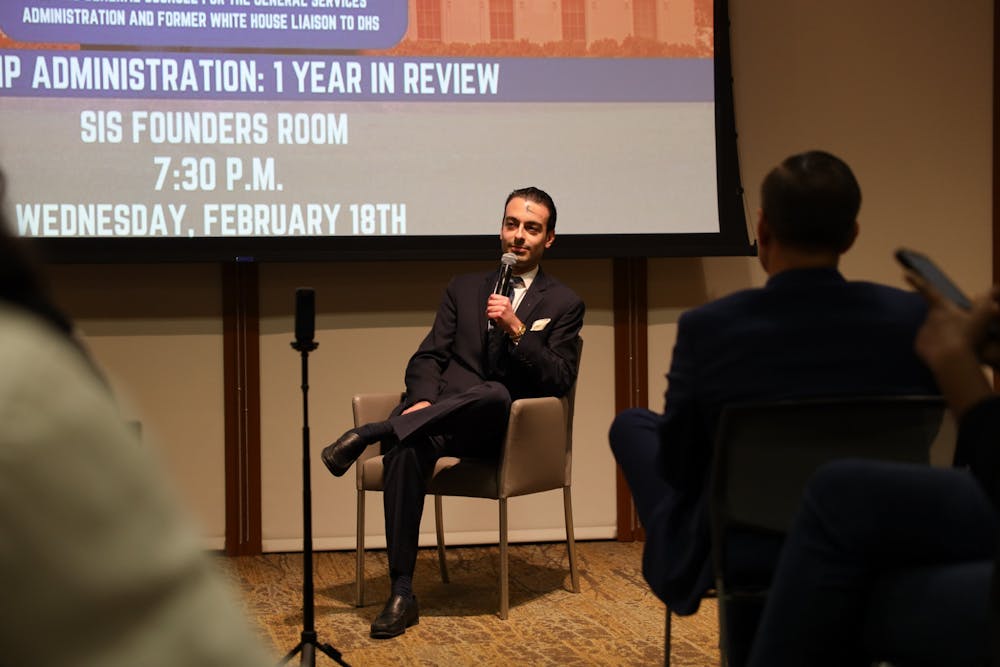
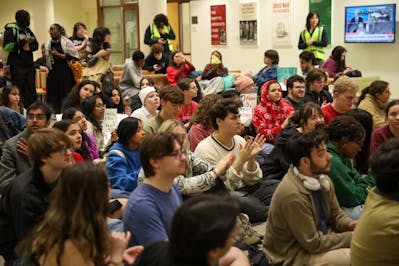
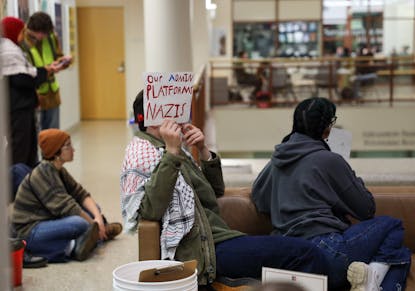
Protestors filled the School of International Service atrium with chants and cheers, the crowd swelling to the beginning of the lobby stairwell. Just below them sat roughly 22 American University students observing a moderated discussion between Paul Ingrassia and the AU College Republicans.
Ingrassia is the acting general counsel at the General Services Administration and the former White House liaison to the Department of Homeland Security. But the crowd of around 100 students had not gathered to make a statement regarding the GSA or even the DHS.
Dissent simmered both outside and inside the Founders Room as students challenged Ingrassia on the accusations against him. Eventually, the event would conclude with a physical altercation between a member of the club and an audience member that led to the latter’s detainment.
Texts obtained by Politico show Ingrassia referring to himself as having had a “Nazi streak.” He additionally labeled Martin Luther King Jr. “the 1960’s George Floyd,” saying the Civil Rights revolutionary should have his federal holiday “tossed into the seventh circle of hell where it belongs.”
In response to the College Republicans announcing they would host Ingrassia for the next installment of their speaker series, a coalition of clubs organized the protest, beginning outside SIS and continuing into the lobby for the entire event. According to Quinn Fitzpatrick, vice president of Student Government and member of AU Rise Up, plans for protest began when organizers caught wind of Ingrassia’s colorful comments.
Luke Brown, co-president of American University College Republicans and a junior in the School of Public Affairs, said the club was aware of the allegations when inviting Ingrassia to come speak. Ingrassia’s persistent denial and condemnation of Politico’s claims assured the club he was not “truly the terrible man that they said he was,” and his lawsuit against Politico established that, Brown said.
The $150 million defamation lawsuit Ingrassia filed against Politico concerns an unrelated article accusing him of sexual harassment against a lower-ranking colleague.

Leading up to the event
According to Brown, the main goal of the College Republicans’ speaker series is to create a space where students can engage with the conservative D.C. community. Though they have hosted other “controversial” figures in the past, Brown said this particular edition of the speaker series brought significantly more discourse.
Prior to the announcement that he would be coming to campus, Emma Finkelstein, a sophomore in the College of Arts and Sciences and SPA, had never heard of Ingrassia. After learning more about his beliefs, Finkelstein said she did not understand why he would be invited to campus.
“I agree with the need for civil discourse and differing political opinions,” Finkelstein said, “but I think this is just, like, another extreme.”
A coalition of clubs came together to release a joint statement of condemnation against the College Republicans on Feb. 2, stating, “Ingrassia’s rhetoric and actions go beyond free speech.” The clubs called on University administration to uphold its responsibility to create a “safe, healthy, and inclusive” campus.
In an email obtained by The Eagle, vice president of the Office of Inclusive Excellence Dr. Nkenge Friday said the University was committed to exchanging ideas “even when ideas are controversial” with “integrity, responsibility, and respect." Friday elaborated that while she understood having Ingrassia on campus raised “meaningful concerns,” it should also be understood that as a Registered Student Organization, College Republicans’ invited speakers did not represent the views of the University.
“It is important to clarify that the University neither endorses nor takes positions on the views expressed by invited speakers,” Friday said. “When events raise concerns related to safety or community impact, the University works closely with campus partners to ensure appropriate planning, policy compliance, and institutional oversight.”
Over the past year, the University has taken numerous steps to combat antisemitism on campus: a partnership with the University’s chapter of Hillel funded a permanent, renovated space for the club, and the University has worked with the Anti-Defamation League to improve its score on its antisemitism report card from a C to a B.
To Finkelstein, an involved member of AU Hillel, the University allowing Ingrassia to come contradicted its claims of combating antisemitism on campus.
“I think it’s kind of like a contradictory message,” Finkelstein said. “So many [administrators] of different colleges are Jewish and we have so many Jewish donors, and I don’t understand why they’re not hearing the pushback and taking that into consideration that so many people are going to be upset by it.”
“We recognize that circumstances such as these may be concerning, and the University is dedicated to supporting our entire community,” Friday wrote.
Brown said the club had University administration’s support from the beginning, and the question was never if Ingrassia would come to campus, but when.
“It was immediately ‘Okay, we know this guy’s a little controversial — we’re gonna get you police, we’re gonna do this,’” Brown said. “That was kind of how it unfolded rather than saying, ‘Well, we need to see if this guy is allowed.’ It was always, ‘How can we help you? How can we make sure everyone’s safe?’”
Finkelstein said she struggled to see what the College Republicans stood to gain from bringing Ingrassia to campus, especially considering nearly 21 percent of the student body is Jewish.
“Why are you gonna put your peers, your friends, people you care about, in such an uncomfortable situation?” Finkelstein said.
During the discussion
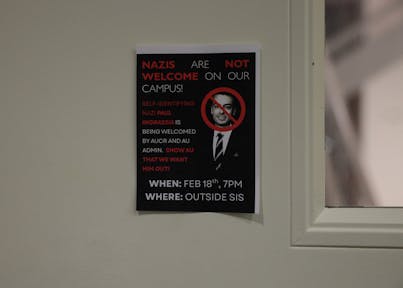
The organized protest was slated to begin at 7 p.m. on Feb. 18 outside SIS, 30 minutes before the event with Ingrassia and the College Republicans. Students who gathered outside the buildings chanted statements like “We want justice, you say how, Nazis off our campus now,” and listened to speeches from many different student activists on campus.
Elizabeth García, one of the two dedicated media liaisons and president of Latinos En Acción, was one of the first to speak. She said Nazi ideology, like normalizing white supremacist men in leadership and the rejection of equality, pose dangers.
“It grows when racialized hierarchy is normalized. It grows when people are told that equality is negotiable,” García said.
Asher Heisten, a junior in SPA, a member of AU Rise Up and one of the organizers of the protest, said Nazis should not be welcome on campus.
“Administration likes to say that they’re hearing both sides of an argument,” Heisten said. “Is there both sides to murdering people, murdering protestors on our street? And is there both sides to Nazism in the first place? We don’t think so.”
Heisten said in his speech to the crowd that organizers got an email the night of Feb. 17, from administrators who did not identify themselves, denying the club’s request for amplified sound.
“So I think they need to take a look at their policies and acknowledge, like, what makes students feel unsafe and what they want,” Fitzpatrick said. “And what type of speech they want to prioritize.”
Approximately 15 minutes into the event, protestors entered SIS to continue their demonstration in the atrium. Members of the College Republicans greeted them, as they sat at a table at the top of the stairs checking students’ AUID and bags before they entered the event. Metropolitan Police Department officers resided next to the table.
While many of the approximately 22 students were in attendance to hear from Ingrassia, others attended to confront him about his past. A student who identified himself as a member of the Young Democratic Socialists of America asked Ingrassia if he stands by his statements, which the speaker deflected.
Following the back-and-forth between Ingrassia and the YDSA member, the moderated discussion finally kicked off almost 20 minutes after the original start time. Alex Austin, AUCRS vice president, asked Ingrassia questions about his previous and current roles, his writing and legal matters pertaining to the 14th Amendment and the Supreme Court’s case on Trump’s tariffs.
As Ingrassia and Austin spoke, the chants and speeches from protestors above continuously interrupted their dialogue. Around 8:19 p.m., protestors could be heard banging on the walls next door to the Founders Room and yelling profanities.
Amid disruptions from protestors, members of the audience joked about the noise. The crowd could be heard calling out while Ingrassia answered a question about the role of the executive branch, and he joked the group outside the room was having a better time than the one inside.
“We fully made [Ingrassia] aware that there could be troubles and all that,” Brown said.
Concluding the conversation
The event concluded around 8:40 p.m., yet those in the Founders Room were instructed to remain inside the room until after Ingrassia left. As students swarmed for photographs and to thank him for coming, one individual approached and expressed his displeasure with the allegations against Ingrassia.
The same student had voiced his displeasure with Ingrassia’s presence on campus throughout the speaker series, yet members of the club had repeatedly asked him to be quiet.
If an attendee began disrupting the event, the University told the club to ask the individual to be quiet three times. Should the attendee continue to be disruptive after the third time, the club could kick them out.
“I don’t think it’s really realistic, but that was what they told us to do, and that was what we did,” Brown said.
But because no one was allowed to leave, as tensions increased, the discontented student was stuck.
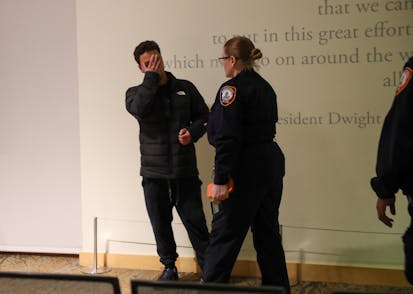
The lone protestor approached Ingrassia, yet as he turned to walk away, club treasurer James Cox commented that the student “loved his trains.” The student then allegedly struck Cox and turned to depart.
“[The student] had exhibited some weird signs before we kicked him out,” Brown said. “We just told the officers to watch him, and they did. But again, it’s kind of hard to prevent that stuff in the moment when everything’s quick.”
Immediately, Cox demanded that the student be arrested and charged with assault.
AUPD officers took the student into a backroom of the Founders Room and shut the door. A few minutes later, Ingrassia and members of the College Republicans walked through the same room to exit the building clandestinely.
After learning Ingrassia had departed from SIS, protestors moved their demonstration back outside.
“No hate, no fear,” the crowd chanted. “Nazis are not welcome here.”
This article was edited by Natalie Hausmann, Payton Anderson and Walker Whalen. Copy editing done by Avery Grossman, Jaden Maitland Anderson, Ava Stuzin and Mattie Lupo. Fact-checking done by Andrew Kummeth.
