
Student leaders emphasized a collective fight for immigrant rights at a recent teach-in hosted by Latinos En Acción. Organizers said the event aimed to emphasize the organization’s diverse advocacy goals.
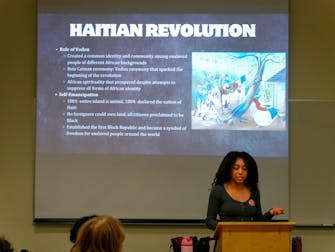
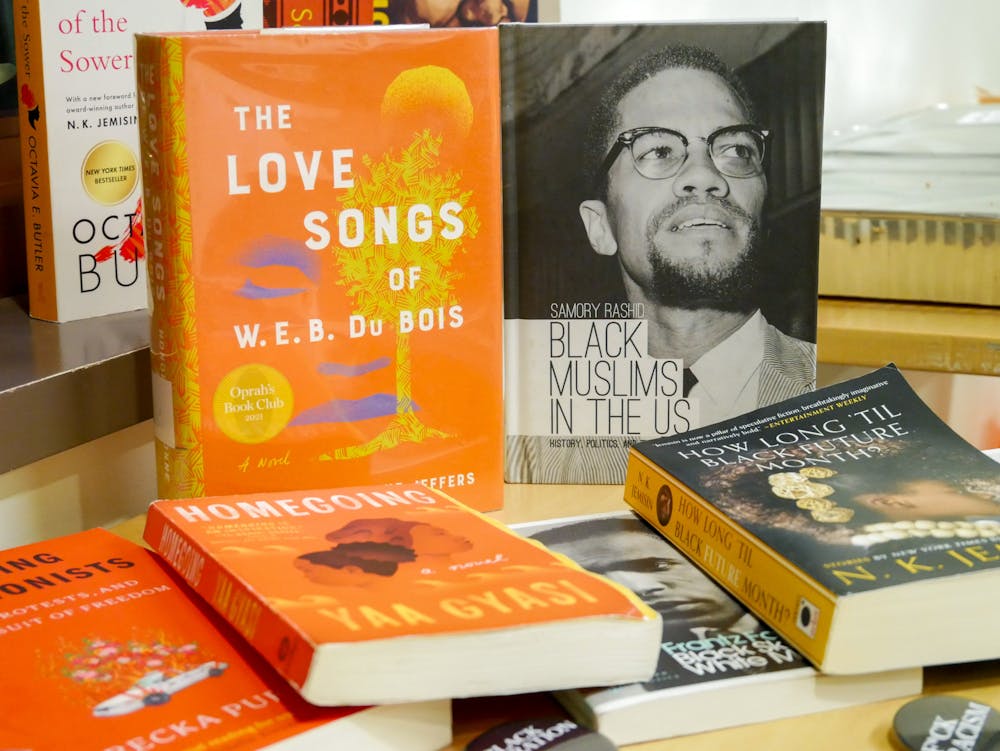
LEA held the teach-in on March 2 in SIS 300, highlighting three historical stories of Black liberation and resistance. The event featured food from local Black-owned business Oohh’s & Aahh’s and books from Black authors on the topics of the teach-in. Organizers taught attendees about the Quilombo of Palmares in Brazil, the Haitian Revolution, and the revolutionary legacy of political activist Assata Shakur.
“It’s a common misconception that LEA is just like a Latino Student Union or a Latino affinity group when actually we’re advocating for all immigrants,” said Elizabeth García, LEA’s president and a junior in the School of International Service. “And a large portion of immigrants in detention facilities right now are Black immigrants, but because of current dominant cultural narratives, [they] are often forgotten.”
The organization’s Community Service Director Angel Quinonez echoed García’s sentiment, reflecting on LEA’s legacy and future goals.
“What we’re really trying to hammer home now this semester is we want LEA to be a space of activism, to be a space of advocacy,” Quinonez said.
Jacob Alejandro, a junior in SIS, said organizations like LEA are essential in the fight for immigrant rights, especially now.
“Especially during this political climate, it’s important to have an organization like this, which their whole focus is advocating for immigrant rights,” Alejandro said.



Student organizers said they planned this event to underscore how interconnected Black resistance and immigrant rights are.
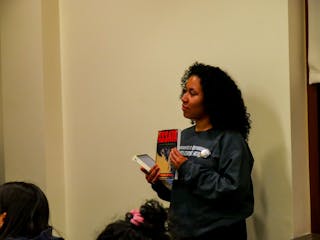
Maya Vasquez-Lopez, LEA’s secretary and a sophomore in the School of Public Affairs, explained during the event how the Quilombo of Palmares, a marooned and independent community in colonial Brazil, is one of the earliest examples of Black liberation. She connected this to the Haitian Revolution, which was the first Black republic and a symbol of freedom and self-emancipation for enslaved people around the world.
Vasquez-Lopez said she hopes event attendees learn that Black liberation and Latin and Hispanic history are deeply connected. Leaders also recognized that with that intersectionality comes an additional burden.
“I feel like there’s a lot of colorism in the Latino community,” J-Lin De Los Santos, a junior in the College of Arts and Sciences and LEA’s historian, said. “So to have an event that specifically highlights Black liberation and Black voices is really important.”
Highlighting the intersectional struggle of Black Latinos is something Kare Coley, a sophomore in SIS and LEA vice president, said the organization wants to extend to future Black History Months and integrate into their organization.
“I see this becoming a recurring event,” Coley said. “I see it as integrating Black ideology, pan-Africanism, and Black lives and all of the liberation work that we do.”
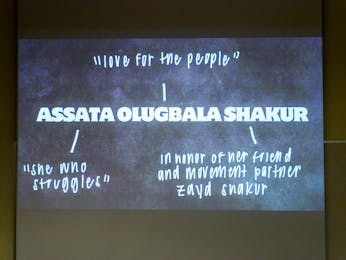
Coley told the story of Assata Shakur, a Black Panther Party member turned Black Liberation Army activist. Shakur was convicted of murder despite contradictory testimony from medical experts, but escaped jail and fled the country to Chile, becoming a symbol of Black resistance, Coley said.
This article was edited by Natalie Hausmann, Isabella Polak, Payton Anderson, and Walker Whalen. Copy editing done by Avery Grossman, Paige Caron, Mattie Lupo, and Ava Stuzin.
