
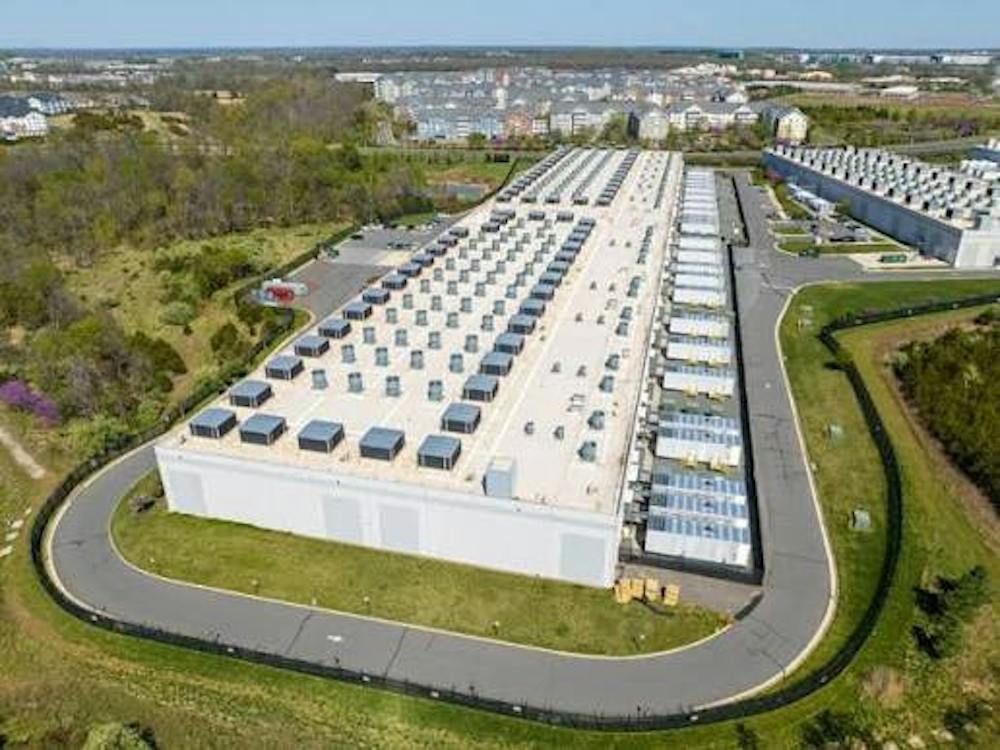
It’s a low, quiet hum that ripples over a mile-long radius into the night. It echoes from buildings that can be as large as a few football fields and often act as an eyesore off the side of the road.
Data centers.
Not just any data center, but large projects like the Dickerson data center. Proposed in 2024 for Montgomery County, Md., this data center was planned to be about 100 acres, as big as a five-building campus.
The Montgomery County Council has worked with the Dickerson data center owner since 2023 on the project under conditional approval. But in January, Council Vice President Marilyn Balcombe said she and her colleagues realized too many questions remained unanswered.
“The reality of a data center was getting much closer, and we still hadn’t really come up with agreements on some of the very complicated things,” she said.
The council had not determined where the large-scale data center would go in Montgomery County, how it could operate and what safeguards were needed to address how it might affect the surrounding community.
So, when the Dickerson data center team returned to the council for final approval in July, the council voted unanimously to put an 18-month hold on all large-scale data center projects.
“The world has changed, and communities are saying, ‘Wait a second, this is too complex. We need a minute,’” Balcombe said. “And so several of my colleagues suggested a moratorium.”


The council also passed a zoning text amendment attached to the moratorium to define large data centers as a building or group of buildings that “has or is projected to have an aggregate monthly electricity demand of at least 25 megawatts (MW),” and stores network systems, computer storage equipment or servers to store or process digital data.
“There’s a lot of fear, and people have a lot of questions about what data centers mean,” said Councilmember Evan Glass, chair of the Transportation and Environment Committee and an American University School of Public Affairs and School of Communication alum from 1999. “People know the big data centers when you see them. They are humming. They take up a few football fields. Those are the data centers I have concerns with.”
Montgomery County’s Data Center Question
Glass said the Council began to grow concerned about large-scale projects like these last year, when one was proposed for construction adjacent to the Potomac River. Although Montgomery County has a few small data centers, Glass said it had never considered hosting a data center of this caliber.
“These large-scale data centers are unlike anything we have ever seen here in Montgomery County,” he said. “And we need to make sure that we get this right without harm to the environment, and without increasing costs or … electric bills.”
With Loudoun County just across the Potomac River in Virginia, home to over 200 data centers and dubbed the “data center capital of the world,” Glass said he instantly became wary of this industry creeping into his community.
“We want to make sure we do not become Northern Virginia, and that we get this right,” he said.
The Energy Cost
The biggest burden large data centers pose to consumers, according to Glass, is the impact of its massive energy demands.
In the past year, Glass said Montgomery County’s utility bills have surged, with some residents reporting increases of as much as $800 or $900 a month. During a hearing Glass hosted in February, the Maryland People's Council reported that half of this sudden increase is “because of data centers in the Northeast hogging the energy.”
“Data companies need to bring their own energy,” Glass said.
However, the Data Center Coalition, a membership association representing the data center industry, argues data centers are not the sole cause of increased energy costs. Khara Boender, director of government affairs for the western region, said several factors are contributing to rising utility rates.
“There’s been more severe and extreme weather events that require more upgrades to the [power] grid,” Boender said. “There’s been supply chain shocks across the world … fuel and energy costs just generally are increasing. [There is also] inflation in and of itself.”
Boender said those against large data centers often overlook this “big picture” perspective. She added that many also fail to consider that data centers are willing to pay for these additional costs.
“If there are costs and upgrades that are directly attributable to what needs to be built out to support those data centers, data centers are paying for those upfront costs,” Boender said.
Who’s paying the price?
Some state legislators are not yet convinced that these data centers will cover its own costs. Several states, like Virginia, have introduced taxes on data centers to offset its impact on local infrastructure.
Charlie Murphy, co-president of Sunrise at American University and a senior in the School of International Service, said taxing alone is not enough.
“Yeah, they’re paying this tax, but at the same time, it’s not comparable to the impact they’re leaving on the communities,” Murphy said. “Just by the sheer number of data centers alone, especially in the NOVA area, it’s almost like it’s too little, too late.”
Murphy said these taxes are also “capped” at a certain amount, meaning governments can only collect a set amount in tax revenue from data centers, even if it generates more taxable revenue.
Murphy also said Boender’s point fails to acknowledge the type of energy data centers use.
“We’re seeing like all of these energy demands surging, and what ends up happening is that you get the energy group … pledging to expand on their energy capacity to meet the needs, but renewable energy can't match the speed at which data centers are being built up,” Murphy said.
Instead, these companies are more likely to turn to gas plants or natural fuels to meet its rapid energy demands, Murphy said.
“So that’s where the real environmental crisis is taking place on the energy side,” he said.
This “environmental crisis” caused by large data centers is already spreading to parts of the Washington, D.C., Maryland and Virginia area.
“The Potomac River is at risk of becoming a failed river if there are more data centers put on it or put along its banks,” Councilmember Glass said.
In April, a historic sewage spill pushed the Potomac to the number one spot for the most endangered river in America. But even without the spill, the Potomac Riverkeeper Network said the risk data centers pose from unchecked water use would still have put the river in the top 10.
For Glass, the threat to the Potomac underscores the broader challenge Montgomery County faces: balancing the economic and technological benefits of data centers with the environmental costs.
“I want Montgomery County to be a tech leader. I want Montgomery County residents to be able to use our devices and be innovative,” he said. “But I also want to make sure we protect our environment and protect our electric bills.”
Not Anti-Data Center. Anti-Unregulated Growth.
Councilmember Balcombe said the council understands how important data centers are for everyday technology use and advancements, but that does not mean its growth should come at the expense of the community. This balance is still the biggest misconception among residents, she said.
“I know that people hate data centers because they tell me in Zoom meetings,” Balcombe said. “They tell me via email. They tell me on social media. All of which is using data.”
Murphy said most anti-data center advocates are also not “anti-internet,” but “anti-excessive internet and a lack of oversight.” But with the sudden rise in AI usage and integration, he said he has seen once environmentally conscious institutions sell out in the name of technological advancement — including AU.
“They [AU] claim they’re carbon neutral,” he said. “At this point, it's become a blatant lie almost because there's been no talks about offsetting the amount of AI that our campus is investing in.”
The Kogod School of Business rolled out incorporating AI into its curriculum, and the administration has also moved to implement a more AI-focused core curriculum. Murphy said he does not think the University can make these changes without also investing in renewable energy.
“It’s rough when a lot of these decisions are being made by boards and people who only are looking at dollar signs,” he said.
Murphy said the larger issue is the “general lack of oversight” surrounding these large data center projects. He said he encourages community members to get involved with groups like Sunrise who are urging community leaders to hold data center developers accountable.
“When people organize to put pressure on these local communities, then you can start to see the pushback on it, and it actually taking hold,” Murphy said.
Nationally, members of Congress are growing more skeptical of data centers as well. Although Glass said he has been pressing this issue for the past year, he said it was only recently that Maryland lawmakers started advocating on the issue.
“I’ve heard a lot of different things on the Hill and among voters, and what I think is also particularly interesting is this is an issue that’s uniting voters on both ends of the aisle,” he said.
According to the AI Policy Institute, 57 percent of likely voters are against large-scale data centers entering their communities. In recent months, both red and blue states have moved to pause or restrict new data center development, including New York and Texas.
With the midterms fast approaching, Glass said this issue will only continue to become more relevant. The responsibility to hold data centers accountable will start locally but shift nationally come November, he said.
“We need there to be federal policy, and we need there to be state and local policy,” Glass said. “This work has to go hand in hand, and we’re each moving forward.”
This article was edited by Norah Aycock, Neil Lazurus, Cara Halford and Gabrielle McNamee. Copy editing by Avery Grossman and Mattie Lupo.
localnews@theeagleonline.com
investigations@theeagleonline.com
