
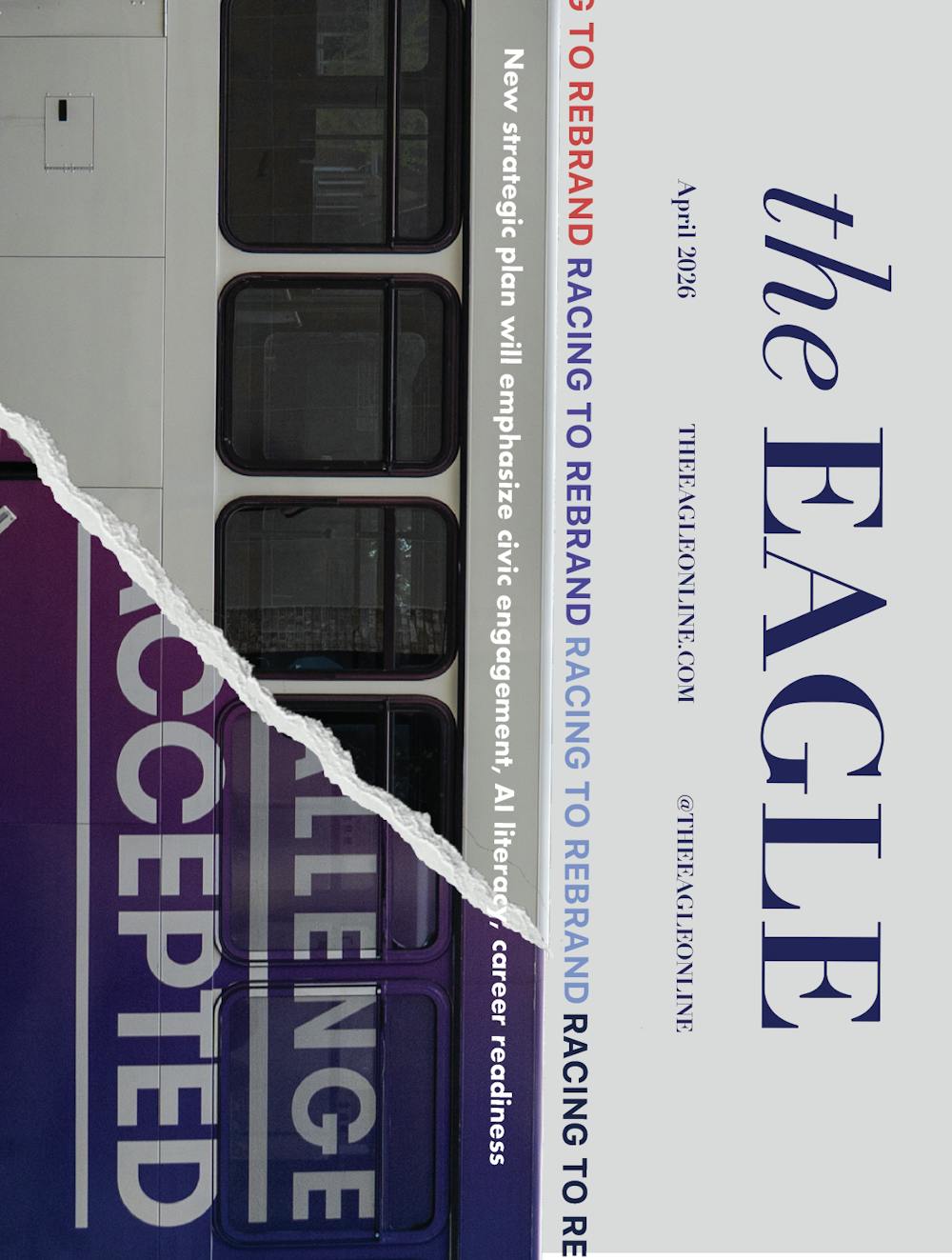
Out with “Changemakers for a Changing World,” in with “Meet our Moment.” With the expiration of former American University President Sylvia Burwell’s seven-year strategic plan, President Jonathan Alger is ushering in a new era of civic life.

In January, President Alger announced the new five-year strategic plan that emphasizes career readiness, community and curiosity. Through various forms of feedback, some still being collected from students and faculty, the University will also launch a new image. This will include reimagining its core curriculum and branding, integrating more AI and launching programming initiatives aimed at fostering civic engagement.
The new five-year plan will introduce curriculum changes in two parts: First, the 90-day-sprint, which is currently in progress, then, structural changes — the longer marathon.
“This is what we’re promising to do so we can meet our moment,” Matt Bennett, University vice president and chief communications officer, said in an interview with The Eagle.
Priya Doshi, a Hurst senior professorial lecturer in the School of Communication, said a strategic plan is essential for a University to illustrate where it aspires to go and how it plans to get there.
“It’s a glue, it’s a vision, it’s an aspirational roadmap,” Doshi said.
For the last seven years, AU’s strategic plan, Changemakers for a Changing World, has shaped the University by emphasizing scholarship, leadership and community. With that wrapping up in 2026, it was time to implement a new guide for the University’s brand.


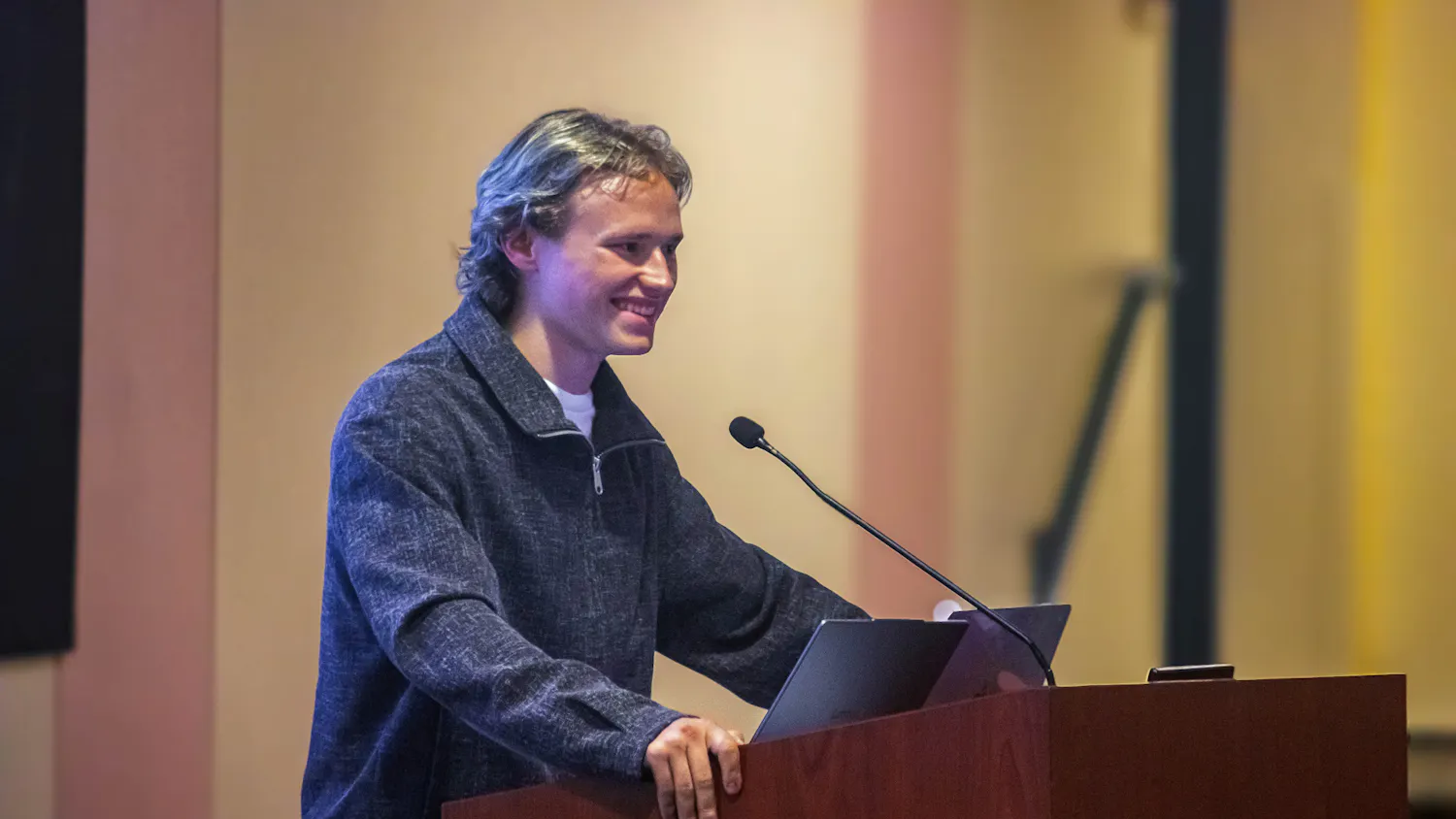
“You’ve heard of the wonk campaign from a long time ago. You’ve heard of ‘challenge accepted.’ This is the next iteration of that work,” Bennett said. “It is foundational to how we operate and how we engage our audiences.”
The strategic plan notes research for a new branding campaign began in August 2025 and creative development in January 2026, which will be fully implemented by July. Faculty Senate Co-Chair Stephen Silvia said more community input will be implemented throughout the process.
According to the plan, this initiative will produce a new brand message, visual identity and strategy for the University. Ideally, the new slogan will stand out in a crowded marketplace, Silvia said.
According to Bennett, advisory groups of students, faculty, staff and alumni gave input on what brand presentation the University should follow.
The brand development is in its creative development phase, which will assess different ideas and creative opportunities. According to Bennett, this phase involves analyzing color, design, font, photography, videography and iconography.
Bennett said the way the University presents itself has become too similar to other Universities, so it is trying to come up with something more unique but still authentic to American University.
“It has to be who we are. It has to be true to our nature, our DNA,” Bennett said.
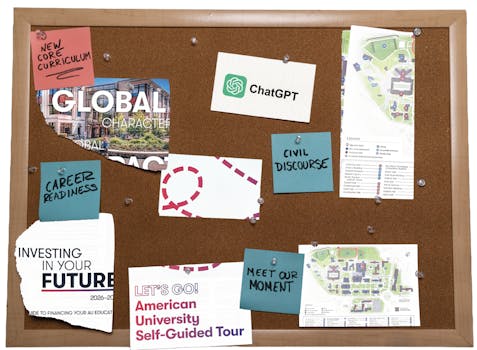
According to Bennett, the brand is not one of the plan’s strategic pillars but rather a supporting element.
“You add on this kind of work to help elevate the uniqueness of the plan and help it make you stand out in the audiences that you’re targeting,” Bennett said.
Meet Our Moment will also establish AU90, a 90-credit degree pilot program designed for students seeking a more efficient pathway to an undergraduate degree or an early start on graduate school.
Additionally, the AU Ready internship program will provide every undergraduate with access to a $4,500 resource for a funded internship or research opportunity starting in their sophomore year.
The core curriculum, classes all students are required to take in addition to classes for their major, currently encompasses three parts: foundation courses, Habits of Mind courses and integrative courses. The foundation courses include Encounters I and II, Complex Problems Seminar, Quantitative Literacy I and Written Communication and Information Literacy I. The Habits of Mind courses are Creative-Aesthetic Inquiry, Cultural Inquiry, Ethical Reasoning, Natural-Scientific Inquiry and Socio-Historical Inquiry, and students must take one of each. The final core requirement, the Integrative Courses, includes Diversity & Equity, Quantitative Literacy II, Written Communication and Information Literacy II and Capstone.
Martyn Oliver, the Faculty Chair for the AU Core said he and involved faculty will change the core so students can more efficiently take core credits while making progress in their degree. Changes could range from a little to a complete overhaul.
“The different groups that we’ve organized to look at this are tasked with articulating the vision for what an AU education means,” Oliver said.
Oliver will lead the implementation of the new curriculum. He said being in the early stages requires a comprehensive evaluation of what’s going well and what needs improvement.
Oliver and other professors who spoke to The Eagle expressed concerns about the rapid pace of change, worrying that the heart of a liberal arts education will be lost. Others underscore the need for the core not to stall students from graduating.
“We’re trying to take a holistic look at [the core revisions] and say, are our rules and regulations sound and efficient?” Oliver said. “Or are they unnecessarily an impediment?”
Patrick Thaddeus Jackson, the chair of the Department of Global Inquiry in the School of International Service, said faculty are working to simplify the decision-making process for which classes count for core credits.

Silvia said the selection of which courses fulfill which credit requirements has made it difficult for students to move through the core when met with their major requirements. Silvia, also a professor in SIS, noted that SIS first-year seminars don’t count as a complex problems core credit.
“It really upset the way the major was structured,” Silvia said. “And so SIS would like to see that changed.”
Still, Jackson said the University needs to ensure it’s not making premature changes.
“There’s the stuff we can do in 90 days, and then there’s broader, longer-term things,” Jackson said. “And major things, like changes to the number and definition of habit[s] of mind are not going to get done in 90 days.”
Jeffrie Chambers IV, outgoing Student Government president and a junior in the Kogod School of Business, said curriculum changes should be driven by student input.
“Students will be more likely to buy into a program that they feel is equipping them to make sure they have everything they need,” Chambers said.
Silvia said much of the core curriculum change is being driven by student and faculty feedback. Keith Leonard, associate professor teaching literature and AU Encounters, added that student feedback from Student Evaluation of Teaching responses will also continue to influence the process.
There are eight strategic plan working groups, ranging from civic pluralism and high-impact experiential learning to operational infrastructure and support and more.
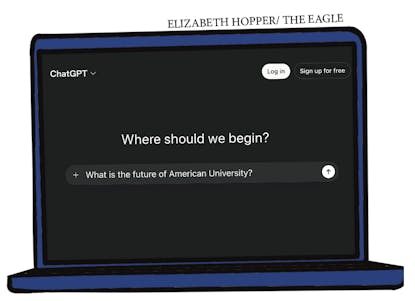
The new core curriculum will also promote education on AI usage and building on the strategic plan, which says all students will complete a required course on AI literacy. According to the plan, which cited a study by the Sine Institute of Policy and Politics, 72 percent of young Americans identify the responsible use of AI as an important part of career preparation.
AI has been a part of the curriculum in Kogod for the past two years. Kogod’s approach to AI in the curriculum, its Institute for Applied Artificial Intelligence and its AI-focused major have made it an AI-first business school, according to the strategic plan.
However, Jackson said there is a difference between embedding AI in the curriculum as a topic and using it in the classroom.
“I don’t think there’s any appetite among the faculty for the second one,” Jackson said.

He added that the University must consider the impact AI has on different career fields, many of which students want to enter.
Oliver said though many faculty members are excited about AI being addressed in the curriculum, others are skeptical.
“We need to bring those people together to articulate what AI literacy is going to mean for us and for our students,” Oliver said. “And then design the courses that will help us get there.”
Michael Robinson, a professor in the College of Arts and Sciences who teaches Exploring AI Scientific Method, said students must understand how to navigate AI today.
“AI systems are not magic black boxes. They’re technologies that we humans have created,” Robinson said. “And we can and should study them with the tools that we have built for studying the world. That involves careful, skeptical, critical, methodological scientific study, and we should not shy away from that task.”
CAS Professorial Lecturer Aref Zahed developed a humanoid AI robot named Iris. Zahed compared AI to the creation of computers and cellphones, adding that it will inevitably become part of our daily lives. He said integrating some AI courses into the core curriculum is a start, but he doesn’t believe it is enough.
“[If] we want to catch up, we have to do more,” Zahed said. “We have to bring new technologies. We have to introduce different techniques, different systems, so we can narrow this gap.”
Understanding how to integrate new classes like AI literacy into the proposed core curriculum is one of the larger objectives of the five-year plan. Oliver said he hopes the working groups will have clarity about how artificial intelligence and civics will look by fall 2026.
CAS may also play a role in integrating technology into the liberal arts and sciences by emphasizing the study of AI ethics. Doshi said teaching students how to use it ethically is critical when finding the balance between education and risk.
“By ignoring it or by not giving it the proper attention, you risk falling behind,” Doshi said.
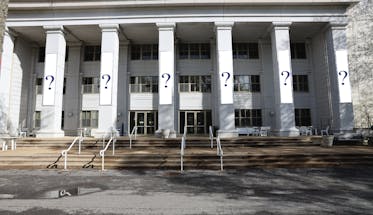
In addition to bringing more AI into the curriculum, the strategic plan reemphasizes the University’s continued focus on civic engagement.
Bennett emphasized that civic engagement was a big theme that came out of the listening sessions Alger did when he started out and dates back to the founding of the University, which was designed to train future generations of public servants. Civic engagement is part of AU’s DNA, he said.
President Alger introduced the Civic Life Series in September 2024, and according to the press release announcing Meet our Moment, the plan is a continuation of the University’s democracy and Civic Life initiatives to promote student engagement. This includes the Student Civic Life Fellows program, the Democracy Innovation Lab, the 250+ initiative and the Sine Institute of Policy and Politics.
“Across our strategic imperatives, we will advance the skills to engage civically, solve problems, and enhance democracy,” Alger wrote in the January press release.
Katherine Kravetz, assistant professor emerita in the School of Education, said civic engagement is a methodology for students to study issues and determine implementable solutions in their community. Students often come to college with preestablished goals and values, but not many understand the value of civic engagement, she said.
According to Kravetz, civic engagement is woven into the fabric of AU, and the University has been doing a good job of giving students opportunities to participate in civic engagement programming.
“Leaders like President Alger are rare,” Kravetz said. “To have the kind of success that he’s had and to maintain the level of integrity and humility that he has is very rare … They don’t make them very often.”
James Madison University’s Madison Center for Civic Engagement was established in 2017 during Alger’s tenure as JMU’s president. David Kirkpatrick, the vice president and chief of staff at JMU, worked closely with Alger and said that he was instrumental in creating an ecosystem to support civic engagement.
“There is no one in American higher education who had more impact on civic engagement than Jon Alger,” Kirkpatrick said.
JMU is opening Alger Hall in fall 2026, which will house a living-learning community of student democracy fellows and offices for the Madison Center.
Kara Dillard, the executive director of the Madison Center for Civic Engagement, described the student body at JMU as one-third liberal, one-third conservative and one-third moderate. In contrast, AU has been ranked by Niche as the most liberal college campus in the U.S.
Dillard said that in order to solve problems, we need real bridge builders and people who can connect others across political, geographic and ideological divides.
Civic engagement is more important than ever, especially for a university based in Washington, D.C., that can offer students so many opportunities in politics, according to Doshi.
“We’ve had real concerns about some of our national institutions struggling, crumbling, [feeling] vulnerable, etc. I think it’s really important that … we’re teaching our students here not to retreat from that,” Doshi said. “Education and an involved electorate, they go hand in hand.”
AU offered programming related to civic engagement before Alger became president. The Project on Civic Dialogue, formerly the Project on Civil Discourse, was founded in 2018 by Lara Schwartz, a senior professorial lecturer in the School of Public Affairs.
The project’s focus is to teach dialogue skills by providing opportunities for students to practice inquiry, disagreement and dispute resolution.
“Our goals aren’t to win. Our goals are to understand, and hopefully, as we understand better, we can explore problem-solving together,” Schwartz said.
Schwartz said polarization is a national issue, but at AU, she has yet to meet someone unwilling to have a conversation with someone with a differing opinion. She hopes to provide students with the skills they need to effectively communicate — whether it’s with their family, roommates or their community.
To her and Dillard, finding compromise in disagreement is practicing democracy.
“If we refuse to talk to our neighbors, if our neighbors refuse to talk to us, we can’t have a functioning democracy,” Dillard said.
This article was edited by Gabrielle McNamee, Payton Anderson and Walker Whalen. Copy editing done by Avery Grossman, Mattie Lupo and Ava Stuzin. Fact-checking done by Luca Palma Poth.
