
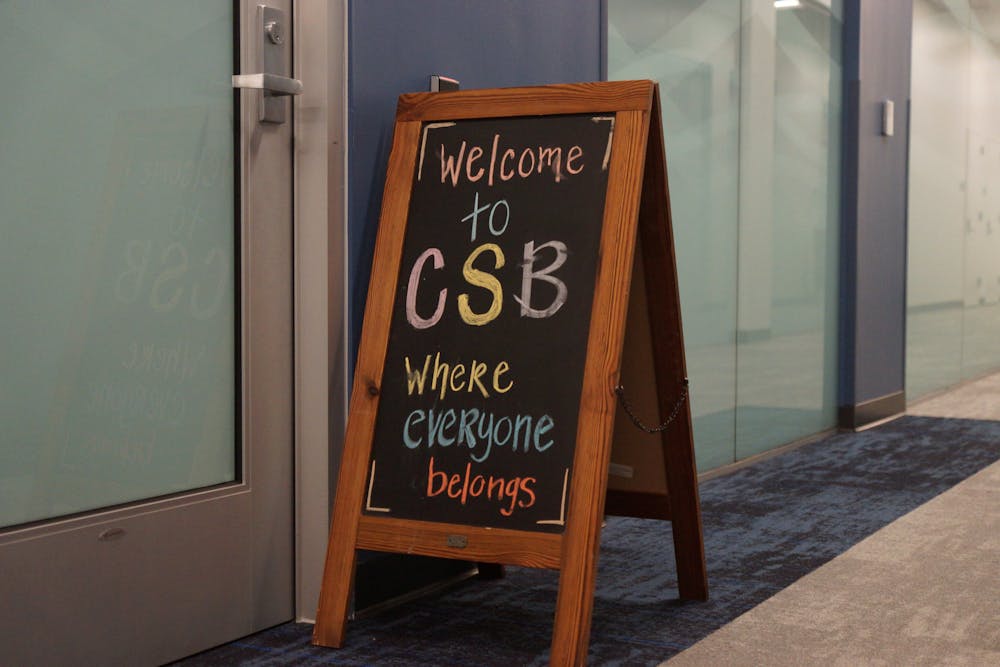
Students weighed whether American University’s renaming the Center for Diversity & Inclusion indicated a shift in its core values of “diversity, equity, accessibility and inclusive excellence.”
Some students, many of whom The Eagle interviewed in Fall 2025, said the name change has been insignificant, while others said AU has sacrificed these values.
The Center for Student Belonging was previously known as the Center for Diversity and Inclusion. The change was announced in a May 2, 2025 email by Robin Adams, director of CSB; Dayne Hutchinson, assistant vice president for student engagement and success; and Raymond Ou, vice president for student affairs.
The statement said the shift addresses students’ evolving needs by ensuring they feel accepted and supported by the University, and that the Center will continue to serve people in all the ways it had before the name change.
President Trump’s executive order to pull federal funding from universities running DEI programs directed the Office of Management and Budget to set guidelines restricting federal funding for DEI-related initiatives. While the OMB does not have the legal authority to directly make these decisions itself, it shapes how agencies decide which schools are eligible grant recipients.
Both the U.S. National Science Foundation Directorate for STEM Education and its Directorate for Social, Behavioral and Economic Sciences terminated American University’s STEM research grants that surpassed $3 million.
Katie LaRue, a junior in the School of Public Affairs, said she has not observed AU taking concrete action to restrict DEI initiatives. She is concerned about the implications of why the office’s name was changed in the first place, however.
“I think overall it’s a little bit problematic just because so many people are fighting so hard to get rid of DEI everywhere,” LaRue said. “I think there’s nothing wrong with those words, so I don’t really understand why we would need to change that.”



Elizabeth Deal, assistant vice president and deputy chief communications officer, denied any correlation between President Trump’s crackdown on Diversity, Equity and Inclusion policies and the Center’s renaming in an interview with The Eagle on Aug. 28, 2025. The University began planning how to better support students before his second term began, she said.
“I just want to be really clear about that ... we have really been looking for how to support student belonging,” Deal said. “That’s the bottom line.”
Adams said, prior to changing the Center’s name, the administration undertook two initiatives that helped them reasonably reassess its effectiveness and what kinds of goals students want them to concentrate on. The initiatives were needs assessments and community listening sessions.
The Center called the community listening events “Listen and Learn” or “Lunch & Listen” sessions, depending on the time of day they were held. It facilitated several sessions throughout the 2024-2025 academic year, such as two on Sept. 24, 2024 and two on Oct. 1, 2024 that were advertised on Engage, a website students can use to explore opportunities to get involved in campus extracurriculars.
“We are interested in your experiences & perspectives,” the Center wrote on the flyer used for both Engage posts.
Adams said the Center conducted needs assessments by collecting over 500 replies from primarily students and also faculty, staff and alumni through a survey. She said they sought to include individual voices in these dialogues so that those unaffiliated with a club could still communicate what they want CSB to accomplish.
The community listening sessions, Adams explained, significantly helped CSB understand the student body’s consensus.
However, she said the fact that the needs assessments allow for individual-based feedback means they offered the most insight into what movement would best serve students.
“At the end of the day, our students are driving our programs,” Adams said.
CSB continues to partner with several other student organizations to plan events surrounding themes of diversity and inclusion. It co-sponsored an event featuring drag queen Katya Zamolodchikova on Feb. 23 alongside other organizations, including Pride at AU and the Spirit and Traditions Board.
Sadie Schwartz, STB’s media and marketing manager, said in a Feb. 25 interview that she is not concerned that the University is scaling back diversity efforts because STB has frequently collaborated with CSB.
“They’ve been great to work with, and their intentions are always amazing in trying to create belonging on campus,” Schwartz said. “So I think they're still doing what they’re supposed to do.”
Michael Mccabe, a junior in the School of International Service, doubts that the name change indicates any difference in the office’s operations and mission.
Mccabe said he believes the University changed the name to distance itself from DEI initiatives and avoid attracting negative attention from the Trump administration. However, he said he felt more concerned that he had not witnessed any student pushback.
“Maybe it doesn’t matter, but I consider it like the boiling frog thing,” Mccabe said. “I’m sure you heard of it before: a frog’s in a pot of water. The heat’s on low — it’s slowly getting to that point. It’s just people don’t notice it. It’s just the small little things that go by day by day that’s not broadcasted. It’s incremental.”
Stevie Brachman, a sophomore in the College of Arts and Sciences, shared similar sentiments. However, she added that the administration should have been more transparent on what motivated them to make this change in the first place.
“I’m hearing there’s a serious lack of transparency, and it kind of feels like we’re dodging the actual question,” Brachman said. “I understand an overhaul. I understand maybe we want to go in a different direction, but why are we renaming?”
When it comes to the quality of the new name, Mccabe does not feel particularly strong about it but believes it effectively captures what the office planned to accomplish before the change.
“I’m not going to die over a hill on what a private university decides to change the name of one of their offices [to],” Mccabe said.
When asked what he thinks motivated the University’s decision, Ahmad Todd, a junior in the School of Communication, challenged the question.
“I think a better question is have they done what they said they did in the email?” Todd said.
Due to President Trump’s decision to pull funding from schools practicing DEI initiatives, AU’s decision to change the name allows them to save money they would have lost if it remained the same, Todd said.
“I think the goal is best accomplished by providing legitimate resources to the students, and doing so costs money,” Todd said. “If keeping an old name is going to cost them money, then they will be less able to provide legitimate resources to their students.”
On the other hand, Brachman felt primarily concerned about whether the University has begun to lose the liberal roots that drew her to AU in the first place. She said she feels “underwhelmed.”
“It definitely seems like I have missed the glory days of the leftist campus,” Brachman said.
Yuri Perelman contributed reporting to this article.
This article was edited by Cara Halford, Neil Lazurus, Payton Anderson, Abigail Hatting and Walker Whalen. Copy editing done by Sabine Kanter-Huchting, Avery Grossman, Emma Brown, Paige Caron, Ariana Kavoossi, Audrey Smith, Ava Stuzin and Mattie Lupo. Fact-checking done by Luca Palma Poth.
