
Gregg Harry has researched gravitational-wave detection for 14 years. The American University physics professor’s work has advanced scientific understanding of quantum physics and filled a need requested by the government.
The CHIPS and Science Act of 2022 put billions of dollars toward boosting nationwide research on semiconductors to center the United States on the scientific world stage. Harry’s lab at AU is one of nine across the country participating in the Center for Coatings Research, funded by a collaborative grant with support from the CHIPS Act.
In February 2025, Harry’s research into Advanced Laser Interferometer Gravitational-Wave Observatory (LIGO) ended up on a government database of “Woke DEI Grants” subject to funding cuts and termination in the wake of President Donald Trump’s surveillance and overhaul of science research.
“It’s almost embarrassingly little on diversity because there isn’t much we can do,” Harry said.
The professor described one paragraph at the end of the grant, highlighting that women made up about half of the primary investigators on the collaborative project.
Harry said it was a “we do what we can” paragraph. Sen. Ted Cruz, R-Texas, classified it among thousands of other research projects on his list of “neo-Marxist class warfare propaganda.”
It was initially co-funded by the National Science Foundation and the Gordon and Betty Moore Foundation, but the Moore Foundation agreed to foot the entire bill of the LIGO grant for the next year after the NSF denied renewal. According to the government’s official spending data website, the grant’s end date was Aug. 31, 2025.
Despite the preservation of his research, Harry said the potential of a cut at any time keeps him apprehensive. Trump’s budget request from May proposed a 56 percent budget cut to the NSF.


“When you have no idea what the future looks like, you can’t make any plans,” Harry said. “And that is really hard.”
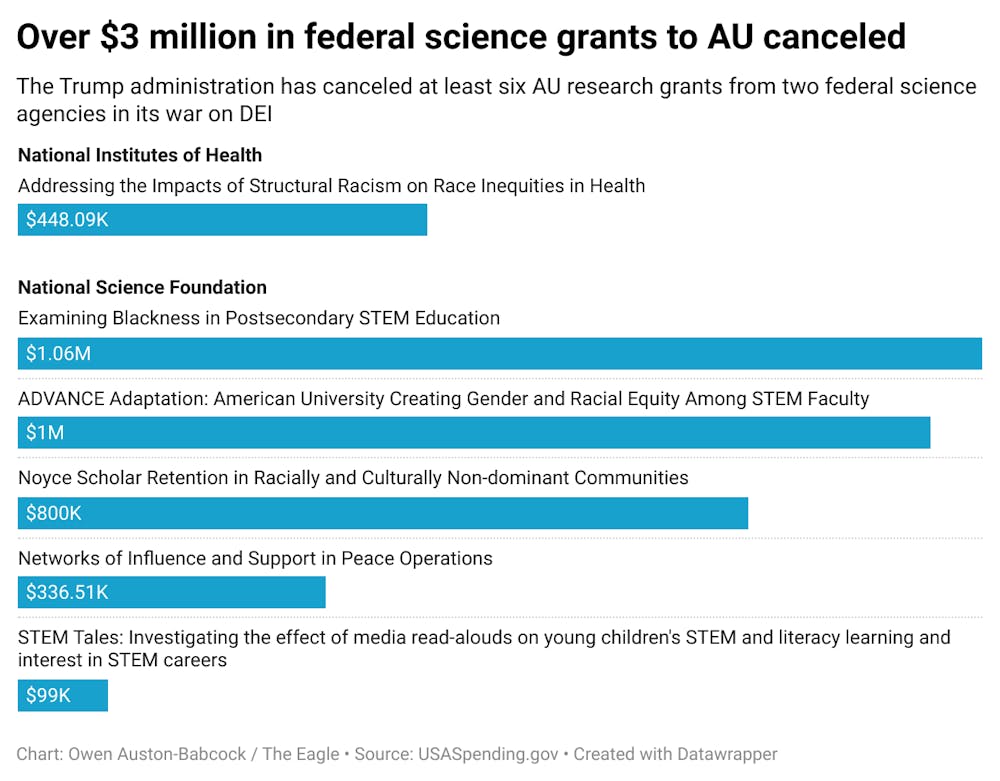
Harry is one of at least six researchers at AU whose federal science grants were canceled amid Trump’s barrage of attacks on diversity, equity and inclusion. These attacks initiated a year of funding cuts at federal science agencies and have hindered the ability of researchers at AU to continue their work, a monthslong investigation by The Eagle has found.
The Eagle pulled a list of all publicly reported grants terminated by the NSF and National Institute of Health since the start of the second Trump administration from Grant Witness — a public database tracking grant terminations — and cross-referenced listings with the official NSF and NIH websites.
The list includes five NSF grants and one NIH grant:
The University has responded to continuing government actions with the Updates on Federal Research Policy Changes page.
Foreign policy research
One timely update not yet added to the page is the U.S. State Department’s proposal to suspend universities from the Diplomacy Lab, according to The Guardian, which received internal documents on the matter on Nov. 17. American University is one of 38 universities included in the list of those who “openly engage in DEI hiring practices.”
Since 2013, the Diplomacy Lab has partnered with more than 60 academic institutions in 27 states across the country, with 120 to 150 project proposals annually for students and faculty to work on, according to an archived version of the U.S. State Department’s website.
The University will be affected if the suspension takes effect on the proposed date of Jan. 1, 2026. The U.S. State Department Diplomacy Lab is listed as an undergraduate senior capstone course within the School of International Service under SISU-419-005 for both fall and spring 2025 on the University’s course registration website, Eagle Service.
“This capstone offers an experiential learning opportunity for students who are passionate about foreign policy issues to serve in a unique role directly supporting the U.S. Department of State. Diplomacy Lab is an official collaboration combining area and subject expertise at the State Department with the intellectual capital of select partner universities,” reads a section of the course description.
However, the professor currently listed to teach the course, Earl Anthony Wayne, told The Eagle that the course will not be running in spring 2026. Wayne is a distinguished diplomat in residence who has served as the U.S. Ambassador to Argentina and Mexico and Deputy Ambassador to Afghanistan.
Wayne said he received notice of the class cancellation a few weeks ago, as he said the University told him that timing would not allow for them to run the course in the spring, but that they would look to bring it back in fall 2026.
On Nov. 25, The Guardian reported that American University is the second-greatest recipient of Diplomacy Lab funding, and it is the largest recipient where cuts were recommended. The program has funded 23 classes over the last five semesters at AU, including five in fall 2025.
In the past, the State Department welcomed the student research just as much as students enjoyed the class, Wayne said, describing the program as a great learning experience for those interested in foreign policy. The professor said he had not heard from the University or the State Department regarding the reports and learned of the proposed suspension reported in The Guardian.
Wayne said he is unsure whether the suspension is related to DEI hiring practices.
“I really don’t know for sure one way or the other,” Wayne said. “I hope there will be an opportunity to talk about this because I hadn’t heard about this until I saw that article, so I assume there’s some sort of dialogue going on between various universities.”
What’s at stake for STEM?
Nathan Harshman has worked at the University for 23 years as a physics professor and the former department chair. He said he is worried about the future of science for an already small department.
Harshman’s research focus is on an aspect of quantum physics called ultracold atoms in optical lattices. As a theorist and mathematician, Harshman creates mathematical models to better understand the concept of topology. Although he has been active in the research space, this year is different.
“I probably won’t apply for funding this cycle until I know how things are going,” Harshman said.
Harshman is the associate director of the NASA DC Space Grant Consortium, which has been based at the University since 1997. The consortium provides funding to various scholarships, internships and fellowships for undergraduate and graduate students across the District.
One program that has faced particular challenges, Harshman said, is the NASA Office of STEM Engagement, or OSTEM, which supports workforce development for the future of aerospace engineering.
Harshman submitted a proposal for a four-year renewal of the OSTEM program in the summer of 2024. He received a response from the NSF in February 2025 filled with red lines and requests for modifications, in line with Trump’s executive order on Jan. 20 that catalyzed his attack on DEI in higher education.
“We had to remove a bunch of language from our grants,” Harshman said. “Because of fear, a lot of people are removing words like ‘equity’ from things.”
OSTEM has now faced a complete turnover and the program is expected to be folded into a larger NASA department, according to Harshman.
Harry noted that cutbacks to programs created to serve American scientific advancement, like LIGO and OSTEM, reflect a shift away from government prioritization of soft diplomacy through science.
“The federal government has decided to get out of the science business,” Harry said.
Different challenges exist for researchers earlier in their careers, but the inclusion of DEI-related content remains a concern. Chelsea Koch said she worries that shifting federal priorities on research targets her unique approach of co-production of knowledge, a type of research that prioritizes indigenous community voices.
Koch, a marine biologist, came to AU in the spring of 2024 as an assistant professor to teach environmental science courses. She also researches Arctic ecosystems to explore how climate change and pollution impact the marine food web through the co-production of knowledge.
Working with Alaskan Native communities, Koch focuses on building trusted relationships to unravel the harmful impacts of colonialism, relying both on generational knowledge and her privilege to achieve federal funding when it was previously unavailable.
“It seemed like we were starting to come towards a place where that was being valued and prioritized,” Koch said. “But now with everything that’s going on it’s not really clear, at least from a federal funding perspective, if that kind of work will be prioritized in any way in the future.”
While she has submitted multiple proposals since last year, she said she has not heard back from most.
Cuts have also affected students in research. For Ishika Nanavati, a senior studying biology and public health in the College of Arts and Sciences, this means her research assistant position is no longer paid.
Nanavati has been working in Professor John Bracht’s Biology lab for almost two years, researching epigenetic cancers and studying drugs that could be used to treat them.
This semester, Nanavati has not gotten paid her previous hourly rate of $18.75. While she is still receiving credit for her research since she is in the Honors Biology program, she said she feels the pay cut.
“It makes me feel annoyed when I know I’m putting in like 10 to 12 hours a week there and I’m like oh wait, it would have been a good check,” Nanavati said. “So sometimes it just makes me feel like I’m not as excited to spend a long time in research.”
In addition to her lack of pay, Nanavati’s research project has been paused, too. She relies on funding from the NIH to get a kit called a DNA Methylation ELISA Kit, which is needed to continue her research to its next stage of testing.
Although the grant for her research hasn’t been terminated, Nanavati said funding was reduced. Because of changes to the funding cycle for reapplying, the lab is hesitant to make any big purchases. The kit costs $500 and, without it, Nanavati’s research is now at a stand-still.
An R1 institution
The University reached the highest level of recognition for research, becoming an R1 research institution in February. Just days earlier, President Donald Trump attempted to freeze all federal aid funding in one of the first of similar announcements and actions that would define the first year of his second term, notably honing in on cutting federal funds for science research.
The University received $5.6 million in awards within the first quarter of its funding cycle, according to Vice Provost for Research and Innovation Diana Burley at a faculty senate meeting on Sept. 3.
Burley said this was a “very significant decline” from the past three years, which each yielded $8-10 million, $5 million and $20 million in awards, respectively.
In the same meeting, Burley said the University had only 22 proposals approved within the first quarter, adding that this was a decline from previous years.
Harshman said he worried about the University maintaining its newly achieved research status, pointing out that the designation came only after the Carnegie Classification of Institutions of Higher Education significantly changed the way it evaluates institutions.
Carnegie’s new metrics simplified the criteria into two categories to qualify institutions as R1 if they spend at least $50 million and award at least 70 research doctorates annually. American University, in addition to 41 other institutions, met these new criteria to reach R1 status in 2025.
While commending the University for striving toward excellence in both teaching and research, Harshman said he felt unsure about how federal funding changes may ultimately impact the research that is already experiencing a hit.
“Administrators like to have accomplishments,” Harshman said. “I wonder if it will be a lasting accomplishment.”
This article was edited by Owen Auston-Babcock, Abigail Hatting and Walker Whalen. Copy editing done by Sabine Kanter-Huchting, Avery Grossman and Ava Stuzin. Fact-checking done by Aidan Crowe.
