
Section one: Are you an American Tourist or a Citizen?
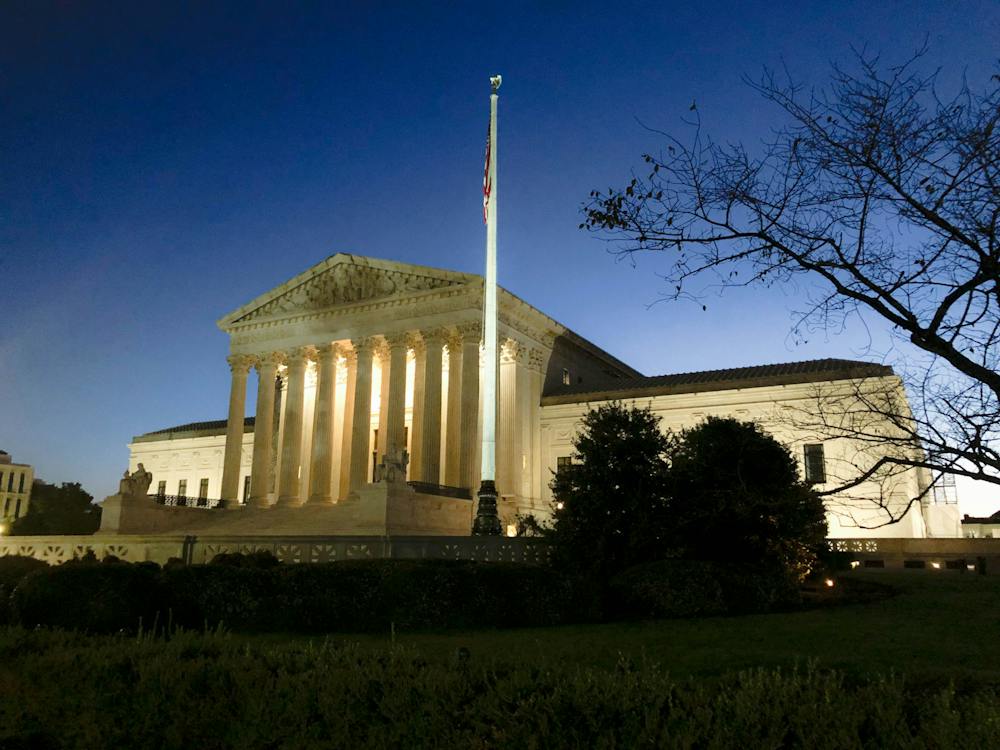
On June 30, the U.S. Supreme Court ruled 6-3 in Trump v. Barbara, denying the Trump administration of using an executive order to end birthright citizenship.
Before the Supreme Court’s ruling, four federal district judges attempted to halt the Jan. 20, 2025 executive order by using preliminary injunctions. Preliminary injunctions are a court order to halt actions in a specific lawsuit before the judge has made a decision.
The attempt by the four judges failed after Trump filed an appeal to the Supreme Court to block the nationwide injunctions in the case of Trump v. Casa.
In June 2025 the court ruled in favor of Trump and the order remained an active threat for the over 250,000 babies born every year to undocumented mothers, until the Supreme Court’s ruling in Trump v. Barbara.
Amanda Frost, a law professor at the Washington College of Law and the University of Virginia, was present during the oral arguments of Trump v. Barbara.
“I expected the government to lose, and most people did expect the government to lose,” Frost said.
According to Frost, the Trump administration’s main legal arguments centered on the distinction of citizenship between documented and undocumented parents, which was unprecedented. Since the ratification of the 14th Amendment in 1868, the Supreme court has held citizenship is applied to anyone born on American soil.


“No president has ever declared that these groups of people are excluded from citizenship, and Trump campaigned on this and said he was going to do it, and issued this executive order,” Frost said.
Solicitor General D. John Sauer also argued against birth tourism during his oral argument. Birth tourism is when a pregnant person travels to a country for the sole purpose of giving birth to obtain citizenship. Based on a review of US census data, there was an estimate of 0.7 percent of all American births being attributed to birth tourism.
Frost said that this concern is not necessarily warranted, including at the federal level.
“The government doesn’t track [birth tourism], which in and of itself suggests that maybe birth tourism isn’t such a huge problem,” Frost said. “I think some people are deeply offended by birth tourism. The answer is not to end birthright citizenship.”
“I know they got it wrong,” Trump said at a dedication ceremony for the opening of the Theodore Roosevelt Presidential Library in Burning Hills Amphitheatre, North Dakota shortly after the Supreme Court ruling. “We will take care of birthright citizenship,” he promised.
Despite this, Frost is confident it would be extremely difficult for the administration to change the outcome of the Supreme Court’s decision to protect birthright citizenship.
“Our Constitution is basically unamendable at this point,” Frost said.
Although it would be difficult to amend the Constitution, Frost points to another way for Trump to eventually get his way on birthright citizenship.
“And the second thing Trump could do is, replace Supreme Court justices with people that would vote his way on this issue, and he’d only need to really replace one,” Frost said.
During an interview with Fox Business in April, Trump said he was prepared to appoint up to three new supreme court justices. Even if the judges were replaced, Frost believes they should feel bound to the current Supreme Court precedent.
“The Supreme Court isn’t supposed to just reverse itself on a dime,” Frost said.
Section two: Whose America is this?
Delaney Holland, faculty advisor for the Bolin Pre-Law Scholars Society and School of Public Affairs adjunct professor, also expressed concern over the court’s debate on the potential overturning of a 150-year-old legal precedent.
“This is our living, breathing document,” Holland said. “This is what our country stands for. You see little by little, things are being stripped away from there. Is this document becoming null and void?”
Whether it’s discussions inside of the classroom or protests on the Hill, Holland saw this moment as a teaching opportunity. According to Holland, students needed to see the impact of how laws created to build unity can also ignite uncertainty in the future.
“You’ll hear people talking about their parents; how they got here or things like that, how they’re personally impacted,” Holland said. “I feel like for other students to hear that, and have the space to hear that, is a good thing.”
Holland isn’t the only one with concerns. Kare Coley, a junior in the Colleges of Arts and Sciences, worries about how this decision will affect issues concerning immigration rights and protections. Her family has been battling the administration’s anti-immigration campaign since Trump took office.
Coley shared how her uncle was detained in Atlanta for four months, and the road for her parents to receive U.S. citizenship took over 20 years to happen because of their DACA status. The Deferred Action for Childhood Arrivals (DACA) program is a federal immigration policy that offers undocumented children brought into the U.S. for temporary authorization to study and work.
Kare Coley is a product of birthright citizenship, and her future wouldn’t be secured without it. To her, discussions around undocumented immigrants wasn’t just a class topic, but instead was the lived experiences of her parents, four sisters and extended family members.
As president of Liberation Education Acción, Coley takes an active role in informing people about the dangers of anti-immigrant sentiments and policy initiatives that target Black and Brown people.
“Immigrants, whether they’re Black, whether they’re Latino, whether they’re from the Middle East, are still fighting to have their citizenship, to have their humanity recognized, despite the amount of contributions that they’ve made to this country,” Coley said.
Broad sentiments remain generally favorable toward immigration. A Gallup survey found that 73 percent of U.S. adults consider immigration a “good thing” for the country — with only 21 percent of respondents viewing it as a bad thing. Many Americans also credit legal immigration with bolstering the economy, citing benefits such as filling workforce gaps (64 percent) and generating tax revenue to support public programs (56 percent).
Across the nation, there’s been a rise in protests pushing back against President Trump’s criminalizing pursuit for deportation. Nearly 65 percent of immigration-related demonstrations were in response to President Trump’s administrative policies, according to a survey conducted in 2025 by Princeton University’s Bridging Divides Initiative, a non-partisan research initiative that tracks and mitigates political violence within the U.S.
Referencing Justice Clarence Thomas and Justice Kentaji Brown Jackson’s dissents, Coley believes that the Supreme Court’s decision revealed how multifaceted this issue really is. Justice Clarence Thomas argued the 14th Amendment only applied to newly-freed Black Americans. However, Justice Kentaji Brown Jackson contested against him, citing that the 14th Amendment was meant to provide a home to all — newly-freed Black Americans, immigrants and anyone else regardless of legal status.
Coley holds strong that the United States continues to devalue and disenfranchise its most marginalized communities. Birthright citizenship is just another effort to dehumanize the American people and rob them of their foundational rights, according to Coley.
“I don’t necessarily feel any relief because of this decision because I truly operate under the belief that, as cliche as it sounds, we’re not free until we’re all free,” Coley said.
Birthright citizenship isn’t an issue that is constrained to the classroom or the Congressional floor. Advocates in the broader Washington, D.C. area have taken actions against the administration’s attempts to weaken birthright citizenship protections.
Section three: A cautious step forward
Tony Alarcón, the Operations Director and founder of Las Doñas, a national women-led immigration advocacy group, celebrated the Supreme Court’s decision to uphold birthright citizenship.
“This is a historic win for our membership,” Alarcón said.
Alarcón worked with pregnant mothers concerned over the legal status of their children.
“There was a lot of uncertainty, there was a lot of fear,” Alarcón said. “We knew that this was unlawful. Today, once again, the Supreme Court rejects this xenophobia, this racist executive order from the White House.”
Tony was not the only one awaiting the decision. Erika Marquez, a Las Doñas leader and mother, was also awaiting the decision.
Marquez is a DACA recipient. During his first term, Trump attempted to end the program and stopped accepting new applications, affecting 800,000 DACA recipients.
Due to the 14th Amendment, Marquez’s four children were able to receive citizenship.
“It’s a hard truth that we're living in a country where we are no longer protected, you know, we continuously have to be fighting for our rights,” Marquez said. "It's just continuous hatred. It’s continuous acceptance of division of our community, of our country and that’s just not okay."
Despite the ruling, Alarcón and Marquez do not believe the fight for immigrant rights has ended.
“We’ll continue to keep ensuring that one day all these undocumented immigrants who have been in this country for many, many years, contributing, get a path to citizenship. We know that we have a long, long road ahead of us,” Alarcón said.
While Alarcón carries optimistic hopes for the future, Coley remains concerned over the administration’s attack over personal liberties.
“I just hope people realize that this is just one of the many things, One of the many freedoms, abilities [and] rights that are being debated,” Coley said. “If people’s abilities to obtain citizenship, like my own, can be debated [by] the Supreme Court, what else can?”
This article was edited by Ella Altman, Cara Halford and Gabrielle McNamee. Copy editing done by Avery Grossman and Arin Burrell. Fact-checking done by Luca Palma Poth.
localnews@theeagleonline.com
