
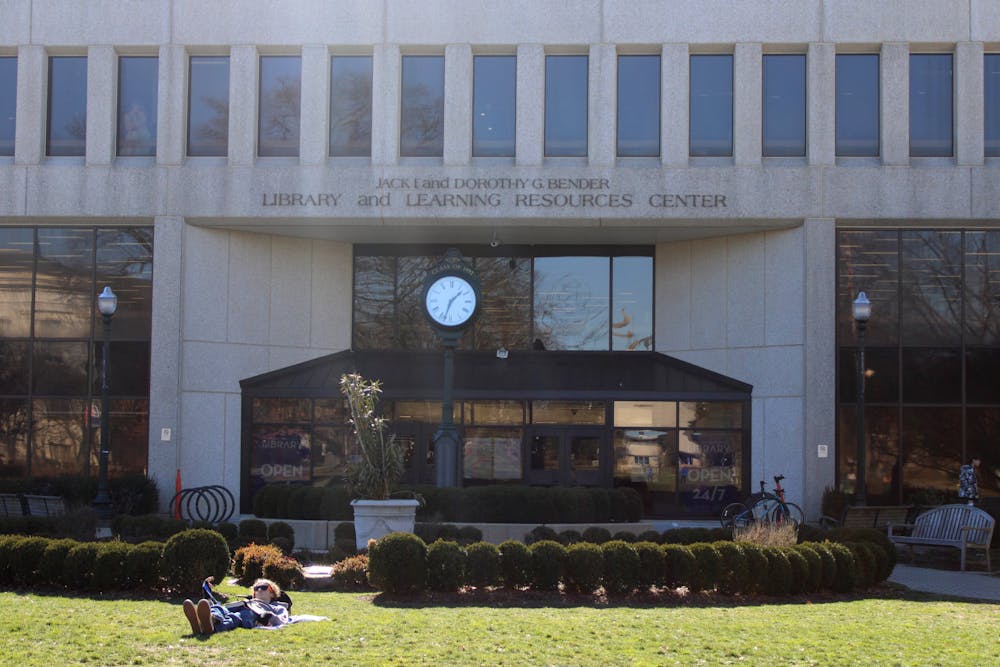
Across the two years she has worked at the American University library, Sydney Henry has compiled a notebook of her experiences. The pages chronicle what she says is a years-long pattern of intimidation and belittlement by supervisors.
Henry said she was left out of meetings and was told she was lucky her employers gave her a chance despite her youth. Henry, 23, is the library’s communication and event coordinator.
When she was assigned work beyond her paygrade and started seeking a raise, Henry met with University Librarian Jeehyun Davis, member of the Dean’s Council and Henry’s top supervisor. Davis told her she likely wouldn’t do anything going through the Staff Union or human resources, Henry said.
Henry, a unionized employee, had already filed a pay grievance through AU’s Staff Union in February 2025. When her supervisors learned of this, the bullying increased, Henry said.
Henry is not the only library employee to say she’s faced mistreatment from Davis specifically, nor is she the only one to report it with no actionable success. Davis declined to sit for an interview but said in an emailed statement she “cannot comment on individual personnel matters” and that she takes “any concerns about workplace culture seriously and support[s] the university’s established processes for reviewing and addressing them.”
According to Henry, others have reported Davis to the University over the last two years. One of those staff members is Bella Goris, now an adjunct professor in the College of Arts and Sciences, who formerly worked in the Office of Inclusive Excellence and for budget and personnel in the library.
Goris said their experience working in the library was similar to Henry’s. They too said they were asked to do work beyond their job description and paygrade and were belittled and excluded once they started asking for a raise.
In spring 2025, Goris said she filed a Title IX complaint against Davis for discrimination, but never heard back from the Office of Equity and Title IX. The Eagle has not seen documentation of the complaint because it was made verbally and in person at the office.


“Everyone knows nothing happens at AU,” Goris said, in reference to ineffective reporting processes.
Five employees across the University who spoke with The Eagle claimed AU has a pervasive culture of workplace bullying with inadequate systems in place for staff to report mistreatment.
The University declined to comment on the allegations about the library as a harsh workplace.
“Consistent with university policy and in accordance with privacy and employment laws, we do not comment on individual personnel matters,” Elizabeth Deal, assistant vice president and deputy chief communications officer, said in a statement to The Eagle. “American University fosters a welcoming and inclusive workplace, supported by strong reporting processes and policies that ensure concerns are addressed promptly and appropriately.”
At the end of the summer, Henry decided to file charges against the University both through the National Labor Relations Board and the D.C. Office of Human Rights. The NLRB charge was based on intimidation and retaliation from Henry’s supervisors after she involved the Staff Union. The OHR charge — which The Eagle verified through emails provided by Henry — regards violations of discrimination protections and employment equity. Both cases are currently open against the University.
AU’s management structure enables mistreatment and a lack of accountability, said Eleanor Sciannella, a financial aid counselor in the Office of Enrollment and co-chair for organizing for AU’s Staff Union.
At the University, it’s common to have a one-to-one or one-to-two supervisor-to-employee ratio, according to Sciannella. She said this leads to staff isolation and called it a “hotbed for abuses of power.” Sciannella also said that having more staff to a supervisor would improve the issue, because they would be able to discuss mistreatment with one another.
Sciannella, who’s been a part of the Staff Union for three years, said she’s heard a variety of stories about staff being bullied by supervisors.
Calvin Elison, Staff Union representative and academic program coordinator for the School of International Service, as well as a two-time AU alumnus, echoed similar points.
He said that the department structure allows faculty to more easily mistreat lower-level staff without consequences. Yet, Elison said, staff have an incentive not to rock the boat by reporting mistreatment, as the process can be long and isolating.
Lack of accountability through ineffective reporting avenues
According to Elison, the system to report workplace bullying at AU isn’t responsive enough to address the scope of the issue. He said he’s seen staff feel too disillusioned with the reporting process to follow it through.
“It’s not even worth the trauma of going and reporting it,” he said. “Sometimes you just need to leave.”
Henry, who first filed a grievance with the union in February 2025, said she saw an increase in mistreatment and described the reporting process as exhausting.
When it comes to reporting workplace mistreatment, staff at AU generally have two options: going through AU human resources directly, or union-eligible employees can file a grievance through AU’s Staff Union, part of Service Employees International Union Local 500.
Employees can also file a Title IX complaint through the Equity and Title IX Office when they feel like they’re being discriminated against based on their sex or gender identity. Goris said she filed a Title IX complaint related to her experiences in the library, yet never heard back from the office.
Though many students know its role in addressing sexual assault, Title IX is primarily a discrimination law. Survivors of sexual assault have long accused AU’s Title IX office of inaction, including poor communication and a lack of transparency. This has led to multiple federal investigations into the office over the years.
The office’s previous Assistant Vice President of Equity and Title IX Coordinator Leslie T. Annexstein stepped down from the position in April for undisclosed reasons and was replaced with an interim vice president this October. Goris filed her complaint in the middle of this vacancy.
Goris said inefficient reporting processes are a consequence of what they said is a University-wide aversion to putting information in documents.
“AU never puts things on paper,” she said. “Everything is verbal.”
This fall, the Staff Union reached an agreement on a new contract after negotiations over the prior six months. Sciannella worked on negotiations for the last three contracts and was relatively satisfied with the outcome of this contract when it came to workplace bullying.
Sciannella said the issue of bullying was more relevant for the six months of bargaining than she originally thought it would be.
“There’s so much about our work culture that kind of normalizes that, and so it’s hard to identify, it’s hard for people to talk about,” she said.
With the new contract, Sciannella said bullying was addressed more extensively, though AU’s higher-up management involved in negotiations did not agree to staff’s original inclusion of bullying language, citing the AU Staff Personnel Policy Manual as sufficient.
The current manual does not explicitly mention workplace bullying or mistreatment and instead refers readers to the Board of Trustees policy page and the Discrimination and Non-Title IX Sexual Misconduct Policy.
The Equal Opportunity, Affirmative Action and Non-Discrimination clause of the Board of Trustees page states, “The fact that the university does not discriminate on the basis of…[an] individual's genetic information, sexual orientation, age, or disability is consistent with and a reflection of its special tradition of social justice.”
The Board of Trustees’ Whistleblower Policy (Policy on Reporting Suspected Misconduct) asserts that compliance with local and federal laws and regulations ensures ethical and respectful treatment of the entire University community.
Under the Whistleblower Policy, reports can be submitted either verbally or in writing to the provost or vice president the individual works under, the Office of General Counsel or the AU ethics hotline.
The Discrimination and Non-Title IX Sexual Misconduct Policy document refers individuals looking to report discrimination, harassment and sexual misconduct to the assistant vice president for equity to open an investigation. The word bullying is not mentioned in the policy.
The University Policies database only yields one mention of bullying across all University policies, which is in the Faculty Manual.
In the past, Sciannella said staff would come to the union seeking help over workplace bullying and that the union was not able to follow through on those complaints due to limits in their contract regarding bullying.
For the new contract, Sciannella said the union developed a bullying definition and investigation procedure, which got watered down through the negotiation process.
“[Management] didn’t want to accept our bullying definition. They said the [definition in the staff manual] was sufficient. We know based on the experiences staff have had that it is not,” Sciannella said.
Sciannella still expressed satisfaction about the new inclusions in the union contract.
“We can always fight for more in the future,” she said. “I’m pretty happy with it.”
Nevertheless, Sciannella argued that structural changes to departments would be more conducive to resolving bullying than policy changes.
In the new contract, workplace bullying is mentioned in one section.
The contract states that the University must update a section of the Staff Personnel Policy Manual with a bullying definition. A proposed definition by the University must be presented to the Joint Labor Management Committee, which includes selected representatives from both the Staff Union and the University, by the beginning of 2026.
Suzanne Fils-Aime, a unionized staff member who worked to develop the contract’s original bullying definition that was denied, said a definition is a critical starting point to improving the reporting and investigation process.
“How do you take [bullying] seriously if you can’t define it?” she said.
How can workplace bullying be defined?
Fils-Aime, a study abroad advisor in the SIS Office of International Programs and AU Staff Union co-chair for labor-management, said it can be difficult to discern if a situation is bullying, a Title IX violation or just management style.
In an interview with The Eagle, Fils-Aime said bullying mainly shows up at AU as workplace sabotage, which can include assigning unreasonable duties or workloads, belittling employees’ opinion or withholding information. The latter could manifest as keeping employees out of meetings.
During negotiation, management called the proposed bullying definition too specific, according to Fils-Aime. When drafting it, the Staff Union turned to other institutions’ official definitions, including those by the University of Maryland, University of Wisconsin-Madison, University of Michigan, Virginia Tech, Clemson University, District of Columbia Public Schools and others.
The UMD Policy on Professional Conduct and Workplace Bullying defined bullying as intentional “persistent, severe, or pervasive behavior that a reasonable employee would find malicious, degrading, intimidating, or threatening.” The policy lists examples such as public humiliation, sabotage, name-calling and cyberbullying.
In the union’s original proposed definition provided to The Eagle by Fils-Aime, bullying is defined as repeated non-discriminatory harassment intended to intimidate, threaten, offend, degrade or humiliate. Specific actions listed include humiliation, yelling, blaming, ostracizing, belittling, berating, gaslighting, workplace sabotage and more.
Retaliation is also mentioned in the original bullying definition. It’s defined as negative treatment carried out because an individual has previously reported supervisor behavior.
Fils-Aime also said that this contract negotiation was not the first time the Staff Union asked AU to address workplace bullying. In the past, they’ve requested non-violent communication training and the review of high-turnover offices or positions. She hopes that a bullying definition enshrined in policy will stick — which the University has to provide per the new contract.
Henry said her own experience reporting workplace mistreatment makes her believe the University does not want to take action.
“AU has everything they need to do something about it, and they have chosen not to,” Henry said.
Mistreatment in the library
Henry and Goris said that Davis has made comments about her staff members’ weight, berated them in front of other staff, told them they don’t have the evidence to come forward with this mistreatment and more.
“It was just those small cuts that really get under your skin, where it devalues you and it makes you feel like what you have done was just baseline, as opposed to going above and beyond,” Goris said.
Goris said that it was also common during her time in the library for staff to joke about who was in the doghouse with Davis, and if someone was on bad terms with her, it was difficult to get their work done because they would be ignored.
At the library, Henry worked on a three-person team. After her two coworkers left and she picked up their work without a raise, she wanted her pay to reflect that.
Davis often justified Henry’s salary with Henry’s youth, according to Henry, telling her she was getting paid what she should for her age and should be thankful. When Henry asked why she wasn’t getting paid more, she said Davis deterred her from going to the union.
Henry filed a grievance with the union in February. In May, she was given a 10 percent raise by Davis and her grievance process was ended as a result.
Henry originally requested to skip Davis in the grievance process — which is common practice when a grievance involves mistreatment from a direct supervisor, according to Sciannella — but Davis was still included in the process by AU Labor Relations.
Henry spoke with Labor Relations in the summer about how her grievance was mishandled and why the supervisor her grievance was filed against was able to end her case. She was told they would follow up and look into it, yet hasn’t heard back since. That’s when she decided to turn to the authorities.
“I went through the avenues [AU] asked me to. I did the internal procedures, I followed every rule set forth and every suggestion,” Henry said. “It started to impact my mental health and my physical health. I went back to therapy. I got on anxiety medication.”
Henry said the exclusionary mistreatment in the library continued after she received a raise.
“I never felt like I was being iced out until I went to the union,” she said.
Robert Alonso, the library’s director of administrative services, contributed to this negative workplace culture and made his dislike of union processes clear, according to Henry and Goris.
When she filed her grievance, Henry was moved under Alonso as her direct supervisor instead of Davis. Henry said that Alonso retaliated against her through micromanaging.
Alonso never responded to The Eagle’s request for an interview or statement.
Alongside emails and messages from Alonso reviewed by The Eagle, Henry explained that Alonso has repeatedly questioned her time sheet and the hours she worked. She believes this is a deliberate act to catch her in a fireable offense.
“I know I’m not wanted there. I know that they would fire me if they could. They want me to quit,” Henry said.
Before leaving the library, Goris also thought her supervisors were waiting for her to make a mistake, in what she called a “silent firing.”
“I was absolutely falling apart under [Davis],” Goris said. “It feels like it’s an accident that you’re there, because [Davis] makes it feel like no one would have hired you. You’re not that good, you’re not impressive, but then you’re doing all of her work.”
When a position opened up in OIE, Goris said they did not hesitate to leave the library.
Workplace culture contributes to staff turnover
Staff members who spoke to The Eagle said they believe workplace culture at AU potentially is a contributing factor to turnover among staff.
Elison called turnover a shame and something that impacts everyone at the University. He said a loss of institutional knowledge and relationships leaves remaining staff to pick up the pieces, and there are students who struggle when they lose an advisor or mentor.
“It really speaks to how bad the problem is,” Elison said. “We should not be seeing anybody leaving right now, because of how hard it is to find a job, and people are rolling their dice.”
Goris said that more staff would come forward about bullying if they weren’t afraid to lose their job. They also said turnover at the University could be a factor in the ineffectiveness of the bullying reporting process, since AU doesn’t want to terminate supervisors when many are already leaving.
While Elison expressed discontent with the number of staff he’s seen leave the University, he said that he doesn’t regret his time at AU, starting as an undergraduate in 2014, then as a master’s student and now on staff.
“I think it kind of speaks to … how maybe just strange of a place it is to be in, being a student, and then being exposed to this culture, and then realizing, ‘Oh, I was special on that side of the glass because I was paying,’” Elison said. “Right as soon as I’m doing the work, things switch up in the amount of attention to my well being.”
Having graduated from college at 20 and entering the professional workforce that same year, Henry continues to feel a similar disillusionment.
“This is a place that’s supposed to inspire young adults and support them,” she said. “And now you flip around the other side, and the minute you walk across that stage, and now all of a sudden, I’m being told I’m asking for too much. It doesn’t matter if I work hard.”
This article was edited by Owen Auston-Babcock, Abigail Hatting and Walker Whalen. Copy editing done by Sabine Kanter-Huchting, Avery Grossman and Ava Stuzin. Fact-checking done by Aidan Crowe.
