
Editor’s note: This story contains mentions of serious and violent crimes, including sexual assault, and may be upsetting to some readers. Please see the bottom of this story for relevant resources.
American University’s Fall 2025 Security Report details an increase in serious crimes since 2022, with 2024 seeing the highest number of reported rape and domestic-violence cases since the end of the coronavirus pandemic and an increase in hate-crime offenses since 2015.
The full report was released Sept. 30 and an email detailing the resources listed on the report was sent to the AU community on Oct. 2. The report outlines safety resources available to students and community members and data on crimes committed on and near campus over the previous three years. The annual Fire Safety Report was also released the same day. This is the first report led by new AU Police Chief Jay Gruber, who joined the University at the beginning of the semester.
Campus crime data revealed in report
The report reveals that there were 19 hate-crime offenses reported on AU’s main campus between 2022 and 2024, which is a sharp increase from the last 10 years, according to data from former security reports accessed via the Internet Archive. These offenses include destruction of property, simple assault, weapons offenses, threats to bodily harm and disorderly conduct characterized as religious/ethnic and sexual orientation bias. In 2023 alone there were 11 hate-crime offenses.
The report also showcases a rise in most criminal offenses when compared to 2022 and 2023. Criminal offenses on campus in 2024 included four rapes, one case of fondling, one aggravated assault, five burglaries, 11 cases of domestic violence and five cases of stalking.
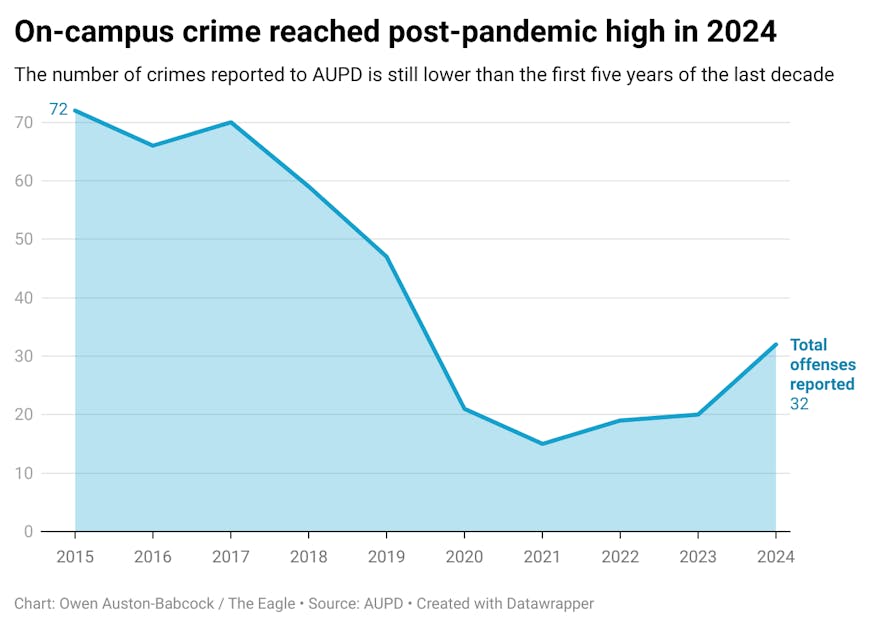
2023 had no reported cases of rape, fondling or assault and fewer domestic violence, stalking and burglary cases. 2022 saw more crime than 2023 but less than 2024, with two rape offenses, three cases of fondling, three burglaries, six cases of domestic violence and two stalking cases.


An assessment of past security reviews dating back to 2015 reveals a similar list of resources and structure to this year’s review. However, there are notable differences in the crime data when compared to the 2025 report.
Between 2015 and 2020, there were over 90 reported rape cases, with an average of 15 reported each year. On average, there were also more cases of domestic and dating violence as well as stalking in these years compared to 2022 to 2024. Burglaries were more common as well, with 32 from 2017 to 2018.
2015 to 2017 saw 12 hate-crime offenses, from simple assault to vandalism characterized by sexual orientation, racial, national origin, religious and gender bias. This declined between 2018 and 2020, with only two reported.
Resources listed in report
After the University decided not to arm AU Police with firearms last semester — a widely unpopular initial proposal — the Security Review Working Group instead advised the University to take steps to improve AUPD’s relationship with the broader community through more public forums and education sessions, as well as increased data transparency.
The Annual Security Report for 2025 lists resources such as AUPD self-defense classes and “crime prevention presentations.” The report directs readers to periodic crime prevention seminars in residence halls and Crime Prevention Boards that are displayed at half a dozen locations on campus, including the Mary Graydon Student Center, select residence halls, and at some campus events during the year.
The report also explains that campus physical security systems are continuously expanding and improving, including access control, alarm monitoring and video surveillance.
The report includes a range of other resources from AU Alerts to campus counseling services. It also refers students to informative content from the Department of Homeland Security and the Metropolitan Police Department.
The report addresses AUPD’s involvement with MPD, explaining that AU officers are commissioned by MPD — meaning they are sworn city police as well — and operate with a close working relationship.
“MPD works with University Police officers on complex or specialized cases,” the report says. “MPD officers meet with campus law enforcement directors to discuss mutual concerns, coordinate programs, and exchange information.”
AU is federally mandated to release this report yearly before October in accordance with the Jeanne Clery Disclosure of Campus Security Policy and Campus Crime Statistics Act, an act passed by Congress in 1990 and named after a college student murdered in 1986.
The Clery Act requires universities that receive federal funding to update the year’s crime log daily with criminal offenses, hate crimes, Violence Against Women Act offenses and arrests and referrals for disciplinary actions, according to the The Clery Center. Reportable crimes occur on or near campus and pose a serious or ongoing threat to the community. However, it is largely at the University’s discretion on what constitutes this threat level.
It is also at the University’s discretion to issue timely safety warnings for crimes that may pose a greater threat to the community, in addition to entries in the Clery Log. There have been none issued in 2025. The last one issued was a simple assault in April 2023.
At the time of this article’s publication, 2025’s Clery Log includes seven reports of sexual abuse, assault or misconduct; 41 alcohol law violations; 43 thefts; four cases of stalking; 21 drug law violations and more.
Students who have experienced sexual assault or harassment can seek support through confidential resources such as the University’s Center for Well-Being Programs and Psychological Services, the Student Health Center, the Kay Spiritual Life Center or the following hotlines:
- Collegiate Assistance Program: 1-855-678-8679
- Rape, Abuse, Incest, National Network (RAINN) anonymous chat
- RAINN hotline: 1-800-656-4673
- DC Rape Crisis Center: 202-333-7273
Other resources include:
Non-confidential resources include the University’s Title IX Office and AUPD.
This article was edited by Cara Halford, Owen Auston-Babcock, Abigail Hatting and Walker Whalen. Copy editing done by Sabine Kanter-Huchting, Avery Grossman and Ava Stuzin. Fact-checking done by Aidan Crowe.
