
Arming American University’s Police Department was entirely possible, according to a new report from the University’s Security Review Working Group. However, the group concluded that the structural, legal and financial challenges — combined with student and faculty pushback — outweighed the potential benefits of transitioning to a fully armed force and recommended that AUPD remain unarmed.
“The implementation of an armed force must be weighed carefully to ensure that it enhances campus safety without compromising trust, equity, or the mission of higher education,” the report reads.
Instead of shifting toward lethal force, the working group laid out a set of recommendations to improve campus safety and AUPD’s relationship with the community. These included more frequent public forums, increased data transparency on policing activities and regular education sessions to highlight officer training in crisis response and mental health situations.
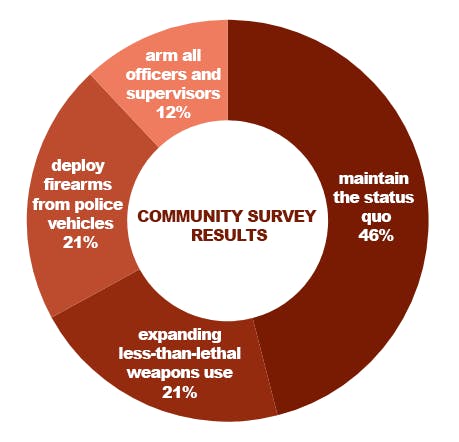
The report revealed that the highest number, 46 percent, of surveyed respondents in the community preferred that the University maintain the status quo to not arm AUPD, which was ultimately the final decision announced by President Jonathan Alger in March 2025 after over a year of review. AU announced in October 2023 that they were considering arming AUPD, citing a shooting at Morgan State University as raising safety concerns.
Community survey results
On March 15, the working group released its report and feasibility assessment, which included results from a community survey.
The survey asked participants questions about their opinions on the four options being considered:
- Maintain the status quo
- Expand the use of less-than-lethal weapons without firearms, including but not limited to tasers and rubber bullets
- Deploy firearms from police vehicles in threat situations involving weapons
- Arm all officers and supervisors

The survey also asked how arming AUPD could impact the campus climate and if respondents would feel more or less safe and welcome.
The Office of Institutional Research and Assessment sent out the survey to the University community throughout November 2024.
More than 15,600 AU students, faculty and staff were sent the survey, which had a 14 percent response rate. Only 3 percent of the 14,400 alumni, neighbors and parents who received the survey responded. In total, the survey garnered almost 2,700 responses.
About 46 percent of those who responded voted to maintain the status quo, 21 percent voted for expanding less-than-lethal weapons use and 21 percent voted to deploy firearms from police vehicles. Twelve percent voted to arm all officers and supervisors.

The Board of Trustees were able to access the survey during their November 2024 meeting and six trustees filled it out. Half voted that their preferred option was to maintain the status quo, while two voted for deploying firearms from police vehicles and one for expanding less-than-lethal weapons. Alger presented his final decision to the board in February 2025 based on the working group’s recommendations and the board supported his decision.
The majority of respondents said that arming all AUPD officers would make them feel somewhat less safe or far less safe on campus, while about one in three said it would make them feel somewhat more safe or far more safe. About 13 percent said they would feel neither more nor less safe.
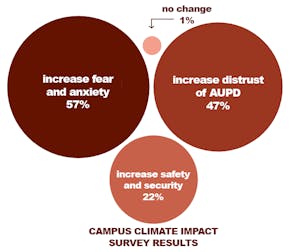
The survey also asked an open-ended question: “What impact would you expect arming AUPD with firearms would have on campus climate?” Respondents’ answers were analyzed by Microsoft CoPilot in the report to list the percent of responses that include each theme. The results are shown in the chart below.
“The predominant sentiment was one of fear and distrust regarding the idea of arming AUPD with firearms,” the report reads. “Concerns about the negative impact on marginalized groups, the potential for increased violence, and the chilling effect on free speech and protests were common themes.”
The working group’s process
In 2023, the Board raised a question about how prepared the University is for a major safety threat on campus and whether overall safety procedures and protocols meet the needs of the community, the report said.
Any change could significantly impact campus climate and would prompt understandable concerns from the community, so “AU leaders brought together a cross-section of faculty, staff, and students to explore this issue thoroughly.”
The working group was assembled in fall 2023 to conduct an assessment of the University’s safety procedures. The group is made up of faculty, staff and student representatives and led by Chief Financial Officer, Vice President and Treasurer Bronté Burleigh-Jones and Assistant Vice President of University Police Services, Emergency Management and Transportation Programs Phil Morse.
The group met throughout fall 2023 and into the spring and summer of 2024 to develop the review, outline key questions, engage outside experts and plan specific actions for community engagement, according to the report.
John Firman, an adjunct professor of justice, law and criminology who has worked in criminal justice for 57 years, said that being a part of the working group was an “eye-opening experience” and that everyone involved had a unique opinion on which of the four options was best.
“It is a tendency as you get older, to get fixed in your opinion … There is that tendency to become very comfortable with the way you think things should go,” Firman said. “My takeaway is that it was a very open and productive learning experience for everybody.”
The report also recommends pursuing national accreditation standards — like those from the Commission on Accreditation for Law Enforcement Agencies — as a way to further professionalize AUPD under the current unarmed model.
Independent survey of AUPD officers
Candace Strickland, a PhD candidate in the School of Public Affairs, surveyed AUPD officers’ perceptions of the department for her dissertation titled “Policing from Within: Understanding the Role of Organizational Justice and Self-legitimacy in Shaping Officers’ Mindsets.”
After getting permission from AU’s Institutional Review Board and Morse, Strickland worked with the working group to tailor her survey questions. Strickland sent out a survey to the 40 sworn AUPD officers, of which 35 responded. Two officers started the survey but did not complete it.
The full survey results are yet to be released because the dissertation has not been published, but the data included in the report showed that officers had differing opinions on whether the presence of armed officers could increase the risk of escalation.
Slightly more than half of 33 completed respondents strongly disagreed or disagreed that arming “increases the likelihood of escalation in certain situations.” However, nine respondents strongly agreed or agreed and seven said they were neutral on the issue.
Additionally, 75 percent officers strongly agreed or agreed that “the presence of armed officers on campus positively impacts an individual’s sense of safety.”
The same proportion of respondents, or 25 out of 33 officers, strongly agreed or agreed that the AU community trusts AUPD to handle situations appropriately, while four respondents answered neutrally and four disagreed.
In an interview with The Eagle, Strickland emphasized the importance of getting both the AU community and the officers’ perspectives on this topic, so that “a decision was made that reflected the needs and the values of everyone involved at American University.”
“I think AU did the very appropriate and rightful decision to look at how the student population feels and how their officers feel,” Strickland said. “Because you’re working in tandem in the community and … making sure students feel safe and secure on campus and that’s what AUPD officers want for their students, and for students writ large on many universities.”
Guardian vs. warrior mindset
In her dissertation, Strickland looks at the concept of a “warrior” vs. a “guardian” mindset in policing. She said she was inspired by the book “Rise of the Warrior Cop” by Radley Balko.
Strickland defined the warrior mindset as officers being more aggressive in their policing tactics and prioritizing use of force and officer safety during their encounters. The guardian mindset is more focused on procedural justice and community policing, prioritizing empathy and de-escalation. However, she said the two are not mutually exclusive and officers can sometimes demonstrate both mindsets.
“You have these two mindsets in policing that were birthed from other conceptualizations of police culture,” Strickland said. “What are the factors influencing whether officers orient themselves toward a warrior or guardian mindset?”
AUPD focuses on training officers on using a guardian mindset and emphasizing de-escalation tactics, according to Morse, who was chief of the U.S. Capitol Police for more than 6 years before he came to AU in 2012.
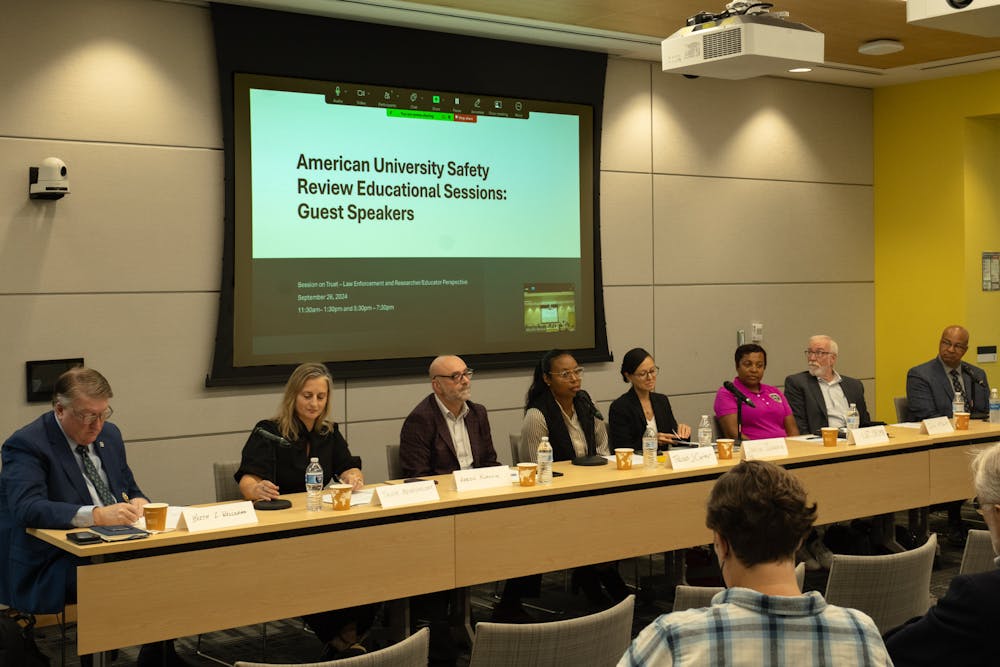
“We do everything we possibly can to ensure that our officers understand that working in a university setting is different than any other type of community setting, like municipality, state or even federal,” Morse said at an AUPD education session in September 2024.
The financial cost of arming AUPD
The feasibility assessment conducted by the working group underscored the steep financial and logistical costs that would come with arming AUPD.
While arming AUPD is technically feasible, the report recommended a comprehensive summary of actions for implementation prior to the transitioning of AUPD to its current practice. These actions include creating a training program in collaboration with local and national law enforcement bodies, enhancing officer pay and retention through, and career development, to ensure high standards.
The total new expenses for the first year alone would range between $900,000 and $1.3 million, according to the working group’s estimates. This includes costs for recruitment campaigns, psychological evaluations, extensive firearms training and outfitting officers with weapons, secure storage and safety equipment. Annual training and requalification costs would also become a permanent line item in the University’s budget.
Additionally, the report proposed increases in pay and benefits that would increase the department’s annual personnel costs by as much as 18 percent, raising AUPD’s personnel spending from about $4.4 million to $5.2 million, depending on the final compensation model.
Most nearby law enforcement agencies offer higher base pay, signing bonuses and additional retirement incentives — factors AUPD would need to match if armed roles were introduced.
Higher insurance premiums were also cited as a major cost driver. Reclassifying workers’ compensation coverage from “unarmed guard” to “armed personnel” would increase insurance rates from $0.17/$100 to $2-$2.27/$100. Although the University’s general liability policy does not currently cover armed officers, any changes could prompt additional scrutiny from underwriters at renewal and result in higher premiums.
Beyond cost, the report pointed to significant institutional and legal obstacles. D.C. does not currently offer a full-service police academy for campus officers. AUPD would need to develop partnerships with external agencies such as the Metropolitan Police Department or nearby state-accredited academies to ensure officers meet national firearms and use-of-force standards.
“Maintaining the unarmed model with targeted investments in officer training, public trust, and non-lethal response capabilities, represents the most sustainable and community-aligned course of action,” the report states.
Ultimately, the working group concluded that the combined legal, operational and financial burdens of arming AUPD would introduce more risk than benefit.
“Whatever your position on justice issues and policing issues, I think we’ve all got to understand that we’re not looking at a system from the outside. We’re part of the system,” Firman said. “The system represents us, it works for us and its goal of the system is to protect us so everybody needs to have a stake in and a say in the justice system in America.”
This article was edited by Owen Auston-Babcock, Tyler Davis and Walker Whalen. Copy editing done by Luna Jinks and Sabine Kanter-Huchting.
