
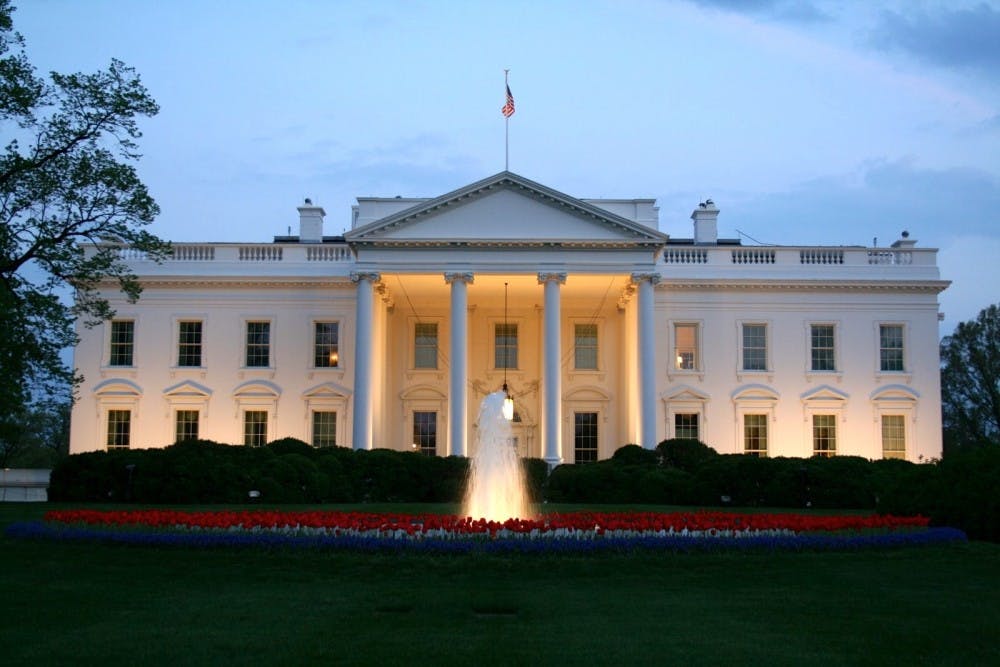
On July 31, the White House announced President Donald Trump’s plans for the construction of the White House Ballroom. In late October, those plans began to come to fruition.
Over 50 percent of Americans are not supportive of the project, according to a poll by ABC News. This project began during a time where 670,000 federal employees were furloughed, 730,000 were working without pay and government-sponsored resources like the Supplemental Nutrition Assistance Program (SNAP) went unfunded.
Outside the White House on Oct. 24, Robin Galbraith held a sign that read “SNAP benefits end on Nov. 1st.” Galbraith described Trump’s ballroom to be “very French Revolution,” and stressed the irony of building the structure at a time where many Americans can’t access essential needs.
Roughly 42 million people who rely on SNAP benefits felt this impact at the start of November.
Zedo Yilmaz, a sophomore in the College of Arts and Sciences, witnessed the impact of the government shutdown firsthand and echoed concerns about the timing of the construction.
“My friends, my family, lost their jobs because they were working at museums,” Yilmaz said. “So it is very upsetting and needs to be fixed right away.”
Galbraith said the timing of the project reveals a lot about the objectives of the administration, relating it to critiques of the administration and recent No Kings protests nationwide.
“Notice they did it after No Kings protests, and I think that was purposeful,” Galbraith said. “They waited until everybody had protested, so that it wouldn’t encourage more people protesting.”

The approximately 90,000 square foot structure is expected to be completed before the end of Trump’s term, the White House stated. In the original announcement, the White House also announced the $200 million building would be paid for by Trump and other donors. Companies contributing to the ballroom include Apple, Amazon and Meta.
A few days into the project, the entirety of the East Wing was demolished.
Laurie Asseo, a former reporter who was outside of the White House on Oct. 24, agreed with Galbraith about timing the construction after the protests.
“They did it to distract people from how giant the No Kings protests were, to try to get people to talk about something else,” Asseo said.
Luke Brown, a junior in the School of Public Affairs and the co-president of AU College Republicans, disagrees, citing that the White House announced the project before they knew the government shutdown and No Kings protests would occur.
“I think it was just unfortunate timing with the shutdown and everything,” he said. “I don’t think it was intentional.”
He said that Trump’s goal of building the ballroom is to expand the White House for when the president hosts state leaders and important events and the construction will benefit what he calls “the most iconic house on Earth.”
Additionally, Brown said that Trump is using the ballroom as a way to leave his mark at the White House and improve the building.
“He sees something and he says ‘I see this and I think I can make it better’... I think that’s the mindset he has adopted,” he said.
Asseo said the Trump administration’s decision is ridiculous and embarrassing. As she sees it, he is tearing down a piece of history.
“This is the people’s house,” she said. “And he ripped down history without any historical review, without any consent at all.”
While the original cost estimate for the new ballroom was $200 million, it is now expected to cost closer to $300 million.
Quynh Pham, who was outside the White House with Galbraith and Asseo on Oct. 24, said that the ballroom is Trump’s metaphor for power and the contributions by donors further convey this display of power.
“At the end of the day, this is just another way of corruption and bribery,” Pham said. “Privately funded just meant bribes.”
Reda Ettouati, a freshman in SPA, agreed and said that the ballroom being privately funded doesn’t excuse its construction.
“So many people are hungry and aren’t getting their SNAP benefits, and this is what Trump is focusing on — funding a new ballroom with his billionaire friends,” Ettouati said.
Conversely, Brown said that the private funding of the ballroom legitimizes the project since the administration is not using taxpayer dollars to fund it.
To Willie Futrelle, a reporter from local newspaper Street Sense Media who was protesting outside of the White House, Trump’s decisions were foreseeable and on par with the trajectory of his presidency thus far.
“Before we even put him in place, they told us that they were going to do all this,” Futrelle said. “So it’s just mind boggling that people are letting it happen.”
Futrelle said that Trump can do whatever he wants since Republicans control the House of Representatives and the Senate and the construction of the ballroom is one example of what he said is becoming Trump’s “unchecked power.”
This is what Pham said the American people are the angriest about. Pham tied the ballroom back to the purpose of the No Kings protests and said it is the perfect representation of what Americans are fighting against.
She urged Americans to use the construction of Trump’s ballroom to fight against the administration.
“The founders went out of their way to say ‘no kings.’ They had a king; they rebelled against that,” Pham said. “This is a democracy. This is a republic, if we can keep it.”
This article was edited by Gabrielle McNamee, Abigail Hatting and Walker Whalen. Copy editing done by Sabine Kanter-Huchting, Avery Grossman and Ava Stuzin. Fact-checking done by Aidan Crowe.
