
A young girl and her mother, hands joined, skipped to the center of a small audience dancing to the spirited music of local rapper and MC Ama’d. The pair, beaming with excitement, bounced to the pulsing chorus of his song “Moving Forward.”
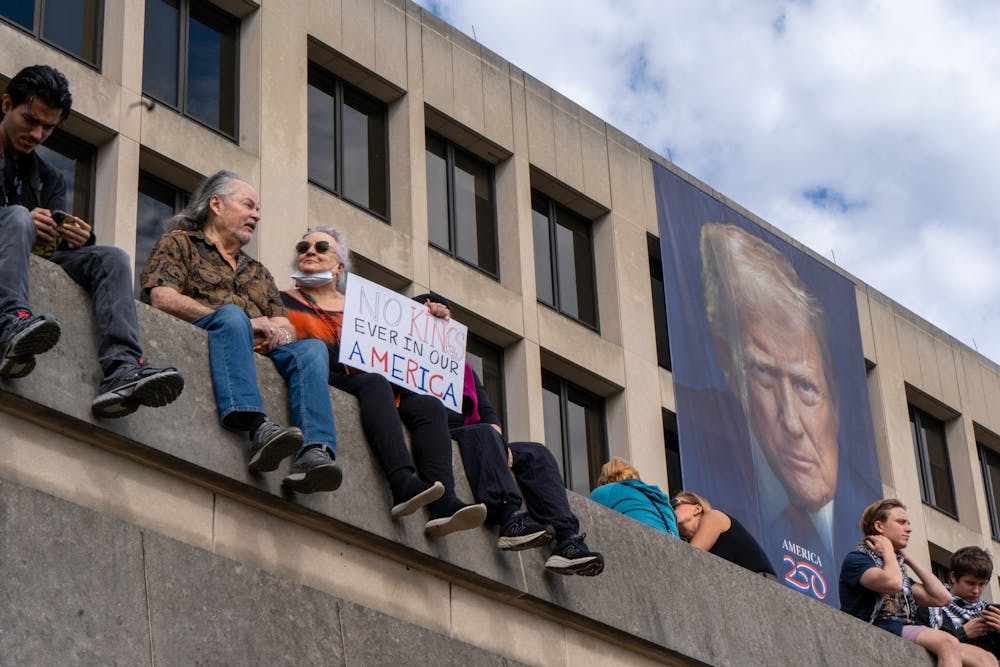
The scene could have been mistaken for a block party, but it took place during one of many Oct. 18 No Kings protests. President Donald Trump’s policies galvanized record-breaking crowds to demonstrate across the United States in a large display of unified resistance.
Demonstrators in D.C. lined the streets of Pennsylvania Avenue with unique signs, costumes, and speeches that expressed the importance of teamwork and collective joy. All came together with the common goal of denouncing the actions of Trump and his administration, as captured by sentiments like those of Ama’d.
“We here to be serious, but we also here to have a great time,” Ama’d said. “I'm still speaking up for what you believe in.”
Members of the organizing group Indivisible sought to provide demonstrators with the space and resources needed to make their collective voices heard.
“We want to firm up that sense of a national movement collectively for democracy and for our neighbors,” Indivisible Co-founder Leah Greenberg said in an interview with The Eagle. “We want to make sure people who show up today feel and understand that they are part of something bigger.”


The diverse range of demonstrators who came to No Kings reaffirms this point. D.C. natives Matthew and Amy Girgenti came with their newborn daughter. The two were dressed in frog costumes, inspired by the ongoing resistance to the federal takeover in Portland, Oregon.
They said the type of people who inhabit the nation’s capital are passionate and driven to unite with others to achieve common goals.
“One thing I love about this city is that you're surrounded by people who pay attention, understand it, and get it,” Matthew Girgenti said about the population of D.C. “When something like this comes here, everyone comes out, and everyone realizes we're all sort of in this together.”
Acknowledging that their costumes could be seen as laughable, they explained that was the point.
“This is a very silly costume. We look ridiculous,” Matthew Girgenti said. “And meanwhile, we're being painted as terrorists and anti-American.”
Days before, House Speaker Mike Johnson released a statement denouncing the D.C. protest as a “Hate America” rally, intended to “bring together the Marxists, the Socialists, the Antifa advocates, the anarchists, and the pro-Hamas wing of the Far-Left Democratic party.”
The No Kings demonstrators were not deterred by these statements. Cathy Kelley of Takoma Park, Maryland, attended the protest with her husband, Larry Bush. She explained that her issue is with the reach of the Trump administration’s rhetoric, rather than with America itself.
“I don’t hate America,” Kelley said. “I love my country. I don't find it very comfortable right now to live in it, but I love the foundations and the idea of democracy, and I'm here to defend it.”
Kelley said that people can protest against Trump while being patriotic, connecting her beliefs to Greenberg’s justification of what Americans can accomplish through unity and collective resistance.
Aparna Raj, a candidate for DC Council in Ward 1, attended as part of her campaign. But she too stressed the importance of collective demonstrations.
“What they're trying to do is … attack us on all fronts and make it hard for us to even get by, let alone resist,” Raj said. “It's steps like [No Kings] that build up to us being in the world that we want to see.”
Tony Battaglia, who traveled to D.C. from Pennsylvania to protest, made an observation about the youthfulness of the crowd.
“When we were down here protesting George [W.] Bush, everybody was my age, because young people didn’t understand what was going on,” Battaglia said. “Now they're starting to finally understand that this is about young people.”
Among these young people were many American University students. Ben Freiberg, a freshman in the School of Public Affairs, and Paisley Gibson, a freshman in the College of Arts and Sciences, attended the protest together.
“I don’t agree with what’s happening right now,” Freiberg said, referring to the Trump administration’s policies. “I feel like when that happens, we should be using our right to protest.”
Gibson believes that the size and scope of an event like No Kings is what makes it important.
“I feel like this is going to be in the history books,” Gibson said.
Marcus Tuomi, a freshman in SPA, said he felt a civic obligation to attend.
“I feel like a democratic backsliding is a huge issue nowadays in the U.S., and I need to do something about that,” Tuomi said.
Looking forward, organizers like Greenberg said No Kings can be a baseline for further action. She said the assembly of such a unique group of people at No Kings can and should encourage individuals to pursue activism in their own lives outside of just protesting.
She offered examples like attending school board meetings and asking about plans to protect students from Immigration and Customs Enforcement raids, or going to church and demanding the minister speak out about current events. It is strength in numbers that accomplishes these tasks, she said.
“They are better and easier to do if you feel like you are doing them together with other people and it's not you shouting into the wilderness,” Greenberg said.
Fellow Indivisible Co-founder Ezra Levin said the most useful purpose of a demonstration such as No Kings is to remind concerned people they are in tremendous company.
“Authoritarians succeed by making you feel isolated and powerless and by projecting strength,” Levin said. “One of the important things that this kind of protest does is it makes it very clear that not only are we not alone, there are more of us than there are of them.”
This article was edited by Gabrielle McNamee, Neil Lazurus, Abigail Hatting and Walker Whalen. Copy editing done by Sabine Kanter-Huchting, Emma Brown, Avery Grossman, Audrey Smith, Ariana Kavoossi and Ava Stuzin. Fact-checking done by Aidan Crowe.
