
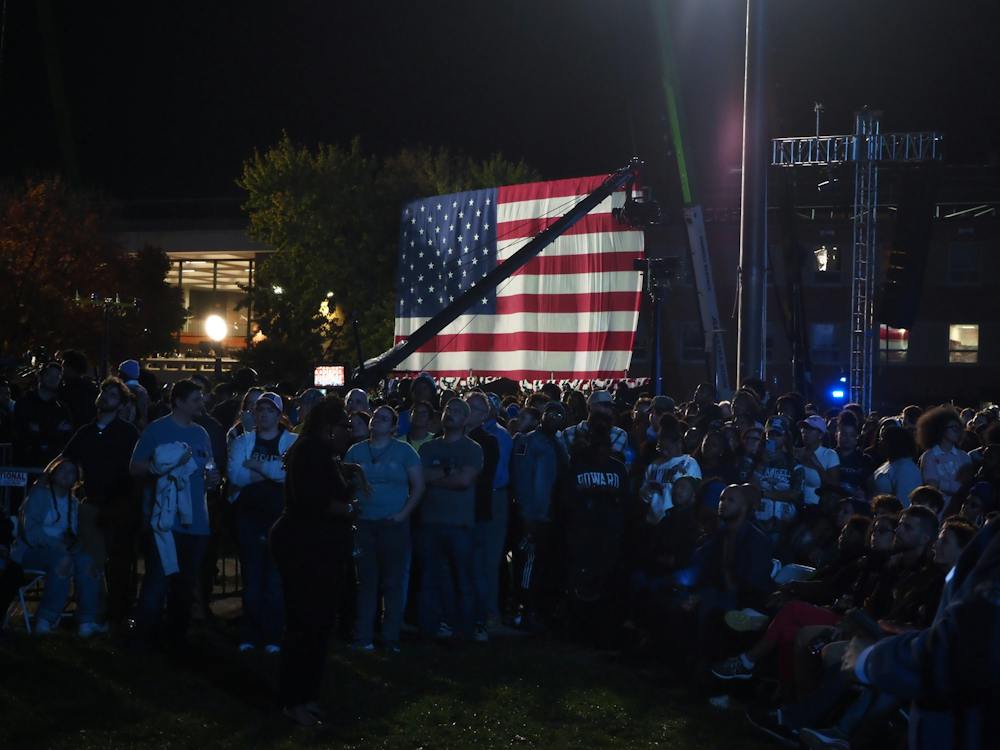
The 250th anniversary of the United States ignited a national conversation about patriotism and nationalism — the former term meaning to love and support one’s nation, and the latter meaning to be loyal to one’s nation.
Aram Sinnreich, graduate director of the School of Communication’s Media, Technology and Democracy masters program, says that the word “patriot” is charged with negative connotations and continues to be weaponized in the current political climate.
“I think the term is dangerously vague and it’s used by a lot of people in ways that are exclusionary or oppressive,” Sinneich said. “Even if I think the term has meaning, and even though under my own definition I would largely consider myself a patriot, I am extremely cautious about using words that can be weaponized in that way.”
Words, and how they’re used, shape our understanding of the world and our place in it, Sinnreich said. According to Merriam-Webster, a patriot simply means someone who loves and supports their country and is prepared to defend it.
As a professor, Sinnreich’s role is to mold students’ approach to how they think, act and participate in the world around them. However, Sinnreich believes that the current Trump administration has deteriorated motivation to remain politically engaged and promote civic life.
“I think this is probably the worst era of social strife that many people alive have ever seen, and I think that’s because the question of who gets to enjoy the benefits of American citizenship in full is being litigated by powerful politicians, business leaders and culture leaders,” Sinnreich said.
Reporting from The Guardian suggests Americans are conflicted about the state of their nation, and only 9 percent of U.S. adults consider themselves mobilizers — people who are actively participating in civic affairs within their community — according to a July 2026 Pew Research Center study. Such individuals regularly attend their local government meetings, follow the news closely and actively volunteer and protest. Respondents said that their civic involvement is defined by routine political action.
In comparison, the same study says 31 percent of U.S. adults consider themselves spectators of political affairs, meaning they follow news updates rather than actively participating in civic or political activities. An additional 31 percent of U.S. adults reported relatively low levels of civic engagement across all activities: protesting, voting, volunteering or following local and national politics. The remaining 28 percent of U.S. adults anchor their political engagement through community life by attending religious services and/or donating to non-political causes.


Based on the Pew Research Center’s study, roughly 70 percent of U.S. adults are not active participants in civic life, opting to look at the nation’s state of affairs rather than act to improve it. As the U.S. experiences a historic erosion of democratic ideals, many are asking what legacy citizens are being loyal to, and how one should show love to a country that is politically regressing.
Such concerns have spread amongst the American University community, leaving some to question their relationship between personal beliefs and their national identity.
The 250 Plus campaign at the University launched in spring 2026 with promises to “lead the difficult, necessary work of preparing a future defined by civic pluralism and a thriving democracy,” according to a campus-wide email from former University President Jonathan Alger. The University’s plans to celebrate the vast history of the United States center programming that spans from speaker series and lectures to events run through the School of Public Affairs.
These efforts are run through internal initiatives that target University students, faculty and campus members; subsequently, the majority of these efforts do not stretch beyond the University’s campus. As a result, students may miss the opportunity to civically engage with the broader DMV community in a meaningful way.
Robert Jaeger, a sophomore in SPA, said that the University’s students continue to stay aware and politically active in times of great distress. Jaeger feels that despite pervading stereotypes of University students being performative in their political actions, which tend to lean liberal, their passion for change leaves him feeling confident when thinking about the future.
“There is an extremely tyrannical rogue government at 1600 Pennsylvania Avenue, and the fact there’s such a drive to protest, to engage politically and to be informed on campus is really uplifting,” Jaeger said.
Jaeger said the word “patriot” — and by extension, patriotism — has been appropriated by politicians across the ideological spectrum to push their respective partisan agenda. All parties are guilty of strategically labeling certain types of behavior as “patriotic,” according to Jaeger.
“I would define patriotism as wanting what is best for your country and for your fellow citizens,” Jaeger said. “When I think of the most patriotic things someone can do or the most patriotic people out there, they’re not the people who blindly accept that their country is in some abstract way the greatest it can possibly be.”
Jaeger’s concept of patriotism is not novel. In his 1955 collection of essays entitled “Notes of a Native Son,” James Baldwin, author and civil rights activist, famously wrote that he loved the United States more than any other nation.
“And, exactly for this reason, I insist on the right to criticize her perpetually,” Baldwin wrote.
Rahul Kirkhope, program coordinator for SPA’s Project on Civic Dialogue, echoed this sentiment.
“Loving your country is not contingent upon loving the government that’s currently in power or the policies that are currently enacted,” Kirkhope said.
Discourse can become more meaningful by practicing facilitation techniques used in civic dialogue practices, according to Kirkhope. In the same way that “patriot” has been misappropriated and weaponized, words like civic dialogue, civic discourse and civic pluralism have been too, according to the program coordinator. Kirkhope said these practices require critical thinking and infrastructure in order to properly accomplish their goal: depolarizing people’s minds.
While the Project on Civic Dialogue is focused on students, Kirkhope sees this practice to be applicable to anyone who wants to improve articulating arguments, listening without the immediate inclination to respond and, more importantly, create community and understanding.
“The United States is a really beautiful amalgamation of a thousand different cultures and a thousand different people,” Kirkhope said. “And finding a way to coexist and also thrive together under a shared banner is what we want to create a space for people to exist in, for all people to exist in.”
That change can happen through multiple avenues.
For Sinnreich, it’s calling local representatives and giving academic talks at retirement centers and libraries. For Kirkhope, it’s inspiring University students to practice their civic dialogue skills and to think about sentiment, not partisanship. For Jaeger, it’s joining political clubs at school and volunteering and protesting in his free time.
Each is civically engaged, from the classroom to the community. And all asserted that being patriotic means wanting better for your country.
All three individuals navigated their own definition on what “better for your country” meant, and the phrase manifested into three categories: accessibility of opportunity, being equipped with language to articulate experiences and tearing down boundaries that obstruct society from being equal and equitable.
Jaeger believes that American University students are empowered and ready to combat what he sees as suppression of political expression from the current presidential regime.
“Regardless of what the powers that may be want us to believe — who gains electoral advantages by separating us — if we stay unified, if we stay protesting and if we keep wanting what’s good for our communities and for our country, for its own sake, we will come out of this administration better than we came in,” Jaeger said.
This article was edited by Olivia Wood, Cara Halford and Gabrielle McNamee. Copy editing done by Avery Grossman, Mattie Lupo, Jaden Maitland Anderson and Ryan Sieve. Fact checking done by Luca Palma Poth.
