
Last semester’s Holocaust Remembrance Week, hosted by American University Hillel from April 12 to 17, centered the theme of Jewish Resilience, allowing students to focus on what being Jewish today looks like while honoring those killed in the Holocaust.
The week consisted of several events made possible by collaborative student efforts and a semester-long planning process.
During this year’s Living Jewish Shabbat, committee members shared what resilience means to them and how consistently honoring Holocaust victims shapes their identities. The Shabbat also featured paper daffodils and white roses made by students to specifically honor the children who died in the Holocaust, as well as the White Rose resistance group, according to the committee.
“A big part of the Jewish community is keeping someone’s memory alive after they pass,” Hannah Foster, a recent graduate from the School of Public Affairs and member of the Holocaust Remembrance Committee, said. “Even when someone dies, it’s not supposed to be a really sad thing; it’s supposed to bring the community together, and kind of reflect on their lives well lived.”
Foster, who spoke at Shabbat, shared how today being Jewish means carrying the stories of those before you.
“My grandfather survived the Holocaust, so that has always been, like, a big part of my identity,” Foster said. “That’s something I’m going to talk about on Friday … to continue spreading, not only awareness, but also bringing up and educating on the Holocaust, to make sure people don’t forget about it.”
Other events included a panel with “The Counterfeit Countess” author Elizabeth “Barry” White and a 24-hour name reading of Jewish lives lost in the Holocaust, among others.
On April 14, White led a discussion on her memoir, co-written with Joanna Sliwa, about Countess Janina Suchodolska, a Jewish mathematician who saved nearly 10,000 Poles in the Majdanek concentration camp.


“Compare that to Oskar Schindler, who is rightly honored for saving maybe 1,200 of his Jewish workers,” White said. “And of course, he was a non-Jew who rescued Jews, whereas Janina was a Jew who rescued non Jews, and did it largely by negotiating with SS and Nazi officials who were seeking to destroy her and everyone like her.”
Suchodolska smuggled food and medicine into Majdanek and directly negotiated the release of at least 2,100 prisoners. Her husband later wrote that she lived her life by the philosophy that a single life has less value than multiple lives, and that her own held no value if she didn’t use it to save others.
“She didn’t ask whether the people she risked her life for were worthy,” White said. “All that mattered to her is that they were fellow members of what she called the vast suffering human family, and if they were suffering, then she saw it as her human duty to help them.”
The memoir was started by Suchodolska shortly before she died in 1969; her husband tried, unsuccessfully, to publish it and the manuscript was nearly lost to history. However, together, White and Sliwa supplemented the pre-existing memoir with historical records and wartime documents to produce a cohesive documentation of her work.
For White, sharing stories about both victims and survivors of the Holocaust is crucial because each one reflects a different lived experience.
“They help us see those people behind it who are just like us,” she said. “And who loved and laughed and cried and argued and tried to create better lives, and that then really shows us the danger that we all face when we fail to confront hate to protect the rights and dignity of every human.”
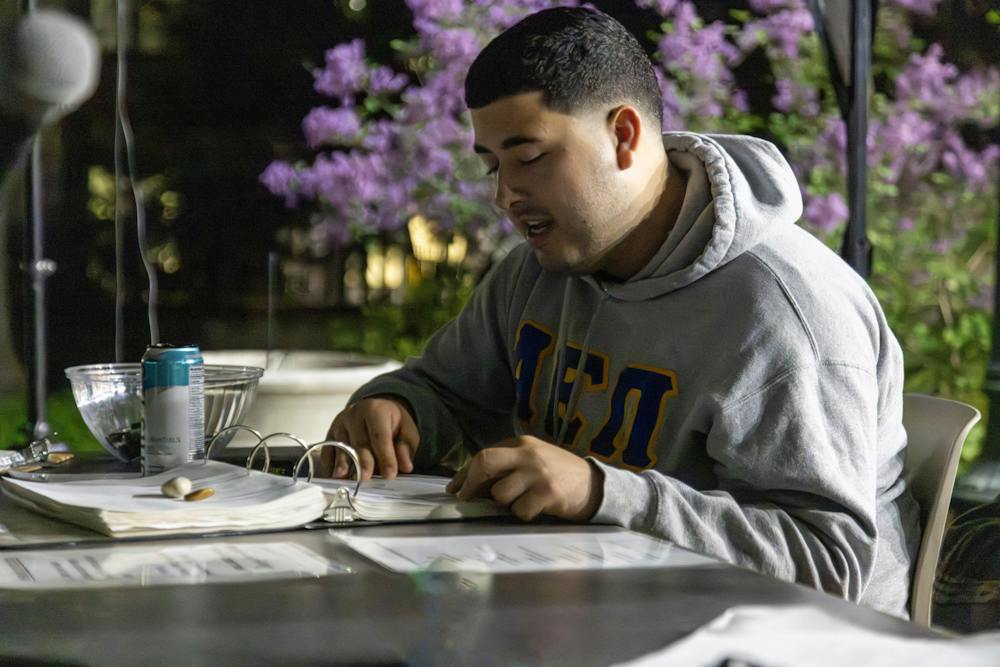
This continued the next day, when the 24-hour name reading ceremony began at 11 a.m., honoring all six million Jewish Holocaust victims.
“We honor those who passed by putting their names back into the world, is how I choose to think about it,” Leah Wayne, a senior in the College of Arts and Sciences and Jewish life ambassador, said.
For Poppy Stiglitz, a senior in SPA and member of the Holocaust Remembrance Week Committee, the annual 24-hour name reading serves as a way to support Jewish students on campus and engage the broader AU community.
“There isn’t great education about the Holocaust,” Stiglitz said. “So every opportunity that we have to both hold space for Jewish students to remember, grieve and feel all the emotions that might come up with remembering the Holocaust, but also engaging the broader community, both in education and just helping them learn about the Jewish community.”
The name reading ceremony concluded the following morning with a recitation of the Mourner’s Kaddish, a Jewish prayer that honors the dead. Wayne added that fraternities, sororities and other campus organizations were invited to the ceremony to read names to keep them alive in the University’s collective memory.
“It’s less about the sadness of a lost loved one and more about keeping their memories alive, kind of like the Day of the Dead ofrendas,” Wayne said. “In that kind of light, you bring people’s memories back. ”
Stiglitz said Holocaust Remembrance Week keeps the memory of those who died in the Holocaust alive, while connecting the Jewish community on campus and educating the AU community as a whole. For Stiglitz, this year’s theme was especially important.
“While remembering the Holocaust and the victims of the Holocaust is a really important part, we’re also focusing on both survivors and resilience,” Stiglitz said. “We’re focusing on what it means to be Jewish today and what it means to carry all these stories of survival and hardship.”
This article was edited by Natalie Hausmann, Payton Anderson and Gabrielle McNamee. Copy editing done by Avery Grossman and Mattie Lupo. Fact-checking done by Luca Palma Poth.
