
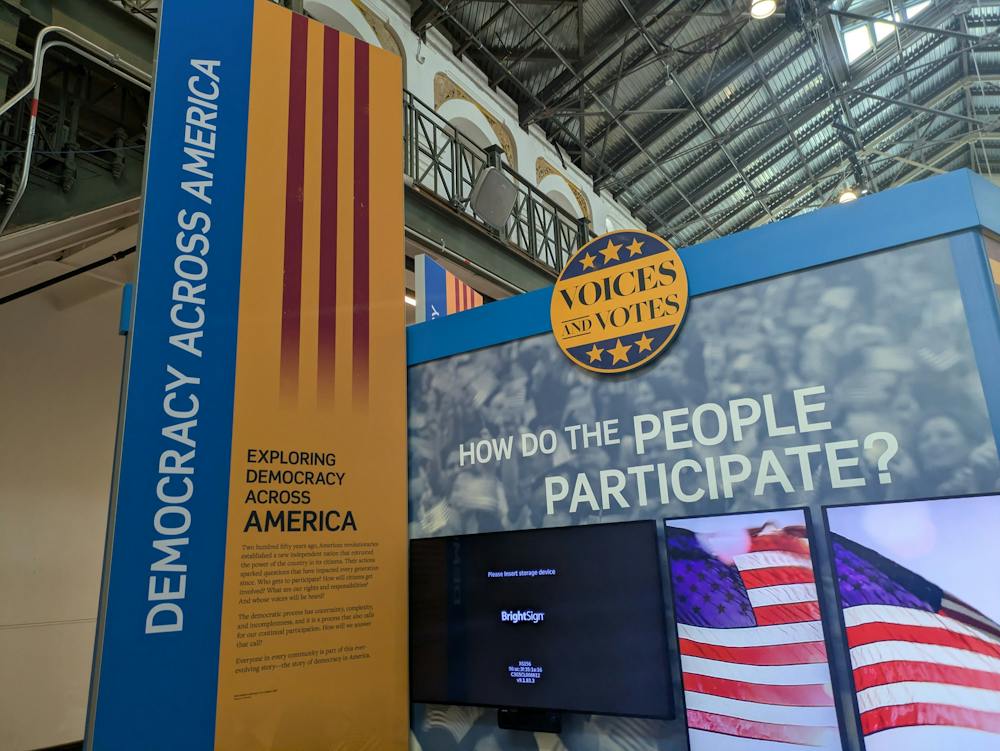
This summer, the Smithsonian’s traveling exhibit “Voices and Votes: Democracy in America” held a pop-up display in the Arts and Industries Building as a part of America’s 250th anniversary celebrations in D.C.
The traveling edition of the exhibit has been around since 2020, and the display featured in D.C. utilized components of the original design’s timeline approach to explaining American democracy. The display also incorporated aspects of the Smithsonian’s work in local communities.
“We actually had an interactive map in the exhibition with like 400 different places across the country where various activities that [the] Smithsonian has been involved with took place,” Robbie Davis, the national outreach manager for the Smithsonian Institution Traveling Exhibition Service and Smithsonian Affiliations, said.
“We’ve always seen Voices and Votes as a conversation starter, a place where people can gather around and kind of talk through some of the things that are up for debate in American democracy,” he said.
The sections were ordered chronologically telling the story of how America’s voting process and civic engagement has changed since its founding. The displays included artifacts such as historic campaign memorabilia and Kraft Mac ‘n Cheese boxes featuring the political party animals.
“I enjoyed the part about the campaigns,” Laurie Clarke, an exhibit visitor, said.
Clarke also had the opportunity to see the Art and Industry Building’s 1976 replica of “1876: A Centennial Exhibition,” the building’s first exhibit.
“I really liked it then, so I thought this was a great opportunity to come back and enjoy this exhibit,” Clarke said.



The exhibit featured a section dedicated to information about how people can get involved with civic engagement. A vote-by-token interactive station allowed viewers to express their own opinions about voting. Participants could voice their opinion by placing a token in a matching tube, with options ranging from feeling like voting was a civic responsibility to feeling like their vote didn’t matter. In the last presidential election, 64 percent of eligible voters participated, the second highest rate in the last century, according to an article by the Pew Research Center.
“I think people in general look upon voting as a positive, as something that it’s theirs,” Davis said. “It’s something that they can engage in.”
The traveling edition of the exhibit is scheduled to make its final four stops in Utah, Wyoming, Georgia and Indiana before retiring at the end of 2027. By the end of the exhibits tour, it will have been shown in 154 communities in 25 states.
“It was just amazing, there were big crowds that came through, it was a lot of fun to watch and I saw people talking with each other and that’s what we wanted,” Davis said. “We wanted those conversations around what this process means to individual people and to communities.”
This article was edited by Neil Lazurus, Cara Halford and Gabrielle McNamee. Copy editing by Avery Grossman and Arin Burrell. Fact-checking by Luca Palma Poth and Josie Burnette.
