
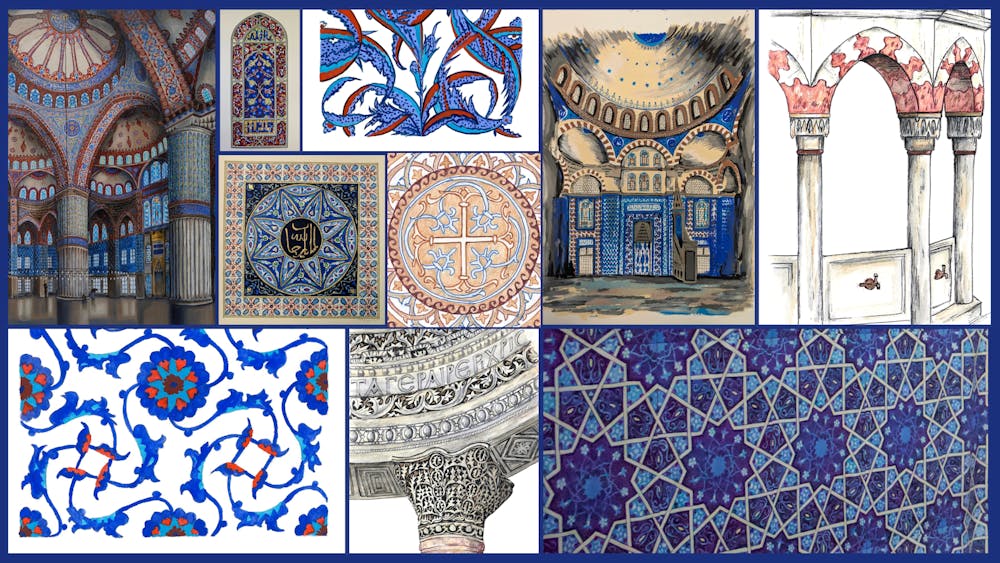
Artwork displaying the rich history of the city of Constantinople — now Istanbul — filled the halls of Katzen Arts Center earlier this year. The exhibition, assembled by Professor Joanne Allen, a senior professorial lecturer of art history, showcased the city’s history of drastic changes in power and religious practice, a timeline outlined on the walls of the center’s rotunda.
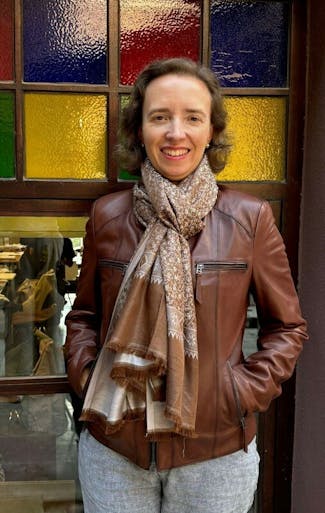
In her exhibition, Allen took audiences through the collapse of the Western Roman Empire and the surviving Eastern Roman Empire, the Crusades, the city’s fall to the Ottoman Empire and the gradual evolution into the more modern architecture of today’s Istanbul.
“My art history is focused on medieval Renaissance art, specifically Italy, but I use my own artwork to educate about other things,” she said.
Allen created each component of the exhibit herself, bringing the city’s longstanding historical influence on religious artwork into her teachings at American University. Further, the exhibition was also a diary piece chronicling Allen’s visits to the city, showcasing her skills of recreating some of the traditional styles used in mosques and churches.
For example, when learning the technique to create the geometric patterns commonly used in Islamic art for mosques, Allen explained of her experience, “If you look online … you can see a lot of computer-generated ones and they look flat and empty. [But] when you see them created by a real person, they just speak to you on a deeper level, so I like it when my edges are a little crooked and so I don’t use the straight edge when I’m finishing off (in reference to the watercolor and gouache technique she learned to recreate the mosaic patterns).”
Allen led a tour of the exhibition in early February, bringing a further personal touch to the exhibit for viewers. She concluded by reiterating why she chose Istanbul as a topic.
“The idea here is to have an educational display,” Allen said. “I thought Istanbul would be a great topic because you can hit the Roman, Byzantine and the Ottoman and all the shifts between them, and it’s still such a vibrant city.”


The exhibition plays out like a mini-lecture on the history of Constantinople and Istanbul, sprinkled with colorful pictures of churches and mosques, intricate acrylics of mosaics, textured ceramic tileworks and drawings of religious figures and patrons. Now, it is available to view online via American University’s College of Arts and Sciences page on past Katzen exhibitions.
This article was edited by Jessica Ackerman and Walker Whalen. Copy editing done by Avery Grossman, Jaden Maitland Anderson, Ryan Sieve and Ava Stuzin.
