
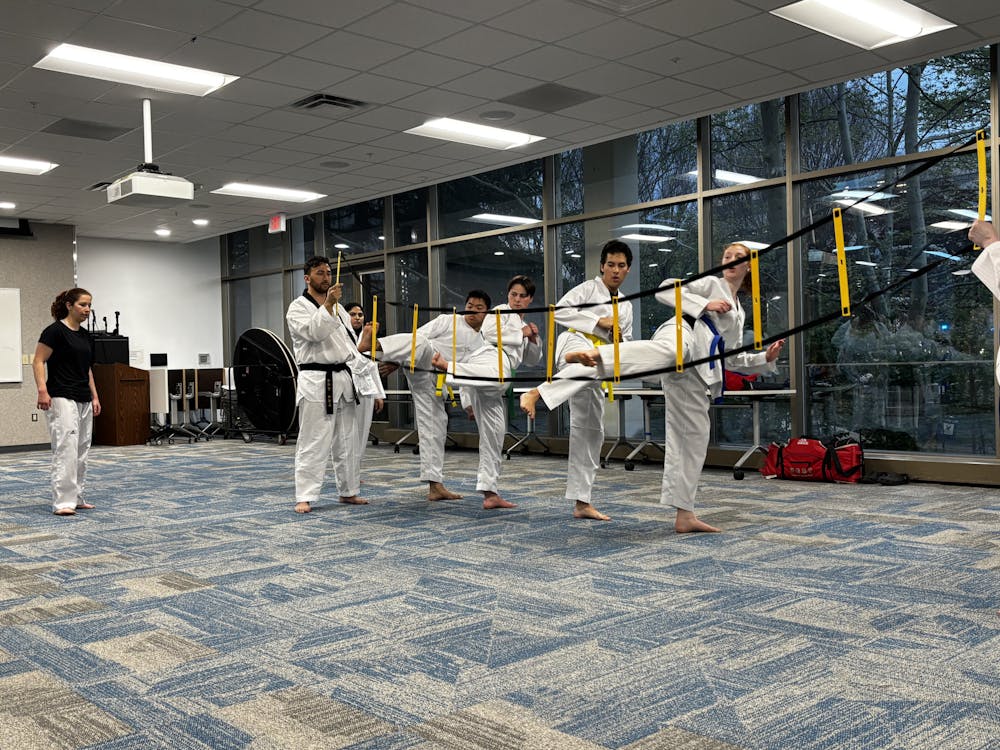
On a typical Monday night in the McDowell formal lounge, the calm buzz of campus life is interrupted by the crisp sound of a kick landing on a training mat, the heavy smack of a punch landing on a pad and the steady rhythm of feet gliding across the floor.
Students aren’t gathered for a study session; they are training with American University’s Taekwondo Club, where beginners learn their first kicks, black belts sharpen tournament techniques and everyone finds space to challenge themselves. For Emma Hatt, president of the Taekwondo Club, it is a place where students can develop their skills while feeling welcome.
“Prior experience isn’t required,” Hatt said. “We teach all levels. Even if you’ve never done the sport before, you’re welcome to join.”
Hatt’s journey began in high school when a friend first introduced her to the sport. Now, she leads the University’s club, blending passion with community building.
“Taekwondo is about more than kicks and punches,” Hatt said. “It is about learning how to push yourself, work with others and grow as part of a team.”
Ongoing campus construction has taught the club how to adjust. When the new Meltzer Center opened, renovations at Jacobs Fitness Center moved their training sessions into classrooms and lounge spaces. Despite these changes, the team has remained flexible and committed to keeping up with their training.
“Our volunteer coaches work 9-to-5s in D.C., and we are all students,” she said. “Late-night slots don’t work, so we make it happen wherever we can.”
Jack Campagna, the club’s social chair, embodies that flexibility.


“We really emphasize teamwork and problem-solving,” Campagna said. “Going to tournaments together has taught me the importance of working with others and having fun while doing it.”
Campagna’s defining moment came while competing at a tournament at the University of Pennsylvania.
“That was my first time doing actual sparring and poomsae in a professional competition setting,” he said. Facing judges, he leaned on fundamentals: “I kept reminding myself everything I have learned so far.”
With guidance from his coach at ringside, his nerves settled into focus.
“Conditioning drills transformed my skills,” Campagna added. “Repetition, hard work, quick thinking — that’s what matters most.”
Anthony Capobianco, the club’s coach who joined the team last fall, tailors training by level. Beginners start by mastering the basics to get into form.
“They come in with enthusiasm but may not have the strength, flexibility or coordination yet,” Capobianco said. “We start with fundamentals, and everything builds from there.”
Black belts get personalized goals, whether that means competition, demonstrations or new curricula. Capobianco believes that breakthroughs happen through repetition and pointed to one moment when the team was working on sparring techniques early this semester.
“At first, explaining the clinching drill was a challenge because the student had never done it before and the concept did not click right away,” Capobianco recalled. “However, during the session, something just clicked. You could see the student understand footwork. That raw determination made it work.”
When asked about the routine that reliably boosts performance under pressure, Capobianco said the club turns to sparring.
“Here, everyone is familiar with each other, and we do it under supervision in a way that makes everyone feel comfortable,” he said. “It makes tournaments less daunting.”
His vision prioritizes commitment, and his version of growing the club has to do with having a dedicated core group.
“Growing the club starts with having a core group of people who reflect its values and energy. Once that foundation is in place, more members are drawn in naturally. It also means investing time in the students who show up consistently and making sure they have the resources they need to improve,” Capobianco said.
Capobianco’s philosophy emphasizes competition and fun. He says taekwondo needs both and that drills should be enjoyable alongside hard work.
Joining as a coach also prompted him to reflect on his own technique. By teaching others, he reinforces his skills while continuing to learn.
Campagna noted that the University isn’t known for sports, but this club gives exposure to hidden communities.
The club connects off the mats, too.
“One of the funniest moments was our movie night,” he said. “We watched ‘Whiplash’ — totally unrelated to martial arts — and everyone loved just talking and hanging out.”
Newcomers are advised by one rule: “Show up,” Campagna said. “It signals commitment to coaches, even during finals I manage my schedule carefully but stay consistent.”
“Every practice is an opportunity to learn,” Hatt said. “Whether it’s technique, strategy or supporting a teammate, everyone leaves better.”
From classroom dojang to bonding over a viewing of “Whiplash” during one of their movie nights, American’s Taekwondo Club proves you don’t need big facilities for real growth. Its powerful kicks, unbreakable bonds and life-changing breakthroughs are forged one relentless step at a time.
This article was edited by Matthias Jaylen Sandoval, Jack Stashower and Gabrielle McNamee. Copy editing done by Avery Grossman, Arin Burrell, Mattie Lupo and Ryan Sieve.
