
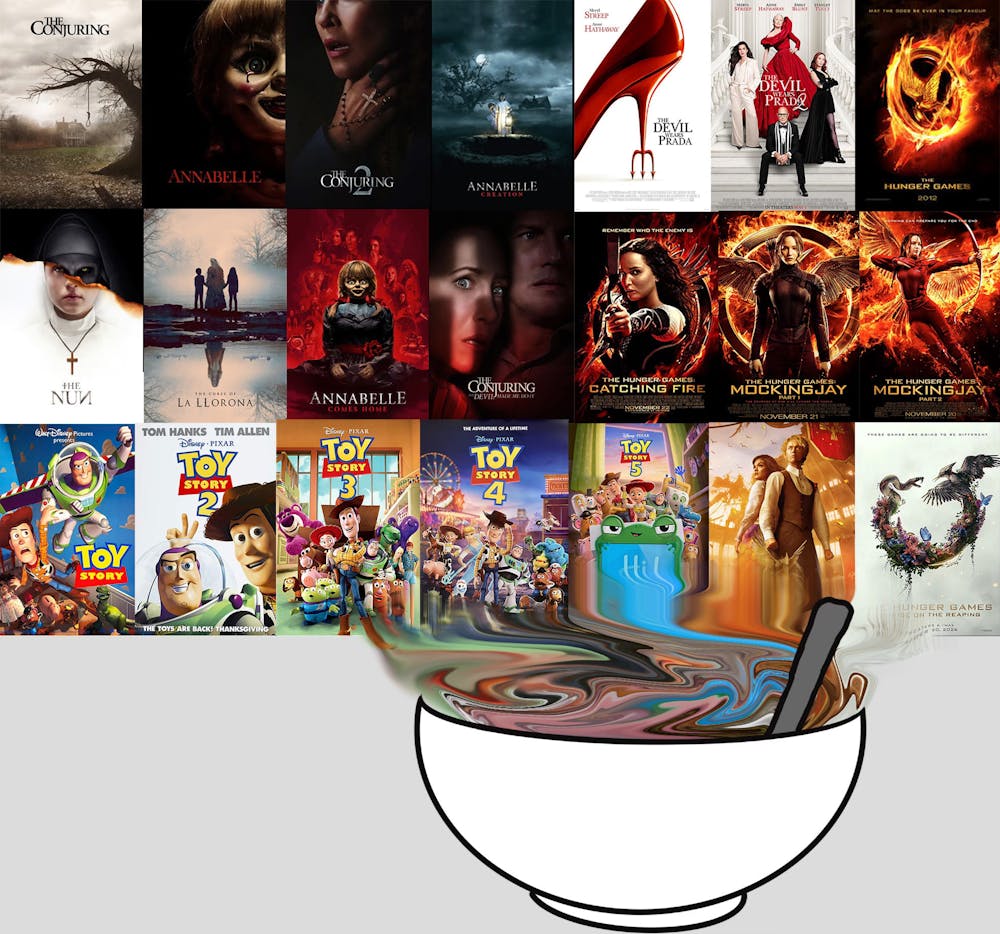
There was a time when hearing about a sequel or franchise was exciting. Now it’s merely expected. Another sequel. Another prequel. Another spin-off. Another live-action remake of a movie that’s not even old enough to feel nostalgic.
Welcome to the era of franchise slop.
Franchises are far from new, and they aren’t automatically bad. The problem is that they’ve become unavoidable. Everything has to be part of something bigger now: a cinematic universe, a reboot show or a sequel that no one asked for but everyone is expected to acknowledge. However, bigger doesn’t always mean better. “Toy Story 5” is set to release this summer on June 19, 2026, extending a franchise that has already said goodbye multiple times yet somehow keeps coming back.
Horror franchises are just as guilty. “The Conjuring” franchise was supposed to end with its fourth film, “The Conjuring: Last Rites” (2025), but due to its box office success, a prequel film is in development. When “the final feature” stops meaning anything, audiences stop believing or caring about finale stakes altogether. Endings lose weight when they’re treated as temporary marketing tools.
Then there are the sequels we never asked for or just forgot about. “The Devil Wears Prada 2” releases in May of this year, which feels less exciting and more like running into an old friend and realizing you have nothing to say to each other. We loved you once. We’ve moved on. These continuations don’t feel natural — they feel like nostalgia grabs for nothing more than revenue.
Early Marvel films felt exciting because they were building toward something, not endlessly extending themselves to stay alive. Somewhere along the way, storytelling became commercial brand maintenance — and audiences felt this shift.
What makes this cycle worse is how much these franchises lose when dragged out. When sequels take years — or even decades — to produce, it’s not just the audience who leaves; the people who made them special often leave as well. Directors move on. Writers exit. Actors age out, lose interest or are replaced.
Sometimes, the only thing that remains is the brand name, stripped of the creative voice or style that gave it personality in the first place. The franchise continues, but the soul quietly disappears.



Franchises used to feel special because they were necessary to capture the story’s depth. Most book-to-film franchise adaptations work because they are always meant to tell one cohesive story. “The Hunger Games (franchise),” for example, is built toward a clear narrative arc. Each installment contributes meaningfully to the larger storyline, giving the franchise a purpose.
What feels different — and often unnecessary — is when stories are extended primarily to sustain the franchise itself. Increasingly, new books seem to arrive with built-in adaptation potential in mind. Suzanne Collins, author of “The Hunger Games” series, published the prequel novel “Sunrise on the Reaping” in 2025, and a film adaptation was scheduled for release just a year later. The speed of that turnaround raises a larger question: is the story being expanded because there is something urgent left to say, or because the franchise remains commercially valuable? When novels begin to feel pre-packaged for cinematic universes rather than written as standalone works of imagination, the line between storytelling and marketing blurs.
This fatigue extends beyond movies — it’s even more obvious in television. Streaming has completely changed the way we watch shows. Because episodes and seasons are available at once, shows regularly split seasons into multiple parts as if eight episodes need to be rationed. We wait years for a new season, only to be handed four episodes and told to come back later.
Netflix’s “Stranger Things” (2016-2026) became the clearest example of this: season finale episodes released on Thanksgiving, Christmas, then finally on New Year’s Eve. Less storytelling, more strategic framing — dropping episodes on holidays to maximize viewership because even the platforms seem to know enthusiasm is wearing thin.
The irony is that audiences are now waiting longer for less. Many shows take nearly a decade to produce five seasons with fewer than 10 episodes per season. Compare that to older television shows that ran for roughly eight seasons with 20 to 24 episodes each, nearly an hour long, and released consistently every year. Now, eight episodes every two years is considered generous — even when the story feels stretched thin or unfinished.
So why has this become the norm? Part of it boils down to streaming economics. Streaming services are more focused on retention than resolution. Splitting seasons keeps shows in the conversation longer, and familiar faces guarantee clicks, which guarantee profit.
The result isn’t outrage — it’s apathy. Audiences aren’t angrily rejecting these projects; they’re quietly disengaging, scrolling past announcements, forgetting release dates and watching out of habit instead of excitement. When entertainment starts to feel like an obligation rather than an escape, something is broken.
People aren’t asking for an end to franchises altogether. They’re asking for intention. For stories that exist because there’s something left to say. Because there’s meaning — not because the name is profitable. Viewers still show up when something feels new, which proves originality isn’t dead yet. It’s just been buried under intellectual property.
Franchises now feel like leftovers reheated one too many times. They used to feel like cultural moments. Until studios remember that audiences value creative voices, meaningful endings and originality over endless continuation, franchise slop will continue to pile up — whether audiences are hungry for it or not.
This article was edited by Alfie Pritchard, Jessica Ackerman and Walker Whalen. Copy editing done by Avery Grossman and Ryan Sieve.
