
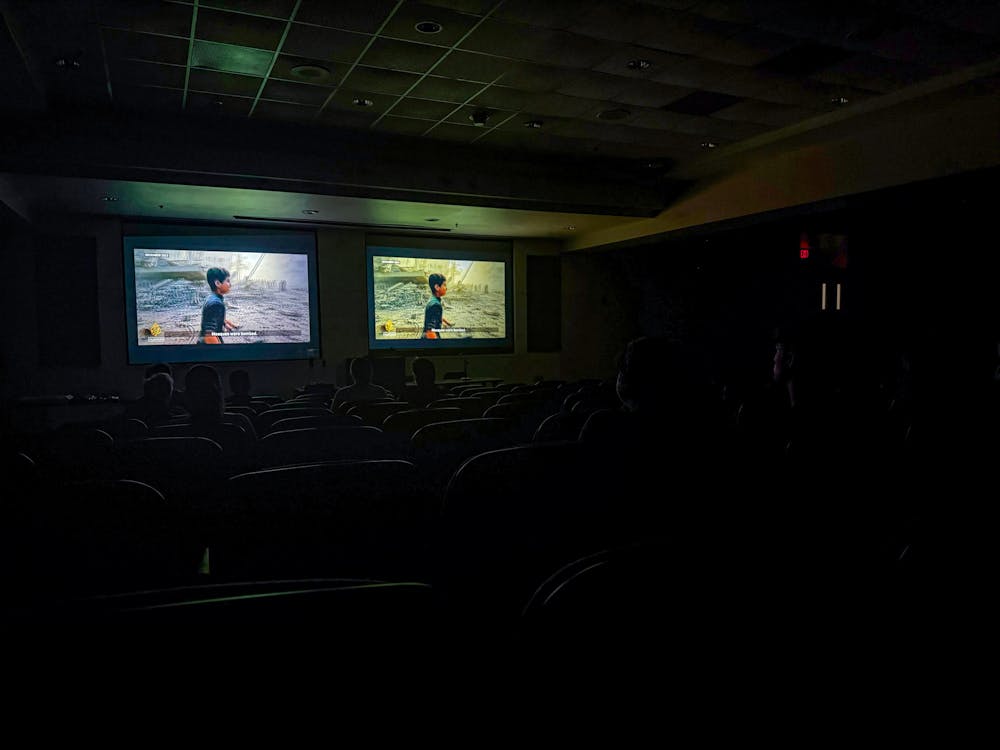
Following screenings of “Kids Under Fire” (2025) and “The Disappearance of Dr Abu Safiya” (2025), attendees fell quiet for a moment of silence at an event hosted on March 31 by AU Faculty and Staff Justice in Palestine. The moment honored the lives lost in Gaza during the Israel-Hamas war and in the wider Middle East.
Executive Producer Laila Al-Arian and Senior Executive Producer Josh Rushing, who worked on the Al Jazeera documentary series, Fault Lines, answered attendees’ questions about these selections from the series and their experiences reporting on the Israel-Hamas war.
John Willoughby, an American University economics professor and a member of AUFSJP, said he hoped the event would make people more empathetic and angry with the U.S.’s funding of the war.
“Kids Under Fire” features 20 American doctors who volunteered across Gaza, highlighting stories from Palestinian children shot by the Israeli army. A 4-year-old, Mira, was shot in the head by Israeli armed drones and remains in Gaza, although she cannot receive the surgeries she needs there due to Gaza’s limited health infrastructure.
“The Disappearance of Dr Abu Safiya” explores conditions at the Kamal Adwan Hospital, under the Director and Pediatrician Hussam Abu Safiya. Kamal Adwan Hospital was the last functioning hospital in North Gaza and remained under siege from the Israeli military for nearly three months.
Abu Safiya led the hospital even after the Israeli military threatened his life and killed his son during a strike on the hospital while under siege. He filmed the hospital every morning to show the world the atrocities that have become a part of daily life at Kamal Adwan Hospital.
“They killed my son because we deliver a humanitarian message,” Abu Safiya said in the documentary.
Palestinian citizen journalists like Abu Safiya have become more important because international journalists are not allowed in Gaza and on-the-ground reporters are disproportionately killed by the Israeli military, according to the Committee to Protect Journalists. Al Jazeera reported that over 270 journalists have been killed by the Israeli military in Gaza since the war began.


On Dec. 27, 2024, Israeli forces stormed Kamal Adwan Hospital, detaining 240 staff members and patients and arresting Abu Safiya under Israel’s “Unlawful Combatants Law,” with no charges or release date set. He remains in Israeli detention, and on March 24, United Nations experts released a statement calling for his immediate release, saying he suffered severe torture, and his health condition is dire.
About those in Gaza reporting on their realities, “I’ve never seen a people who’ve been so betrayed and demonized by the media believe in it so much,” Al-Arian said.
Willoughby said it is crucial not to suppress these perspectives, especially considering American University’s Students for Justice in Palestine organization received multiple suspensions for what he described as illegitimate reasons.
“I think that’s a shame. That’s not what AU should stand for,” Willoughby said,
Willoughby said AUFSJP formed, in part, because of this lack of student representation.
“The AU administration is not an even-handed player in this, and so we thought there was a need for some sort of counterweight,” Willoughby said.
At the event, Rushing and Al-Arian discussed the many challenges they faced while reporting on the Israel-Hamas war, not only because international journalists are not allowed in Gaza, but also because some doctors are blacklisted from returning to the region.
Doctor Mimi Syedm, when returning for her third trip to Gaza, was denied entrance by Israel presumably because she spoke to the media, Rushing said.
“They basically banned any doctors who have any connection, any Palestinian heritage as well. Very few doctors are now able to go in,” Al-Arian said.
Al-Arian also offered some recent updates from Gaza, based on her correspondence with Palestinian reporter Ashraf Al-Masharawi, whom she spoke to last month.
“He said there’s no real, meaningful ceasefire, they just took out the mass from mass killing,” Al-Arian said.
According to Al-Arian, Al-Masharawi added that many are especially fearful of Israel’s reliance on Palestinian militias, because their own neighbors or friends could be working with them.
“He just said people are very frightened,” Al-Arian said. “People are still looking for their missing loved ones.”
Al-Arian described how challenging conditions remain, especially as Palestinians see the outside world pull back, with fewer protests and pressure to hold Israel accountable.
“Do I really have freedom of speech? Are universities really protected? Are the students protected? And the answer here is no,” Rushing said. “You can talk about anything except for Palestine, and that’s all I want to talk about when I come to these places.”
This article was edited by Natalie Hausmann, Payton Anderson and Walker Whalen. Copy editing done by Avery Grossman, Paige Caron, Mattie Lupo and Ava Stuzin. Fact-checking done by Andrew Kummeth.
