
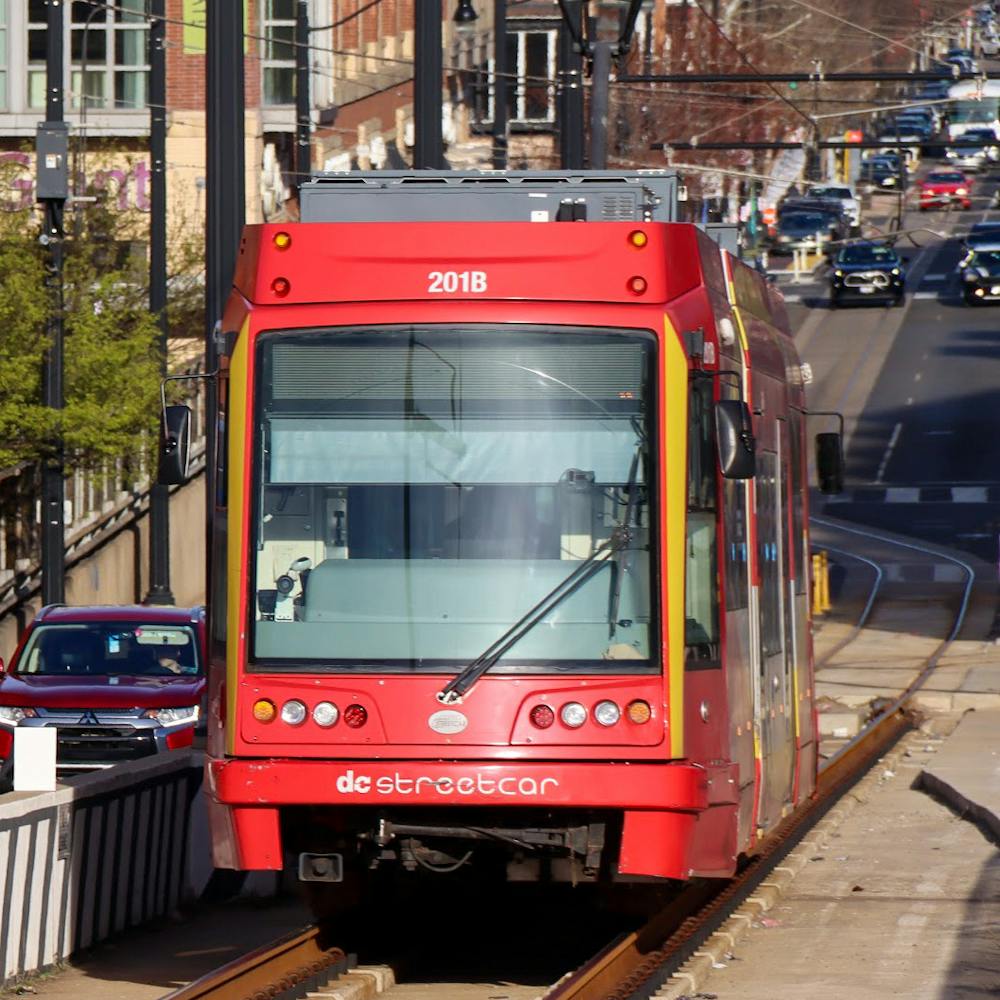
The sun shone brightly on the last Monday in March while Stephanie Kellogg sat on a bench at the corner of H Street NE and 4th Street NE. She was waiting to catch a ride on the D.C. Streetcar to Union Station.
Kellogg is a social services worker who commutes to her job at the H Street Corridor from her home in Virginia. She described the streetcar as an ideal mode of transportation for when she was tired on days like a hot Monday in early spring.
“If I feel like walking, I’ll walk up to Union Station,” Kellogg said. “If I’m tired like I am now and I don’t want to pay for the bus, I’ll take the trolley.”
The D.C. Streetcar was a light rail service that ran from Union Station to just short of the Anacostia River along the entire length of the H Street Corridor. Kellogg is one of many H Street frequenters The Eagle spoke to who lost their preferred means of transportation when it ceased operations on March 31 after ten years of service.
Seated to Kellogg’s left on the platform bench was Russell Sveda, an H Street resident who is visually impaired in one eye, holding bags of groceries. The streetcar was an accessible way for him to run errands.
“I could get on the trolley and off the trolley very easily with my little rolling device,” Sveda said, referring to a mobility device he uses to navigate.
Sveda said the buses operating on the corridor won’t be nearly as easy to find because they do not stop in visually identifiable locations.
Brenda Wilson said she rode the streetcar two to three times a week to and from the Benning Road and 15th Street stop, where she would connect to a bus to take her home. She will now need to walk more.


“I might walk five blocks to H Street, which is where most of the restaurants, the places that I do go to from time to time, are located,” Wilson said. “And that’ll mean it’s like 10 or 15 blocks to get to those places that I won’t normally walk to.”
The service on the streetcar was unique in that there was no fare charge. The District Department of Transportation has instead encouraged displaced streetcar riders to utilize Washington Metropolitan Area Transit Authority’s bus services, such as the D20 route, which collects fares.
Wilson expressed concern about how those who’ve relied on the streetcar will navigate paying these fares.
“I notice these little old women use this trolley to get to Giant and Aldi,” Wilson said. “And I wonder what they’re going to do, because the cost of transportation is going to be a problem.”
Kellogg offered a probable solution — because people aren’t going to be able to pay for bus services, they will instead practice fare evasion.
Monique Williams and Savanna Young boarded the streetcar at the Benning Road and 15th Street stop. Young had ridden the service before, while Williams was riding for the first time. But neither were impressed.
Young recalled attempting to stop the development of the streetcar while working with D.C. Jobs for Justice, a non-profit that advocates for workers’ rights.
“We were like, it’s unnecessary because look at all the traffic it caused,” Young said. “It really [has] no point.”
Williams and Young recalled witnessing many cars get towed for parking slightly over the white parking lane line, which was narrowly parallel to the streetcar tracks.
The streetcar ultimately took up too much road space, they argued.
“The trolley cannot go around,” Williams said. “They cannot back up. It cannot reverse, cannot go around your car. It has to stop.”
Sveda said that free public transport, like the D.C. Streetcar, can be strongly beneficial to a community and prevent traffic congestion by making cars unnecessary.
“People who are not dumb realize, wait, I’m following a trolley through Stockholm — why don’t I just park the car, get on the trolley, which is free? And there would be less congestion and traffic,” Sveda said. “There was.”
This article was edited by Gabrielle McNamee, Payton Anderson and Walker Whalen. Copy editing done by Avery Grossman, Mattie Lupo and Ava Stuzin. Fact-checking done by Andrew Kummeth.
