
The following piece is an opinion and does not reflect the views of The Eagle and its staff. All opinions are edited for grammar, style and argument structure and fact-checked, but the opinions are the writer’s own.
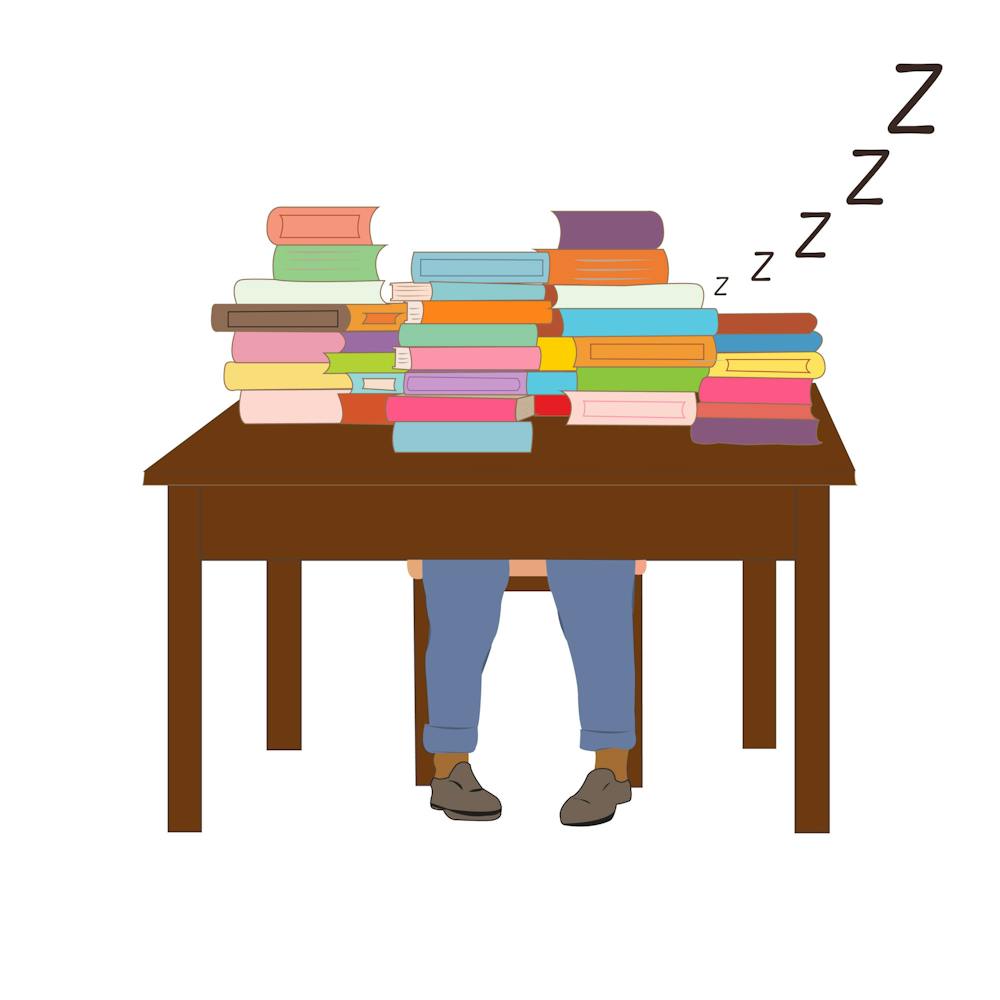
We are seeing a crisis in higher education.
We could point fingers at an over-reliance on our cellphones or the growing monster of generative AI. We can blame students for skipping class, or we can blame teachers for failing to engage students. It would be most productive, however, to look to the American K-12 education system for failing to adequately prepare students for higher education. There is an undeniably poor allocation of funds and resources around student-centered growth.
Unfortunately, as students, there are few things we can do about this during our four years in undergrad. But regardless of our scope of influence, it is imperative to our development that we reject the mindset of prioritizing efficiency over intellect.
Students are no longer expected to excel. A college degree, which used to represent mastery in one’s field, now represents mere relative competence. The diploma received after four years in undergrad is no longer a testament to late nights of research, hardened work ethic and excellence: it is a mere baseline for employment.
Grades have also significantly decreased in value. An A stands for excellent, per our University and others’ grading standards. Nationwide, however, overall student GPA in public and non-profit universities has increased 21.5 percent from the years 1990-2020. This would be great if it were due to a stunning increase in academic performance — but it’s not. It is the result of lower expectations and a decrease in academic rigor, and weaker foundations to build upon.
A mix of students gravitating towards less rigorous courses and teachers responding to demands for high marks, has led to an A representing proficiency, and at times, mere basic understanding of a concept or skill. We see this on sites such as ratemyprofessors.com, where professors get bad reviews for assigning too many readings or being a tough grader.
Higher education is meant to challenge young adults — giving them the advanced writing, research and communication skills necessary to broadly excel in the workforce. So why have expectations in college dropped so drastically?


I began questioning this when I took a comparative politics class the first semester of my sophomore year. This course was nothing short of eye-opening. It was the most difficult class I had taken at the University. It was also the most rewarding.
I was pushed outside of my comfort zone, and was required to understand concepts at a remarkably high level in order to succeed. I worked closely with academic articles that were more complex than any material I had ever studied. In a single semester, my comfortability with dense material and my ability to narrow down arguments improved exponentially.
This class and the professor’s high standards equipped me with tools to succeed in any class — tools that, up until that point, had not been provided to me.
This is not a critique on professors, but rather commentary on what is expected of us as college students and what we expect from ourselves.
The ever-growing presence of AI in academia has only made it easier to reward efficiency over disciplined analysis. Having a software that can spit out a superficial essay in seconds has empowered students to not hold themselves to a high standard in academic pursuits, easily conflating a generative AI summary with true understanding.
However, it is difficult to solely blame AI or student laziness. We must continue to sound the alarm on the academic backsliding that has taken place following the pandemic. Students deprived of a comprehensive curriculum in high school are likely to fill gaps in their knowledge with quick blurbs from ChatGPT rather than spend significant time outside of class having to learn complex concepts on their own.
This is especially true when students are outside their academic comfort zones. A political science student required to take a chemistry class may feel that having a solid understanding of the lessons at hand is unnecessary — leading them to feel even less motivated to add to their workload. Yet, the ability to take on challenges that may not serve a primary interest is a skill that serves both you and your resume.
By the time I graduate, it is improbable that the American education system will be reformed. The presence of AI will only have grown, and the job market will only require more experience with software that can complete a task in seconds. However, as students, we cannot lose our ability to engage with long-form works and think critically about the subjects at hand.
We should not expect college level courses to be easy — the point of higher education is in the name. We are meant to excel and heighten our understanding and abilities, and our professors are here to facilitate that growth. Professors must feel emboldened to require more from their students, and students must feel compelled to take on these challenges with determination.
Ava DiGiacomo is a Sophomore in the School of Public Affairs and a columnist for the Eagle.
This article was edited by Harry Walton, Addie DiPaolo, and Walker Whalen. Copy editing done by Avery Grossman, Arin Burrell, Paige Caron and Nicole Kariuki. Fact-checking done by Andrew Kummeth.
