
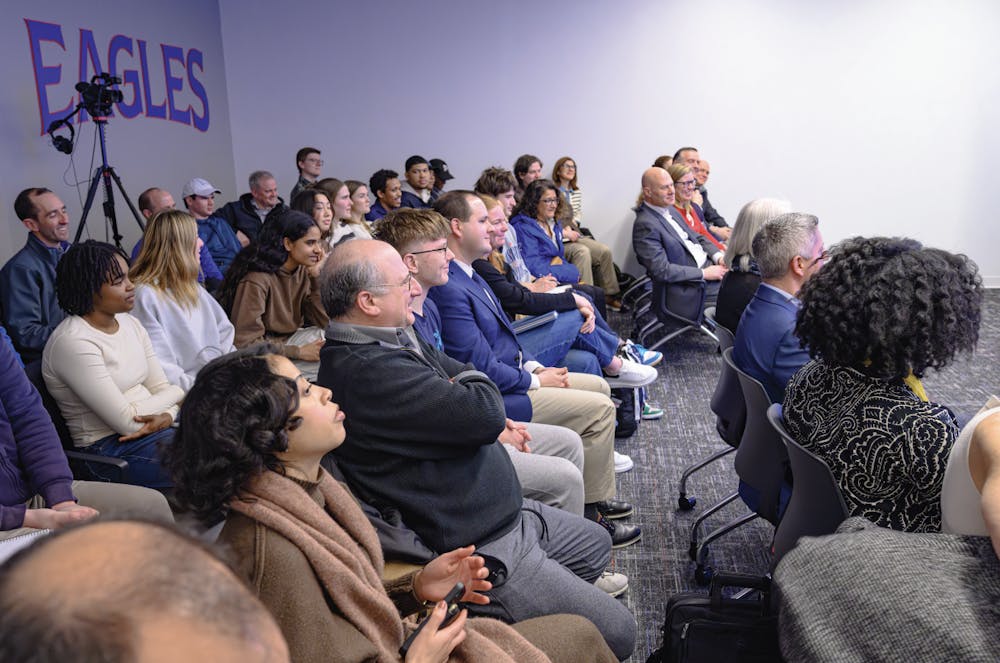
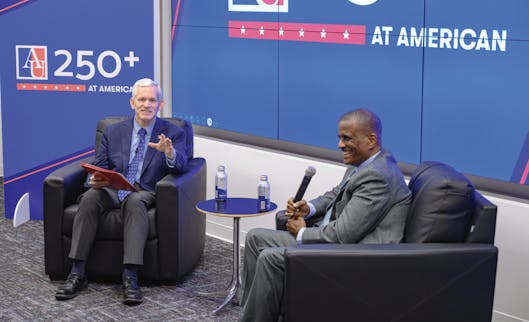
American University is celebrating the 250th anniversary of the United States with its “250+ at American” conversation series. On Feb. 24, President Jonathan Alger sat down with University alum and The Athletic senior columnist David Aldridge.
Aldridge is a Curt Gowdy Media Award recipient and NBA2K’s sideline reporter, who spoke at length about his experience at American University and how it led to a long-lasting career in sports journalism.
Aldridge grew up in the heart of Washington, D.C., and like many who grew up in the nation's capital, he grew up an avid reader of the Washington Post. He was 9 years old when the Watergate scandal broke, and despite not being old enough to understand it, he described it as being life-altering.
“I didn’t know all the details,” Aldridge said. “But I knew it was important. It was always on the front page.”
He saw the consequences of such a monumental event play out in front of his eyes with Nixon’s resignation. He said he remembered thinking that those journalists must have been really important.
The lesson stayed with him throughout his youth, and when a teacher praised his writing skills and encouraged him to pursue a career in journalism, that’s exactly what he did.
Aldridge joined American University and enrolled in a double major in history and print journalism. A professor there encouraged him to run for editor-in-chief at The Eagle.
“When someone you respect tells you you’re ready, you run through walls for them,” he said.



Journalism is a career where talent often isn’t enough. Aldridge described one of the proudest moments of his career as one where he was rewarded for his hard work rather than his talent.
He told a story of sitting alone in an NFL press room around 11 p.m., making his last call of the night when he saw an executive walking past. The executive decided to give Aldridge the information that he was looking for. When Aldridge asked why, the executive told him he worked harder than everyone else in the room.
“It was the best compliment I ever got,” Aldridge said.
In a city deeply divided and defined by the hustle and bustle of politics, sports are a unifier.
During the Washington Commanders’, formerly named Washington Redskins, championship run in the 1980s, the entire city got behind the team. At the Kennedy Center's Christmas concert, the biggest cheer of the night came when the orchestra played the team’s fight song, showing how, through sports, the city could be united.
Another point Aldridge made was that sports now offer something that is increasingly rare: certainty.
“Facts are being attacked every day,” explains Aldridge. “But I can tell you beyond a doubt who runs the fastest 100 metres.”
If sports offer certainty, today’s journalism operates in much murkier conditions.
“Journalism is the first occupation mentioned in the First Amendment,” Aldridge reminded the audience. “That shows just how important it is.”
However, legacy media newsrooms are shrinking, with entire sports sections being hollowed out. The institutions that used to back journalists for big stories like Watergate are now under political and financial strain.
“Who’s going to back the next generation when they go after the truth?” Aldridge asked the audience.
He alluded to two defining moments at The Washington Post, where he once worked, the decision to publish the Pentagon papers and the decision to pursue Watergate.
Both times, leaders decided to take a risk and say yes. The policy Aldirdge learned under was to find out the truth, and in return he’d be backed by his superiors no matter what.
That policy, he argues, is what gives journalism its spine.
He still remains cautiously optimistic, as legacy newsrooms shrink, a new opportunity rises to fill the void. That is, of course, the supercomputer we all carry around in our pockets.
“You can do anything with those phones,” Aldridge said. “That’s power.”
He said the challenge isn’t the tools for storytelling, but the importance of backing and empowering young people to become the next generation of storytellers.
As the evening drew to a close, Aldridge reflected on the true significance of 250 years in a democratic America. Aldridge picked apart the most familiar song to all Americans, “The Star Spangled Banner.”
“The last line of the anthem is a question, not a statement. It doesn’t mean the country is perfect,” he said. “But it means we’re still moving forward, trying to get better. It means we are not going backwards.”
This article was edited by Connor Sturniolo, Matthias Jaylen Sandoval, Jack Stashower and Walker Whalen. Copy editing done by Avery Grossman, Arin Burrell, Mattie Lupo and Ryan Sieve.
