
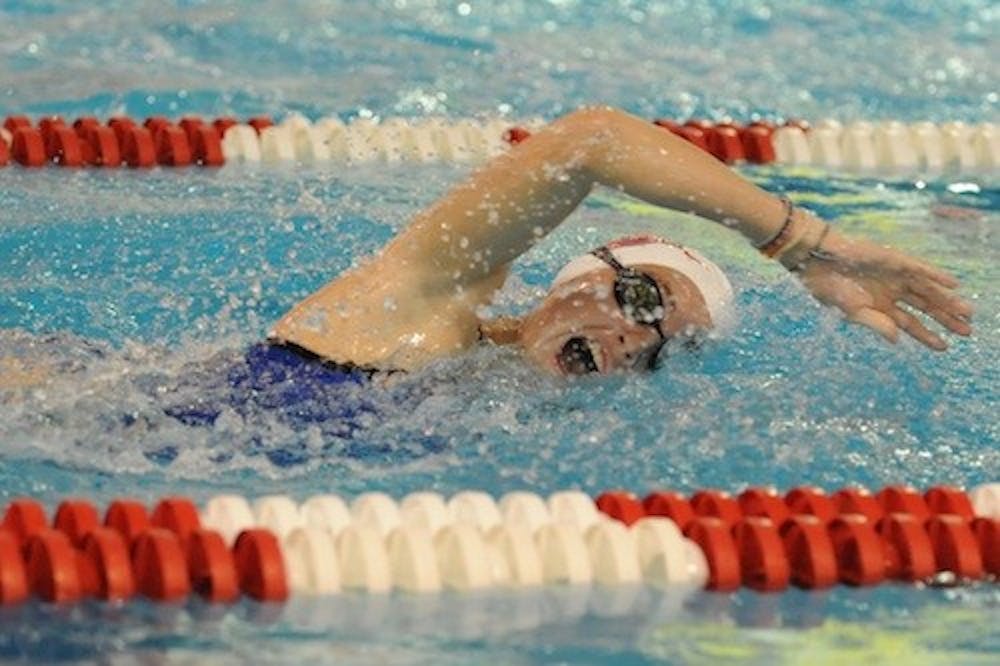
It’s 6:15 a.m. While most students are sleeping, including me, American University swimmers are already in the pool, and they will be for at least three more hours that day. That makes for a busy week, every week, for these athletes.
“It’s a lot of time,” American head swim and dive coach Garland Bartlett said. “It shows just how dedicated they are to the team and the sport.”
A swimmer at American University will swim anywhere from 3,500 to 4,000 yards per practice — and that’s just for the sprinters. For long-distance swimmers, upwards of 7,000 yards can be swam each practice.
These are not insignificant numbers, and they can take a toll on swimmers as they compete and fulfill their role as students.
Swimming is a sport that gets overlooked by a lot of people, including myself. However, from youth programs to the Olympics, swimming is much more than a simple exercise.
What gets underappreciated and underestimated the most, perhaps, is the process that goes into being an elite swimmer. The amount of time spent in the pool and the weight room in preparation for competition is remarkable.
AU swimmers begin practice with a 6:15-8 a.m. workout in the pool three days a week. They have daily practice from 2:30-4:30 p.m. and Saturday morning practices.


Outside of time management skills that student-athletes are forced to build because of their sport, they also have to deal with the physical toll. Extreme hours in the pool cause many problems for athletes, like fatigue and skin issues due to pool contents such as chlorine and certain acids.
“The dry skin, especially now in the winter, it’s a very real thing,” sophomore swimmer Charlie St. Louis said. “It’s just another layer of — I don’t want to say crappiness — but it’s just another thing that kind of stinks.”
This was not a surprise to hear, because even when I go swimming for one week during the summer, my skin dries up. Imagine doing it multiple times a day or week.
Aside from the physical toll, swimming is also a very mental sport. Despite their training, swimmers can become fatigued and feel like they cannot make it through. This is where the coaching staff comes in.
“I think it’s really important to create a positive environment on deck, from all the coaching staff,” Bartlett said. “We just try to make practices very positive, high energy.”
What truly shows how great the coaching staff handles these situations is the athletes themselves, who find themselves thankful for the support they have around them.
“Coach Matt [McKenney] is really good at rallying us and getting us to the end of the set, even when we start to hurt,” sophomore swimmer Luke Martens said. “The coach can see it, and they’re really good at that.”
The coaching staff is important, but the swimmers themselves also play a role in supporting each other. This is important for any team, no matter the sport, because when you have teammates by your side cheering you on, it makes the finish line seem much closer.
“There’s always somebody in the pool who’s got a good smile that you can turn to when you are feeling negative,” sophomore swimmer Piper Crosby said.
One thing that surprised me when talking to these athletes was the difference in their workloads from high school versus college. I expected them to be relatively similar, but there are different aspects of the sport that change as you get more advanced.
One AU swimmer, sophomore Hailey Rees, who is from The Woodlands, Texas, told me that high school swimming is very serious down there. Yet, she still appreciates what being on a collegiate team does for her.
“Here, the practices are a lot more curtailed to my distance swimming specifically,” Rees said. “I know [what] I’m working on and working towards, and it just feels a lot more detail-oriented.”
The same sentiment was shared by other swimmers.
“Now in college, it’s definitely a lot more race relevant than it was in high school,” St. Louis said.
It is hard to articulate a comparison between swimming and other sports. I think it is so different in the way they train versus how any other sport trains.
Swimming athletes and their coaches seem to agree that it would be difficult for an athlete from another sport to train for swimming.
“Even if you spend a couple days out of the water, it’s just crazy how long it takes to get back into it,” Bartlett said. “One day off, it’s like a week in another sport.”
The hours and work that go into being a good swimmer are unmatched. It is truly impressive and shows the grit that these athletes have to continue going to practices so early in the morning and for so many more hours during the day.
This article was edited by Matthias Jaylen Sandoval, Jack Stashower and Walker Whalen. Copy editing done by Avery Grossman, Mattie Lupo and Nicole Kariuki.
