

When Erek Williams, a freshman in the School of International Service, ran for president of the Residence Hall Association, he thought he could distinguish himself from the competition by creating an on-campus parody of President Donald Trump’s outspoken campaign.
That all changed the day his roommate showed him a social media post. An anonymous student had written, “That Erek weird as F—.”
The platform housing the anonymous comments made about Williams was YikYak, an app primarily targeted toward and used by college students.
YikYak allows unlimited anonymous communication between students with no way to identify posters or commenters. It also includes group chats, a trending tab, a popularity measurement system called Yakarma and the capability for users to upvote or downvote a post.
Williams said he was less affected by the targeted post, but worried about how others might react if something similar happened to them. He said YikYak’s promotion of anonymous online trolling could have serious effects on student mental health.
“If you’re just out there hurling insults and somebody harms themselves … that’s gonna be on your conscience for the rest of your life,” Williams said.
YikYak’s community guidelines prohibit users from naming students but doesn’t immediately ban these posts. Often, the posts stay on the platform for hours before being taken down.



Consequently, some students have found themselves weighing whether the platform is truly safe.
“It can be a good thing,” Illa Benson, a senior in the School of Public Affairs, said. “It can also be a tool that can cause a lot of harm. There’s no real consequences to your actions and you don’t need to back up what you’re saying.”
Holland Swan, a freshman in SIS, said she noticed the platform’s anonymity allows for antagonism to spread more easily.
“The majority of stuff I read on there is people sniping back at one another — which is totally fair, because it’s anonymous,” Swan said. “But I think it also creates a space that’s a little bit unsteady.”
Zoe Likely, a freshman in the College of Arts and Sciences, said YikYak would not be as popular an app if users could be identified.
“I think if it wasn’t anonymous, no one would post on it,” Likely said.
Ali Azhar, a freshman in CAS, thinks the anonymity of YikYak allows ample discourse to fester.
“It encourages people to talk more and give more news out,” Azhar said.
When a user signs into YikYak with their AU email address, they are given access to a feed available only among their fellow students.
This allows for discussion of niche topics specific to AU. When it was revealed that SIS professor Earl Anthony Wayne was mentioned in the Epstein files, many students said they learned about it through YikYak.
“He’s not famous, so I wouldn’t find it out from the internet,” Azhar said. “I found out from YikYak, because it’s specifically towards American University.”
Students have also found it to be a capable platform for building community on campus.
During freshman orientation in August, a group of friends took to Instagram to promote a performative male contest — a satirical competition mocking men who performatively adopt certain aesthetics to attract women.
The flyer found its way to YikYak. The contest’s moderator and one of its organizers was Lily Erfani, a freshman in CAS. She recalled being surprised by the attention the event garnered after it was promoted on YikYak.
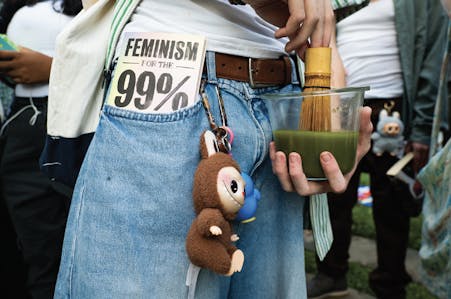
“We thought there’d be twenty people, but there were like, three hundred,” Erfani said.
Erfani said that for days after the contest, YikYak was still flooded with audience input. Attendees talked about their favorite outfits and complimented the contestants, judges and her job as host.
“I saw so many people say the host was so good,” Efrani said. “I was really flattered.”
Dylan Sapienza, a freshman in SPA, recalled that this time was a period of bonding for the freshman class.
“The first week when everyone moved in, everyone was kind of relating to each other,” Sapienza said. “It was a shared experience between all the freshmen.”
The anonymity of the app makes it easy for posters and commenters to hide. But for some, like Erfani, it is a valuable resource that enhances the University’s campus culture and keeps them up to date.
“Even though your name isn’t with it, I think it’s actually kind of refreshing because it detaches who you are with what you have to say,” Erfani said. “People are just upvoting or downvoting based on your thoughts, opinions and what you’ve written. It becomes a thing separate from your physical or public identity.”
This article was edited by Madeleine Olive Redd, Payton Anderson and Walker Whalen. Copy editing done by Avery Grossman, Mattie Lupo, Ava Stuzin and Jaden Maitland Anderson. Fact-checking done by Luca Palma Poth.
features@theeagleonline.com
