
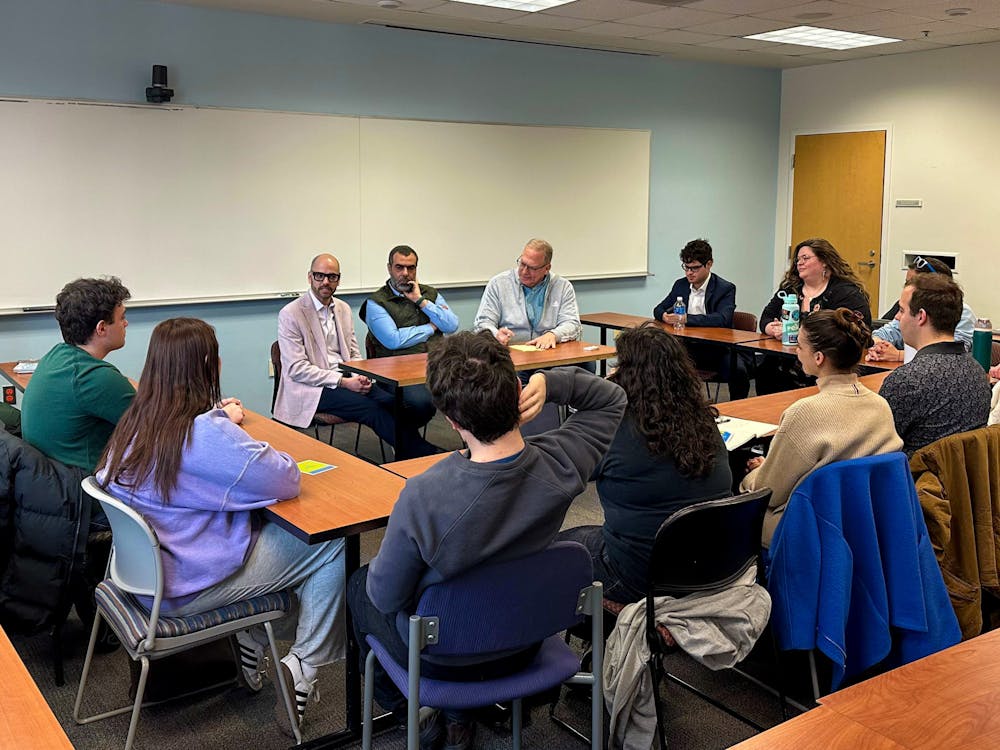
The Peaceworks Foundation’s Emerging Leaders program hosted a masterclass at American University on Feb. 11, encouraging students to engage in constructive dialogue and long-term conflict resolution surrounding the Israeli-Palestinian conflict.
Peaceworks Foundation is a nonprofit organization that advocates for a two-state solution that “respects the security and rights of both Israelis and Palestinians,” by bringing Israeli and Palestinian voices together. Its Peaceworks on Campus program brings pairs of Israeli and Palestinian scholars to college campuses across the United States to model dialogue across conflicts and discuss paths toward ending violence in the region.
This masterclass brought together Jaser Abu Mousa, a Palestinian 2025 Yale Peace Fellow focused on Gaza’s postwar reconstruction, and Kobi Skolnick, an Israeli peacebuilder and the director of leadership development at the Center for World Religions, Diplomacy and Conflict Resolution at George Mason University.
“I think we are introducing a very unique example,” Mousa said. “Given our backgrounds, given our stories… and still we found a way to communicate with each other.”
Mousa was previously a program officer for the Swiss Agency for Development and Cooperation in Gaza. After an Israeli airstrike hit his home following the Oct. 7 attacks, killing his wife and two of his children, Mousa and his two surviving children left Gaza for the United Arab Emirates. After a year of medical treatment, they came to the U.S. Skolnick grew up in southern Israel, surrounded by extreme Zionist ideology that encouraged violence against Palestinians. He described his younger self as full of hate. Before leaving Israel after the Second Intifada, he worked with the United Nations Children’s Fund and other UN agencies to support humanitarian efforts for children in Gaza.
Now, the two travel together to campuses across the country to lead masterclasses and discussions among potential future policymakers.
“We’re doing this to model a different kind of Israeli-Palestinian dynamic,” Jonathan Kessler, director of the Emerging Leaders Program, said.
According to Kessler, Peaceworks’ goal is to equip future diplomats and policymakers with a solutions-driven understanding of Israel and Palestine that goes beyond binary thinking by beginning with open dialogue between Israelis and Palestinians.

“If you actually look back at every social change, every transformation goes back to a conversation between two or three people,” Skolnick said.
The program encourages students to see dialogue as a starting point rather than an endpoint.
Kessler referenced Julia Lever, a student at Columbia University who was inspired by a Peaceworks dialogue and is now working with them to talk to young girls in Israel and Palestine about women’s healthcare and potential improvements.
“Dialogue should be the baseline, not the objective,” he said.
The Peaceworks Foundation’s Emerging Leaders Council, launched by Kessler in April 2025, allows students who engage with Peaceworks programs on campus to continue their involvement at a higher level. Amishai Goodman-Goldstein, a graduate student in the School of Public Affairs, helped structure the program as the Inaugural National Chair.
Goodman-Goldstein described Peaceworks as an organization dedicated to a “pragmatic approach to Middle East peace [that] tries to break binaries while still acknowledging power asymmetries.”
Panelists also addressed what they described as increasing polarization on U.S. college campuses since the war began. Kessler said that the public discourse quickly framed pro-Palestine and pro-Israel as zero-sum. As a result, Kessler said pro-Israel often became anti-Palestinian, and pro-Palestine was often anti-Israeli.
“The polarization, it keeps you engaged until [the] dust settles,” Mousa said. “[And] you feel you don’t need to be there. Despite the fact that the situation in Gaza is now brutal.”
UNICEF reports that around 13,500-17,500 children in Gaza have severe limb injuries that require major rehabilitation and the Gaza Strip has the highest number of child amputees per capita in the world.
Mousa said that support for the people of Gaza has ceased at a time when they need it most — the war ended but the conflict has not settled or resolved. He also said there’s a gap between American policymakers and what’s happening on the ground.
Peaceworks hopes to bridge that gap by connecting with a new generation of policymakers early in their careers.
“The future is here,” Skolnick said. “We define it with our hands, with our minds, with our conversations.”
This article was edited by Natalie Hausmann, Payton Anderson and Walker Whalen. Copy editing by Avery Grossman, Ryan Sieve and Ava Stuzin. Fact-checking done by Andrew Kummeth.
