
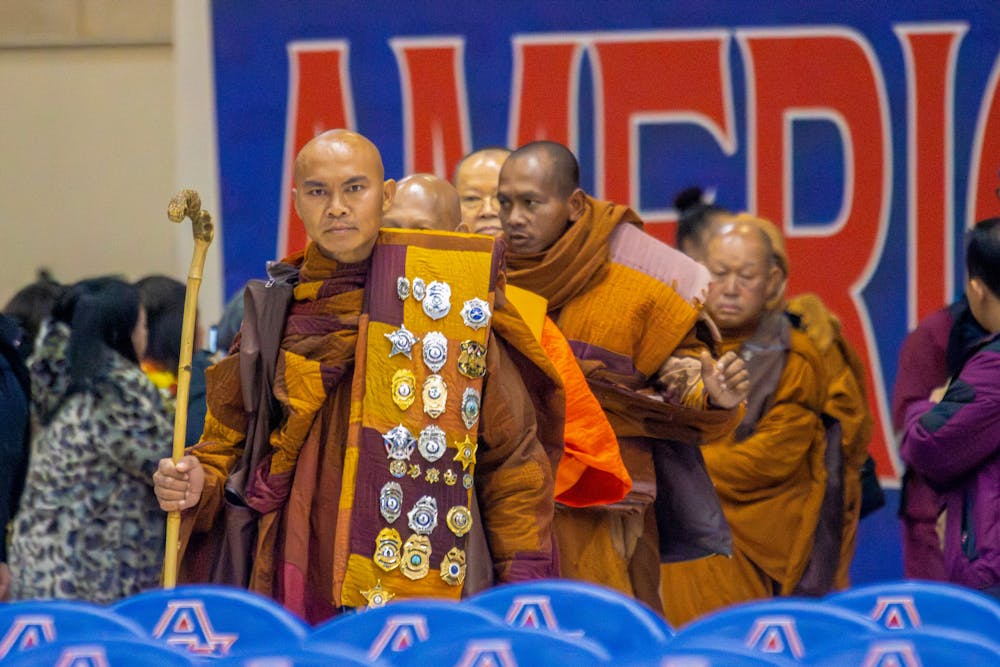
Nearly two dozen Buddhist monks arrived at American University on Tuesday morning, Feb. 10, marking one of the final stops of their months-long pilgrimage.
According to Venerable Bhikkhu Pannakara, who led the group, the Walk for Peace is rooted in the belief that peace begins within oneself and is the first step toward broader change. The 2,300-mile walk manifests the monks’ message of urgency in prioritizing mindfulness daily.
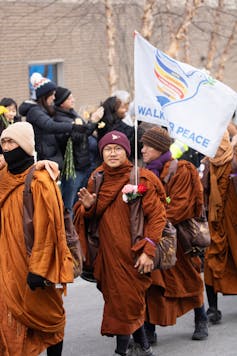
The monks began their journey on Oct. 16, 2025, at the Hương Đạo Vipassana Bhavana Center in Fort Worth, Texas, and returned on Feb. 14 after 108 days of walking. They traveled east through Louisiana, Mississippi, Alabama and Georgia before heading north through South Carolina, North Carolina and Virginia, finally stopping in Washington, D.C. last week.
In an interview with The Eagle, Pannakara expressed that arriving in D.C. brought mixed emotions as it marked the near-end of their long journey.
“Seeing people coming out to greet us on this journey makes me happy — that makes my day,” Pannakara said. “But at the same time I feel sad, because people really deeply suffer. That’s why a lot of people are coming out to support this mission.”
Pannakara said that having support along the route has reinforced his belief that their mission is always ongoing.
“There’s a lot more things to do,” Pannakara said. “That is the reason why I always encourage people to walk together with us in spirit. Together we can change this world.”

The monks gathered in Bender Arena, where they were welcomed by University President Jonathan Alger, who presented them with a khata, a yellow silk ceremonial scarf traditionally offered as a sign of purity, goodwill and compassion. A small plaque was also gifted to them on behalf of the D.C. Buddhist communities.
Bhante Katugastota, a Theravada Buddhist monk and Vipassana meditation teacher who is the Buddhist chaplain at the University, introduced the monks and invited students and community members to join his Thursday meditation classes at the Kay Spiritual Life Center.

Prior to the University announcing that the monks would be passing through campus, Payson Dillon, a sophomore studying in the School of International Service, said she was planning to see them walk through Virginia.
“Being able to experience this moment meant being able to witness a crucial part of our history,” Dillon said. “As the U.S.’s political climate becomes more hostile, it’s so important to promote unity and coming together, protecting those in our communities and using peace as a tool of power.”
Pannakara also gave students and those in attendance advice on managing stress and prioritizing inner peace, describing mindfulness as a practice rooted in attention to the present moment through the breath.
“Mindfulness is something that we have to live with — every second, every breath,” Pannakara said. “Otherwise, stress, anxiety and depression will always be there with us.”
Pannakara told students that many people struggle to stay present because of distractions and multitasking.
“Thinking about the past, living with the future — those are thoughts,” he said. “Those are not usable. Those are trash. We do not need to live with that.”
He addressed students directly, acknowledging the pressures of schoolwork as well as the benefit of using breathing as a stress management tool. Pannakara spoke about acknowledging thoughts as they arise and returning to the present moment through the breath.
According to Pannakara, mindfulness is a daily practice that requires intentional effort, rather than something to turn to only during moments of stress.
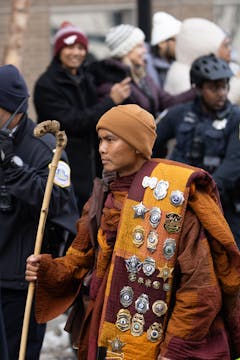
He also tied the practice of mindfulness to the impermanence of life, emphasizing reflection and self-awareness. Starting from within, Pannakara said it’s important to change ourselves for the better because without inner peace, there can be no world peace.
“We could die at any time, any moment,” he said. “Imagine if we die before we can focus on ourself, focus on our breath.”
Pannakara described the Walk for Peace as a message meant to extend beyond the monks’ physical journey, emphasizing shared responsibility in shaping change.
As the monks near the end of their pilgrimage, Pannakara encouraged members of the AU community to continue the journey through daily practice of mindfulness.
“Peace always begins from within, not without,” Pannakara said. “Write down this statement: ‘Today is going to be my peaceful day.’ Live with it, be mindful with it.”
This article was edited by Natalie Hausmann, Payton Anderson and Walker Whalen. Copy editing done by Avery Grossman, Jaden Maitland Anderson and Ava Stuzin.
