
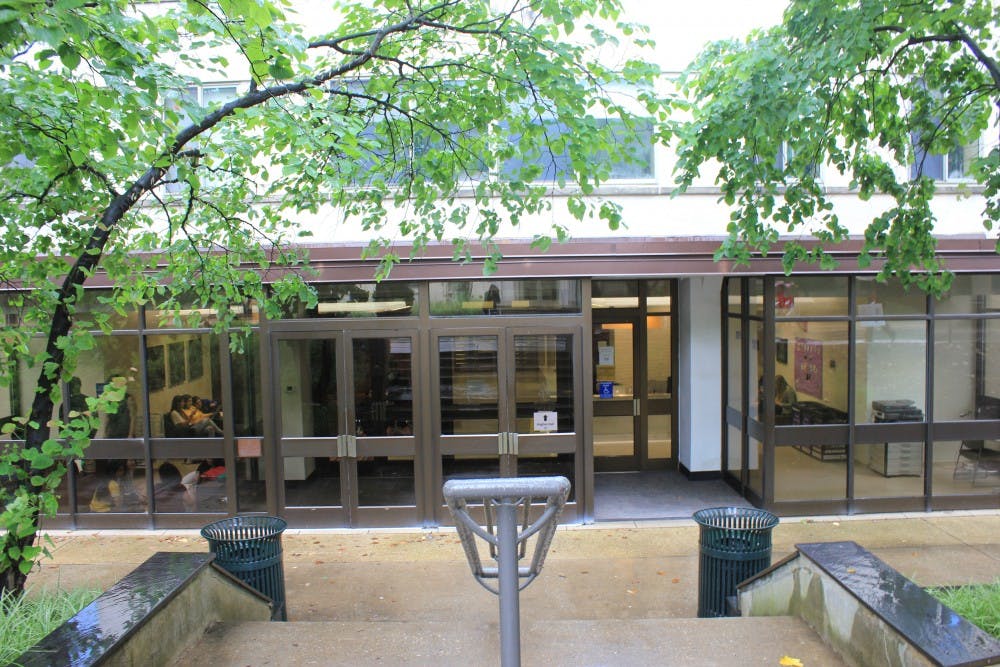
The American University administration’s establishment of a new, on-campus Hillel center ignited polarizing reactions among AU’s Hillel and an anti-Zionist Jewish student group, spotlighting divisions within the campus’ Jewish community.
AU’s Anti-Zionist Jewish Student Front — named Jewish Voices for Peace at the time — posted a critical response to the AU administration on June 23, 2025 for establishing the Trone Family Center for Jewish Life, starkly contrasting with Hillel’s celebratory welcome.
The administration has yet to announce when the Trone Center will open, but said it will be in a non-residential wing of Hughes Hall as part of their recently launched Campaign for the Future of Jewish Life at AU. It established both the center and the campaign to accommodate the recently tripled number of AU students engaged with Hillel, according to the announcement.
The AJSF said this decision is the administration’s way of handing Zionist, Jewish students real-world advantages under the guise of creating an inclusive space for all community members. Their post said that the administration historically and continually silences anti-Zionist Jewish community members and quashes their ability to organize.
“This is a direct attack on and repression of organizing for divestment and Palestinian liberation,” AJSF wrote in their Instagram post.
AU Hillel Executive director Jason Benkendorf said the new center will enhance Jewish students’ on-campus relationship to their religion and community and still be open to all students, regardless of identity.
“We’re excited to create a Jewish space on campus,” Benkendorf said. “A space that is welcoming to all, but where Jewish students in particular can find community and express their identities without reservation.”
School of Public Affairs junior Jason Eagan had a different perspective on the inclusivity of the new space. The Eagle interviewed him on Aug. 15 before AU Jewish Voices for Peace rebranded itself as AJSF. At the time, Eagan was a spokesperson under the group’s former affiliation. He later confirmed that everything he said still holds true for AJSF.


Eagan said he thinks anti-Zionist Jewish students like himself and other identities will not be accepted into this new space.
“I think it’s ironic that [Hillel] boasts that their contributions are extending to the whole AU community regardless of faith or cultural background,” Eagan said. “When in reality, many students are aware that if you are Palestinian, Arab, Muslim, Jewish but you don’t love Israel, that space is not for you.”
Conversely, Benkendorf said Hillel offers programs that they believe align with AU’s community needs and anyone can participate.
“Hillel events are open to all students,” Benkendorf said. “We have students who are deeply involved in our community who have a wide range of relationships with Israel, and that’s never a litmus test for participation in our community.”
Benkendorf elaborated on the role he believes the Trone Center will play for both the Jewish community and all students.
“The establishment of the Trone center offers the opportunity for us to expand our impact, engaging even more students in Jewish learning, community building, service projects, interbelief and intercultural initiatives and so much more,” Benkendorf said.
In their Instagram post, AJSF wrote that the University is biased in which Jewish student groups are allowed to organize, contending that while Hillel is extending its presence on campus, Jewish Voices for Peace — which AJSF was branded as at the time of the post — was denied club status that year and still is.
“This expanded partnership with AU Hillel comes after 2 years of suppressing, silencing, and restricting anti-Zionist Jewish students from organizing on campus,” they wrote.
On top of Eagan’s prediction that anti-Zionist Jews will not be welcome at the Trone Center, he contended that they have been unable to organize their own dedicated spaces because the administration has made it increasingly difficult for organizations who share common goals with AJSF to exist.
“We’ve heard a lot about ‘combating antisemitism,’ but in actuality supporting Jewish students does not mean supporting just Zionist Jewish students ... but actually listening to your students,” Eagan said.
Eagan said that the administration overgeneralizes the Jewish community, insisting each student supports modern-day Israel.
“I think it’s more evident in AU’s administrative actions how they sort of synonymize all Jewish students as being Zionist,” Eagan said.
The Eagle requested comment from the AU administration.
“The center is funded through philanthropic gifts designated specifically for AU Hillel and Jewish life and does not involve a reallocation of general University resources or affect support for other student communities,” Elizabeth Deal, assistant vice president and deputy chief communications officer, said in a statement to The Eagle. “AU Hillel serves Jewish students with a wide range of identities, religious practices, and perspectives, and the Trone Family Center is open to students regardless of their views on political issues. The space is not affiliated with any political ideology.”
In their post, AJSF said that only student groups who follow Hillel International’s partnership guidelines can reserve the formal lounge in Hughes Hall. However, Benkendorf, who was involved in the planning process, denied this claim during his interview with The Eagle.
According to Benkendorf, the center will operate separately from the formal lounge, so they will not have any jurisdiction over who uses it. He added that AU’s Hillel chapter does not follow Hillel International’s guidelines.
“We are proud to be part of the global Hillel movement,” Benkendorf said. “But we independently set our policies and strategies to align with the needs of the AU community.”
He added that AU Hillel will not implement any policies that restrict whom they partner with and have historically worked with groups they substantially disagree with. He believes the new location will become an important place for people with different opinions and identities to engage with each other.
The AJSF post said Hillel will continue to operate in the Kay Spiritual Life Center, but Benkendorf said they will no longer have an office in Kay, adding that they will continue collaborating with the center when hosting events.
Eagan said his next goal is to institute a place on campus for AJSF, and the group hopes AU will collectively shift away from Hillel’s goals and programming.
“As an organization, our goal is to get Hillel off of our campus because we recognize [their] complacency in the Israeli genocide occupation and apartheid in Palestine, but we recognize that that goal is probably very far in the future, so we’re sort of taking these baby steps towards that and prioritizing our University’s divestment from Israel,” Eagan said.
Benkendorf responded to this statement in an interview with The Eagle.
“Calling for the removal of the largest Jewish organization on campus — which supports hundreds of AU students in celebrating Jewish holidays, connecting with Jewish community, and exploring their Jewish identities — is wrong and unfortunate,” Benkendorf said.
This article was edited by Payton Anderson, Neil Lazurus, Abigail Hatting and Walker Whalen. Copy editing done by Sabine Kanter-Hutching, Avery Grossman and Ava Stuzin.
