
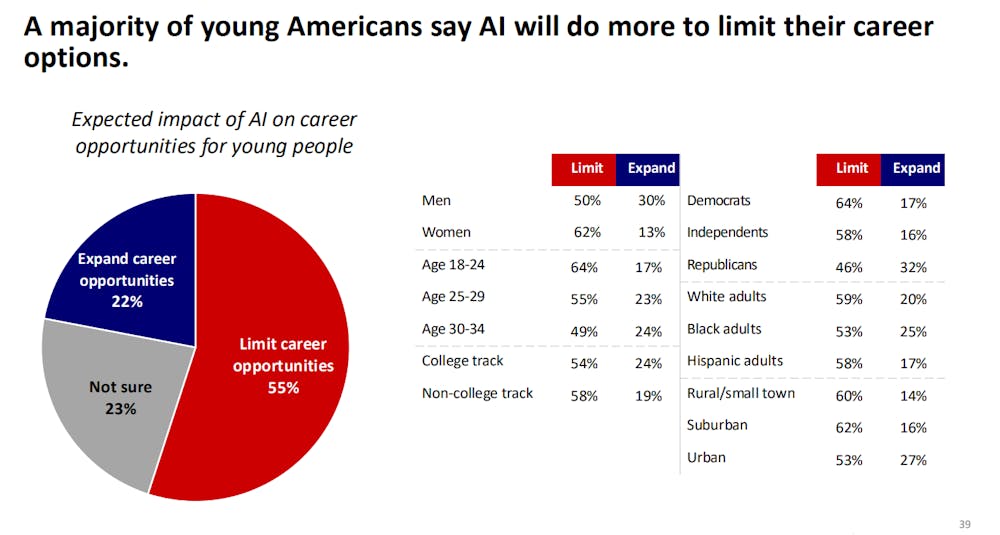
A 2025 Sine Institute Poll found that many young Americans say artificial intelligence will limit their career opportunities, but that AI is necessary to learn in higher education, paving a way for new learning opportunities for American University students.
The 2025 poll was the fourth annual survey designed by the Sine Institute of Policy and Politics at AU in partnership with Future Caucus, Close Up Foundation and the Kogod School of Business. The survey, conducted through over 1,000 interviews by Generation Lab, gauged young Americans’ (ages 18 to 34) perspectives on politics, policy and technology. The interviews were conducted from Sept. 5 to Sept. 13. On Oct. 28, the organization published a press release to announce the survey results.
“The Sine Institute’s latest poll demonstrates that young people value civic education and that they want more of it. It also helps policymakers and institutions to better understand young Americans’ fears, dreams and current struggles as they work to ensure a life of happiness and success,” AU President Jonathan Alger said in the press release.
Molly O’Rourke, senior advisor of the Sine Institute who leads research for the annual polls, said the three previous surveys focused on campaigns and leadership, the American Dream and community engagement.
The 2025 poll had six different categories: higher education, defining higher education’s mission, civil discourse, perspectives on different types of learning, decision-making about higher education and AI. O’Rourke said the Institute chose this focus because it has been “a very important and sensitive time for higher education.”
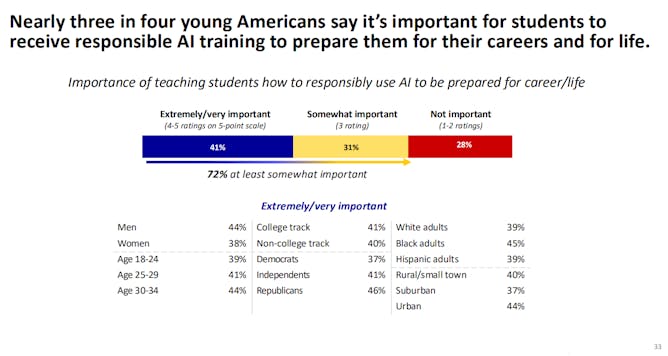
Seventy-eight percent of the interviewees said AI did not get enough attention in high school and 55 percent said it will limit career opportunities, but 72 percent believe AI needs to be taught in school for career readiness. David Marchick, the dean of Kogod, responded to the results of the poll in a video discussing the importance of AI in education.


“This is a call to action for every university and college and at Kogod, we’re meeting the moment with ambition and drive,” Marchick said.
Eleven American University graduate and undergraduate students were part of the advisory board that helped design, formulate questions and provide feedback on the poll.
“[Critical thinking] encourages cooperation on issues that we can find common ground on and allows us to see each other as human and as people on issues that we do disagree on,” Alex Moskovitz, a second-year graduate student in Kogod, said in a video posted on Sine’s website.
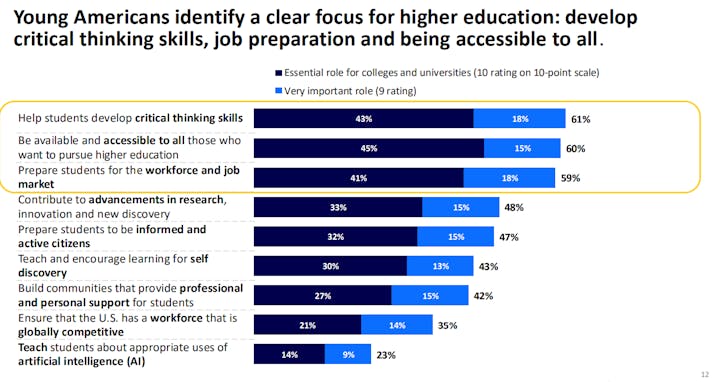
The poll also found that young Americans have multiple ideas of what higher education should focus on: being available to all, developing critical thinking skills and preparing students for the workforce.
O’Rourke said this finding provides a clear direction for higher education and that AU has been responsive to these needs.
“The University is undertaking a strategic plan that I think is wrestling with a lot of these issues, the Kogod School, in particular, looking at the impact of development and advancement of AI and how that will affect the job market,” O’Rourke said.
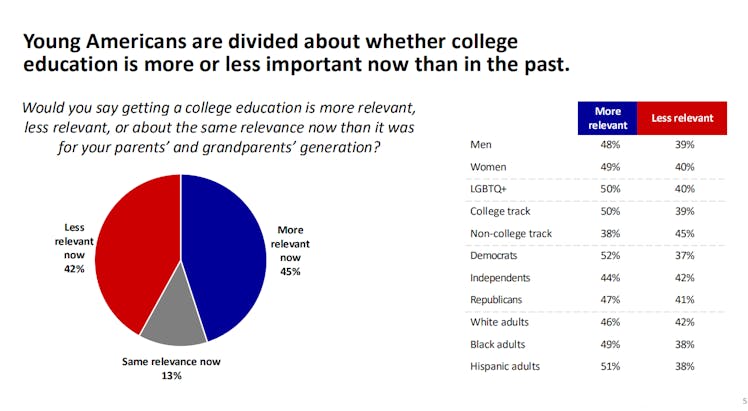
Forty-five percent of respondents said college education is more relevant now, while 42 percent say it is less relevant. Despite this divide, 72 percent agree that being secure financially is essential for “achieving the American Dream today.”
Financial burdens also prevent students from viewing college positively. According to the poll, 69 percent consider college being too expensive as their top or second reason for why it isn’t important or necessary. According to the Education Data Initiative, the average cost of college in the United States is over $38,000 per year.
Despite the costs, a primary motivator for attending college is to get a better job or salary, according to 46 percent of the interviewed individuals.
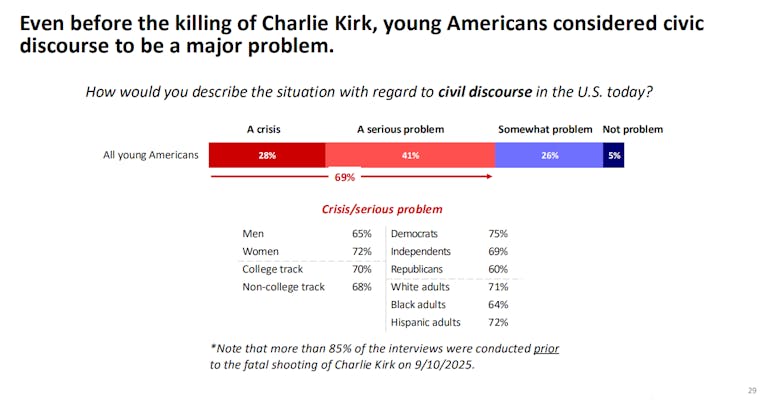
The poll also explored the views young people have on civic discourse, which 69 percent said is either a crisis or a serious problem. A majority said changes from news media and elected officials would help improve the problem.
AU founded the Project on Civil Discourse in 2018, now known as the Project on Civic Dialogue, featuring events, programs and facilitated discussions for students.
“There needs to be a collaboration between different groups of people to recognize that you have different opinions, but we still need to be able to find common ground,” Julia Cucchiara, a junior in the School of Public Affairs and School of Communication, said in the video.
Despite O’Rourke citing a declined trust in major U.S. institutions among young Americans, she was encouraged to see their trust in colleges and universities.
“It puts colleges and universities at the forefront of continuing to earn that trust and confidence,” O’Rourke said. “It’s almost like we’re at a little bit of a precipice.”
This article was edited by Cara Halford, Abigail Hatting and Walker Whalen. Copy editing done by Sabine Kanter-Huchting, Avery Grossman and Ava Stuzin.
