
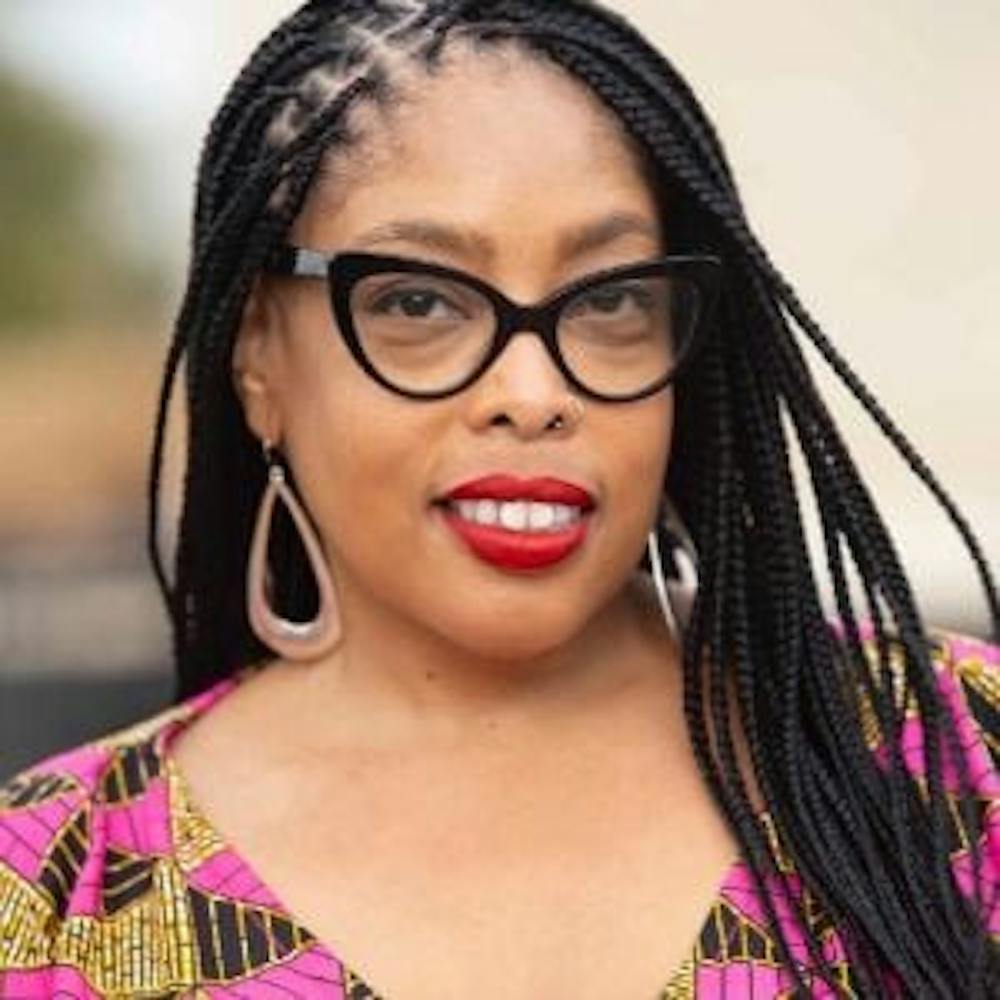
While spending her Sundays in graduate school watching the Real Housewives of Atlanta, Sherri Williams began to notice a pattern.
Aspects of the show, like the characters’ catchphrases, where they went and what they wore, became trending topics on Twitter. One Sunday, all top 10 trending topics were related to the show.
Williams, an associate professor in the School of Communication at American University, published her book, “Black Social Television: How Black Twitter Changed Television,” last December. While working on the book, Williams noticed how Black television users have used the power of hashtags and digital activism to make a difference in the media, such as taking shows off the air or even blocking them from airing.
She said she wanted to dispel misconceptions that Black Twitter is all jokes and frivolous conversation.
“When people think about Black Twitter, I think they tend to think about the jokes and the memes and things like that, but they rarely think about the real change that Black Twitter has really sparked and caused,” Williams said.
Williams said her research was fun because it allowed her to watch a lot of TV and read a lot of Tweets. For her graduate school dissertation, she collected tweets in real-time as shows aired, put them into a qualitative research software and coded from there.
Since Elon Musk bought and rebranded Twitter as X in 2023, the app has experienced a mass exodus, according to Williams. GLAAD named Twitter the most unsafe platform for the LGBTQ+ community for the amount of homophobia and transphobia that has been amplified there. The use of the n-word increased by 300 percent in the week following Musk’s acquisition, according to a study from the Center for Countering Digital Hate.
“What that has meant for Black Twitter and Black social TV in particular is that there are still conversations there, but they are not as robust and powerful as they used to be because key players are no longer on the platform,” Williams said.


At the University, Williams has taught classes such as “Race, Ethnic & Community Reporting,” “Identity, Power & Misrepresentation” and “How the News Media Shapes History.”
Paige Gibbs, a senior in SOC and the College of Arts and Sciences, took “How News Media Shapes History” with Williams.
Gibbs’ capstone focused on Black queerness in the cyberspace and how it’s shaped within mediums, like social media, forums and online gaming. They interviewed four people for the project, including Williams, whom Gibbs said was the most engaging and that they stayed in contact after.
“She was really great in that project,” Gibbs said. “She just had so much knowledge and so much perspective that I didn’t initially bring to the table.”
Whitney Harris Christopher, a professorial lecturer in SOC, said Williams has become a personal friend, along with being a colleague.
“I would just say that she’s just a fierce advocate for our students and a supporter of all of our faculty and really jumps in to do a lot of the work that we have to do as a department,” Harris Christopher said.
In 2021, Williams was awarded the National Association of Black Journalists’ Journalism Educator of the Year award. In September, Williams was honored with two awards from the National Communication Association: the Outstanding Book Award from the African American Communication and Culture Division and the Bonnier Ritter Book Award from the Feminist and Gender Studies Division.
“Her work stands apart in and of itself, but she’s also just a strong and empathetic teacher and person and mentor,” Harris Christopher said. “Her work really stems from advocacy and liberating people of color and marginalized communities through all of her work.”
Williams said when covering marginalizing voices in her classes, students have good intentions of wanting to be a voice for the voiceless, but one of the first things she tells students is that there’s no such thing as a voiceless person.
“Everyone has a voice. There are people who those in power have selectively silenced, but everybody has a voice, right?” Williams said. “But just because there are people in society who don’t really have an opportunity to speak loudly or to really be heard, even though you want to write their stories, they don’t owe you their story.”
One of the main things Williams said she tries to get students to do is to respect the everyday person that they want to write about, who she calls “lived-experienced experts,” as much as they would respect an expert with a Ph.D.
“They can give reporters insight that a Ph.D. expert or a subject matter expert cannot give because they live it,” Williams said. “So I talk about lived experience as a legitimate and important source of knowledge.”
Williams said it’s important for all students to understand that news media has done a lot of harm, causing communities to automatically distrust the fourth estate and they don’t see it as a vanguard for the truth. She hopes students understand the power they have as storytellers to influence the narratives that are projected.
Williams’ next book is due in June 2026, which she hopes will serve as a handbook for both student and professional journalists. It will explore journalism’s need to shift its focus from “people deficit” reporting to “system deficit” reporting.
According to Williams, she has often seen that when marginalized people are portrayed in the news media, they are framed in a way that whatever happened to them is their fault, so the group itself is portrayed as deficient and problematic.
“I really think that journalism needs to shift from doing that and really think about not groups as being deficient, but how systems that groups are living within, embedded with barriers, blocks and biases that make it difficult for groups without power to not only survive but thrive in this country,” Williams said.
For Gibbs, the most impactful part of their experiences with Williams was how the professor saw something in them. Gibbs said that sometimes people are confused about why they are studying both computer science and journalism, but Williams understood their decision.
“She’s really had an impact on me and I know she’s had an impact on a lot of other students, and not only her teaching but her representation, like what she represents for students of color, students who are queer, students who are journalists and want to engage in journalism,” Gibbs said. “She really does take up a lot of space in the most beautiful way possible.”
This article was edited by Samantha Skolnick, Neil Lazurus, Payton Anderson and Walker Whalen. Copy editing done by Sabine Kanter-Huchting, Avery Grossman and Ava Stuzin. Fact-checking done by Aidan Crowe.
