
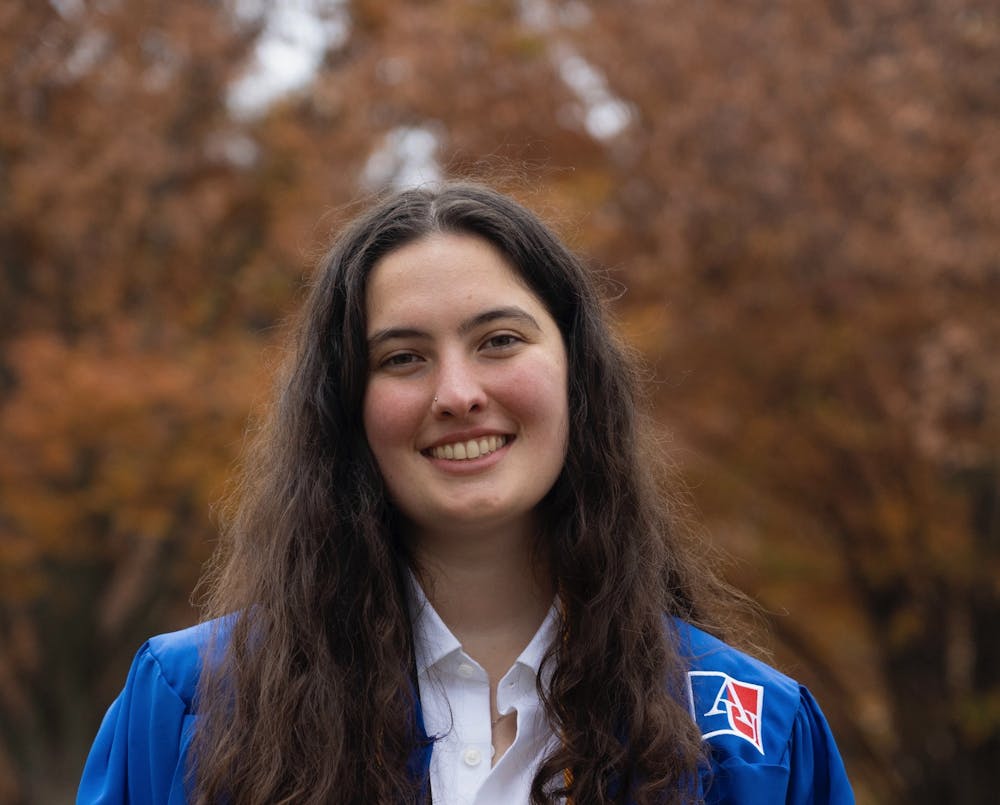
As the fall semester comes to a close, some seniors are completing their time at American University and forging ahead into an uncertain future and unprecedented job market.
Following the recent government shutdown and federal research cuts, the current job market presents instability and a shift in demand for certain positions, especially those in D.C. At least 600,000 federal workers’ jobs were suspended and hundreds of millions of dollars in research grants across various institutions were cut.
Students can choose to graduate a semester early, provided they complete the University’s graduation requirements. Those who graduate a semester early often choose this path because of financial circumstances, transferred credits from high school or to get a head start in their post-grad path.
Fionnuala Schefers, a senior in the School of Public Affairs and the College of Arts and Sciences, is a double major in political science and women’s, gender and sexuality studies. Schefers said she plans to stay in D.C. and is currently interviewing for a full-time internship.
She said she has experienced challenges with internships scaling down their workforce, especially in her field of politics at the federal level.
Because of her increased course load due to her double major, she used planning resources early in her college career to help her graduate a semester early.
“I had taken a few extra classes throughout my first 2 years,” Schefers said. “I really wanted to make sure that with a double major I could graduate on time and when I met with my advisor, they said I could graduate a semester early.”
While applying for internships, Schefers utilized the House of Representatives’ House Vacancy Announcement and Placement Service, which helps candidates find jobs and submit resumes through its general postings. During the most recent government shutdown, that service was no longer available to her.

“They sent something saying that they were no longer going to be looking at any of the resumes or applications until further notice,” Schefers said. “That was right in the heightened time of me applying for things, so that was pretty frustrating.”
Tasmin Owen, a senior in CAS, said she plans to stay in D.C. for the spring semester, working at an on-campus lab as a research assistant while also looking for another part-time job. She has faced challenges finding additional research jobs because of funding cuts.
“Even the [research lab] that I’m going to keep being a research assistant at, I’m not going to be getting paid,” Owen said.
Owen said she was originally also looking at PhD programs, but had to shift her focus towards master’s programs because of the extensive cuts to PhD research programs. She said it is difficult to find jobs that can accommodate another worker.
“There’s not a lot of jobs that are hiring,” she said. “And the ones I’m applying to I’m just not hearing back from.”
Emily Randolph, a senior in CAS, is graduating with a major in women’s, gender and sexuality studies and a minor in both statistics and health promotion. She said she planned to graduate a semester early since her freshman year because of the International Baccalaureate credits she brought into college.
Randolph said she is looking for jobs within the D.C. area, including potential roles in corporate risk, corporate human resources and corporate marketing. Additionally, she plans to go back to school to get her MBA, ideally while she is in the workforce.
Randolph said she has seen how the government shutdown caused many government workers to seek corporate jobs, which presented her with challenges finding open positions within the D.C. area.
“Government workers make up a huge portion of D.C., so there aren’t a lot of corporate roles to begin with,” Randolph said. “So that’s really caused a shortage within D.C., which is why I’ve been looking elsewhere. Even though the job market isn’t great elsewhere, it’s still better than it is here.”
This article was edited by Cara Halford, Payton Anderson and Walker Whalen. Copy editing done by Sabine Kanter-Huchting, Emma Brown, Avery Grossman and Ava Stuzin.
