
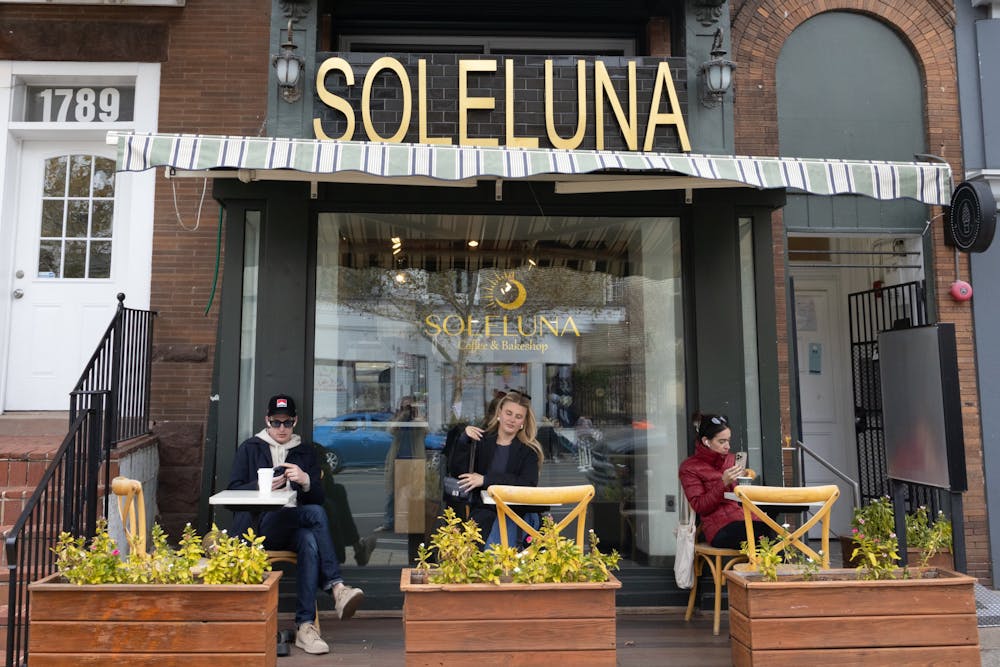
Nestled between imposing buildings on American University’s campus lies what many students would consider a staple of their campus life. Visitors could easily miss it if it weren’t for The Bridge Cafe’s booming stereo, hum of student chatter and beloved reputation.
Jess Moskowitz said The Bridge, one of AU’s two student-run coffee shops, is a life raft where students can be themselves and take a deep breath amidst the rocky waves of daily life.
When Moskowitz, a first-year graduate student studying sociology, first stepped on campus, they fell in love with The Bridge for its community feel, various types of seating, political art and range of events.
The Bridge is not alone in providing community with a side of coffee. D.C. has a rich culture of independent coffee shops, many of which host musicians, poetry readings and book talks.
With the National Guard patrolling the streets starting in August and a presidential administration causing uncertainty, some see these community cafes as particularly vital in today’s stressful D.C.
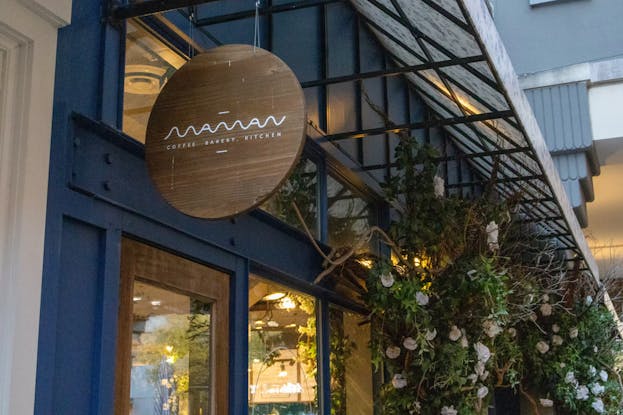
Marin Broadbent-Bell, a junior in the School of Public Affairs and assistant general manager of The Bridge, said community spaces like coffee shops contrast with the divisive national image of D.C. and instead affirm a “well-rounded, connected community.”
The basement of the famous Connecticut Avenue bookstore Politics and Prose is home to The Den Coffeehouse & Wine Bar. The Den often hosts receptions for Politics and Prose events, as well as its own book clubs, collage nights and live music sessions.


According to Mica Burgess, MFA/College of Arts and Sciences ‘23 and the manager of The Den, the coffeehouse has a particular emphasis on connection and conversation.
“We have people who come and just start chatting with each other about current affairs, state of the country, state of the District,” Burgess said. “They’re never heated conversations. It’s just dialogue.”
Burgess started attending The Den regularly while she was finishing her thesis as a graduate student at AU; she spent so much time there that she decided to become a barista post-graduation. Not only do customers open up political conversations with each other, but also with the coffeehouse staff, she said.
Burgess said these conversations have become more frequent over the last few months. Yet, she noted that cafes have a lengthy history as political meeting spaces for revolutions.
According to the Smithsonian Magazine, drinking coffee in colonial America was an act of rebellion in itself — a slap-in-the-face to British tea — and coffeehouses were meeting places that helped lay the seeds for the American Revolution.
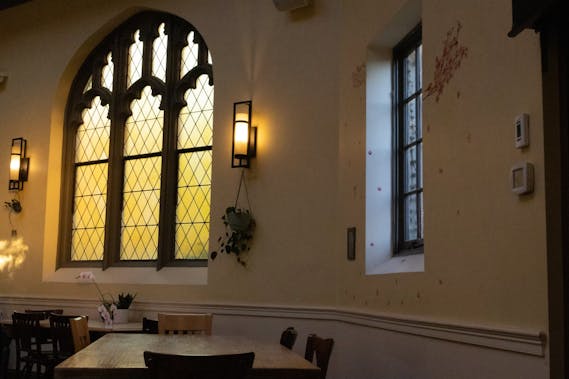
Moskowitz recognized that these spaces are still vital for belonging and community engagement.
“We’re under an occupation right now,” Moskowitz said, referencing the National Guard’s presence in D.C. “Having cafes, those are the spaces where people can come together to organize … and come up with ways to protest and to stand up to the occupation, stand up to a lot of the abuses of power that go on here.”
Down the street from AU lies Open City at the National Cathedral. The cafe is often packed with students, working professionals, locals walking their dogs and tourists.
“I think we draw quite a few disparate groups here that mesh really well, but are coming from very different places in life,” Connor Curtin, the general manager of Open City, said.
Similar to The Bridge with its live music and club events, it’s not rare for Open City to host community events. According to Curtin, the cafe held a bat mitzvah this year.
With its mismatched dishware and wooden furniture, Open City manages to maintain neighborhood charm despite its proximity to one of D.C.’s most popular landmarks.
Though Open City is part of a larger company, Curtin said that each establishment has a unique feel that encapsulates its neighborhood, which he explained is “something that’s honestly dying out a little bit in D.C.”
Despite worries of a loss of independent establishments, many still maintain appreciation for what D.C. has to offer.
On the freedom of running a neighborhood cafe, “We get to be a little weird, a little odd,” Curtin said.
For Broadbent-Bell, it isn’t so much about the place as it is the company.
“Half the time they’re playing club music [at The Bridge] while people are trying to study. But it’s still always full,” he said. “It’s kind of just being in a space with other people, and feeling like you belong.”
This article was edited by Samantha Skolnick, Abigail Hatting and Walker Whalen. Copy editing done by Sabine Kanter-Huchting, Avery Grossman and Ava Stuzin.
