
When George Washington University students heard Robert F. Kennedy Jr.’s voice in person on Nov. 17, many of them erupted in laughter while pointing their cellphones at him.
Kennedy visited the university as part of an event organized by GWU’s College Republicans and Turning Point USA chapters. Students and community members packed the Lisner Auditorium while others gathered outside on 21st Street in protest.
Throughout the event, the auditorium was replete with the blue glare of audience members’ phone screens, including the phone of a moderator seated on stage. A girl in the audience giggled with her friends as she recorded a TikTok of herself and Kennedy, who sat a few yards away discussing healthcare reform.
From time to time, many attendees expressed their approval, such as when Kennedy said that pharmaceutical companies offer medical schools payments and, in turn, these schools promote pharmaceutical mercantile interests.
“We have a sick care system as a result, rather than the healthcare system,” Kennedy said. “All those institutions make money from keeping America sick.”
A few attendees began to clap, soon joined by many others in a loud chorus of applause.
Liam Kelleher, a GWU sophomore studying political science, said he had looked forward to hearing from a government official with as much influence in national politics as Kennedy, regardless of his own differing political views. He said he was troubled to hear audience members laugh at Kennedy’s voice, calling the situation “messed up.”
“I wouldn’t say I agree with RFK’s policies, but I wouldn’t go so far as to make fun of a disability,” Kelleher said.


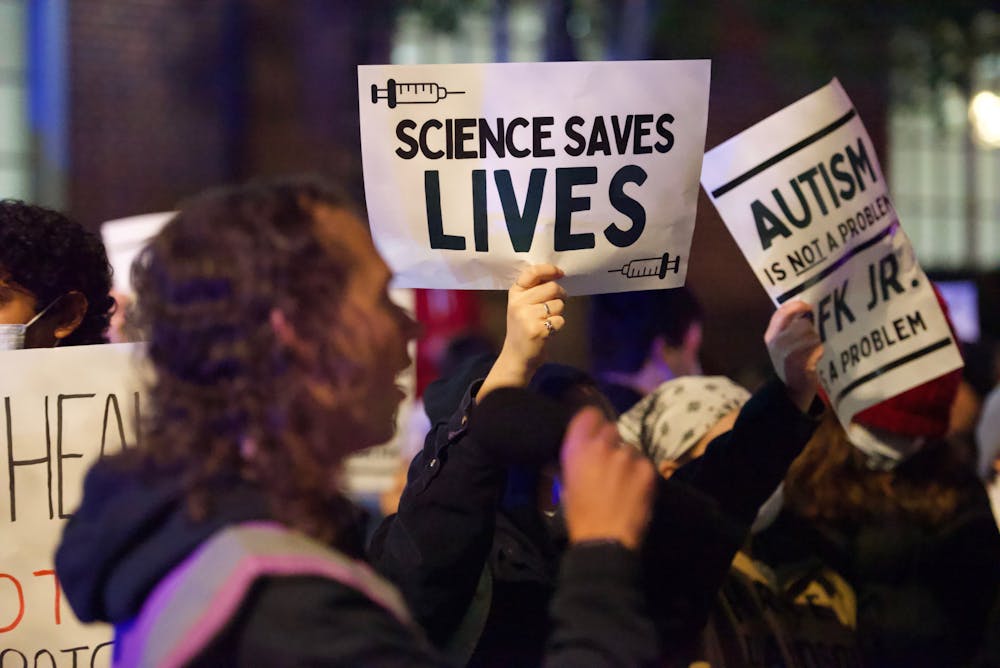
The student counterprotest, which was organized by GW Democracy Matters, GW Swing Left, the GW Disabled Student Collective and Stand Up for Science, attracted a small crowd that thinned out as the event progressed.
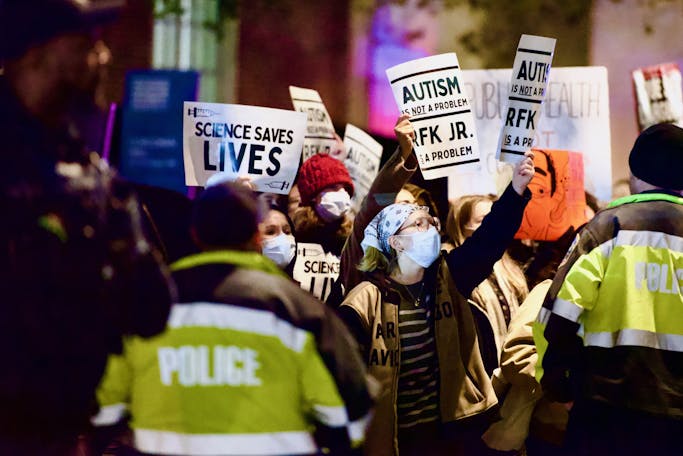
Vy Vuong, a sophomore premedical student at GWU, decided to attend the protest after walking past it. She strongly believes Kennedy is a problematic figure because of his views on health care.
“A lot of the information that he's been spreading is harmful to health care and its access,” Vuong said. “It’s easy to believe people in positions of power, and with that it makes it even more difficult to find correct information.”
Consequently, Vuong does not believe Kennedy should have been invited to speak by the university.
“I think that we should be a lot more careful and intuitive with who we bring here and who represents us overall,” Vuong said.
Inside, Micah Clark Sauve, a D.C. resident, decided to listen to Kennedy despite disagreeing with many of his views. Although the event was organized by Turning Point USA, Clark got the impression many in the audience were not conservatives.
“I was sort of surprised to see more of a wide variety of people — which makes sense since I did show up after all,” Sauve said.
Sauve said he sees the importance in institutions like GWU inviting high-ranking government officials to hold events on campus, regardless of their viewpoints.
“I think that it’s good to hold events where people at high places in the government can hear from regular people who live regular lives,” Sauve said. “I think that’s an important part of our democracy.”
But others believed allowing Kennedy to speak on campus constitutes an endorsement of his views.
Grace Santos is a sophomore studying Health Sciences on the pre-med track. She had no plans to protest that night, but was compelled to do so after walking by with a friend.
“I’m a little disappointed that the university would allow him to come and speak,” Santos said. “I understand we have the right to freedom of speech. I just thought that we were going to take more of a stand for justice, equality, kindness and peace.”
Luna Hernandez, a ‘Refuse Fascism’ volunteer who assisted at the counterprotest, firmly believed that Kennedy, as a member of the Donald Trump administration, is a fascist. Universities, she said, should show no tolerance for them.
“Whenever any of these fascists come to any campus to speak, there needs to be wave-upon-wave of students and others coming out,” Hernandez said. “It needs to build the kind of movement where there’s a political earthquake from below, where Trump is not able to implement his fascist program day after day.”
While discussing the state of free speech after the assassination of Charlie Kirk, Kennedy emphasized the importance of openly transmitting and conversing ideas in preserving democracy.
“When we shut down debate and we shut down conversation — open, free flow of information is oxygen,” Kennedy said. “And when you shut it down, democracy will die.”
This article was edited by Gabrielle McNamee, Abigail Hatting and Walker Whalen. Copy editing done by Sabine Kanter-Huchting, Avery Grossman and Ava Stuzin.
localnews@theeagleonline.com
