
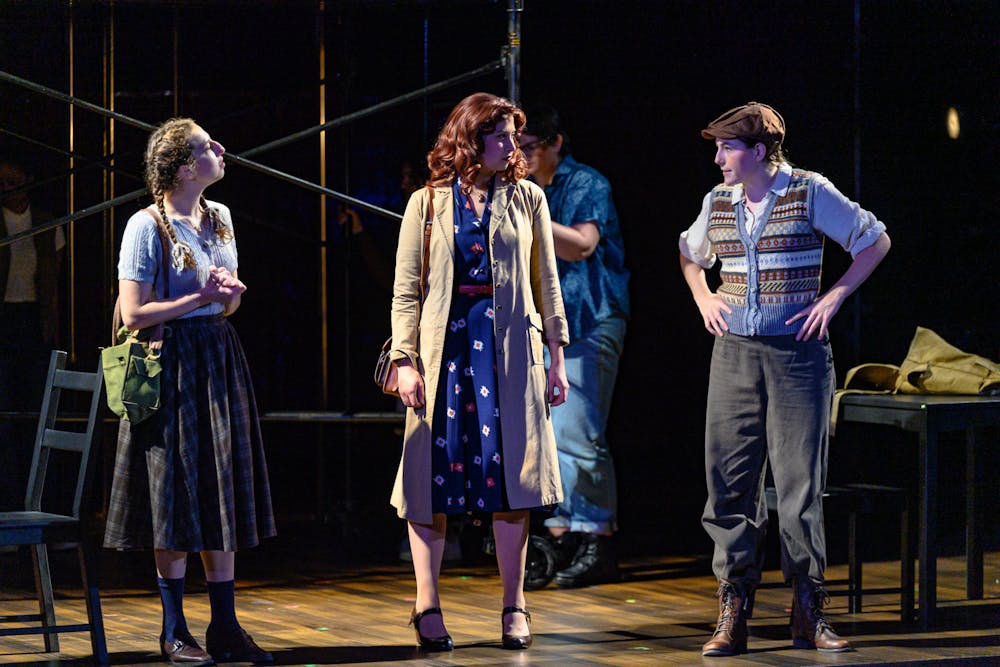
“Disarming Girls,” a new play created by Sarah Caroline Billings and Kallen Prosterman, recently debuted at the Greenberg Theater from Oct. 16-26.
The story is set in 1941 against the backdrop of the Nazi-occupied Netherlands and follows Hannie Schaft, Truus Oversteegen and Freddie Oversteegen as these three fearless women join the Dutch resistance to take down the Nazi Regime. Through the power of their own femininity, exercised by flirting with Nazi soldiers and gaining their trust, the women are able to lure them into the forest and assassinate them in the dead of night, demonstrating how unassuming, yet truly disarming, they can be.
Billings and Prosterman collaborated with American University students as early as August 2025 to workshop the script and show. It invites students onstage and in the audience to explore themes such as the sacrifices that come with nobility, the personal boundaries that must be challenged when participating in resistance and the courage it takes to stand up to oppression.
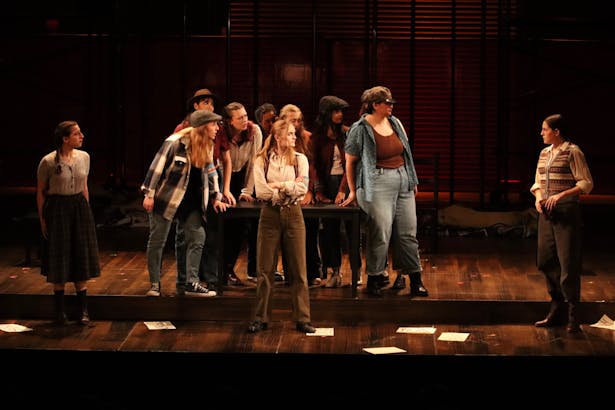
Chosen by the American University Department of Performing Arts for this year’s theater season, the show was quickly integrated into AU’s Core Curriculum and became required viewing for 1,700 freshmen enrolled in Encounter AU this fall. The characters in the story are of the age of their performers, sparking conversation and reflection on the role of young people in resistance.
Fake IDs, secret training, target practice and disguises drive this female-centered story, following women on a powerful journey to confront the power striking pain and fear through their community.
The “Disarming Girls” trio is well-balanced, both on paper and onstage. Hannie, played by Maddy Cooper, a senior in the College of Arts and Sciences, is witty and resourceful — the brains behind the brigade, using their femininity as a weapon against the enemy. Played by Lucille Rieke, a senior in CAS and the School of Communication, Truss is the grounded, sometimes militant leader, fiercely protective of her friends and little sister, Freddie, as she grapples with the emotional toll of their mission and the pressure of her father’s military background.
Freddie, played by CAS sophomore Mira Gross-Keck, rounds out the bunch, offering a unique air of youth and hope in a show with such serious themes set in a historical period where the future seems uncertain. Through her dreams of having a family, audiences see why the women continue to fight for an end to the conflict and a peaceful tomorrow.


The production’s set and design are industrial and stripped down, keeping the spotlight on the performers. The Greenberg Theater’s shipping door and brick wall are revealed minutes into the performance, as large curtains depicting a colorful Netherlands backdrop are ripped away by the ensemble. Other set pieces such as cafes, prisons, watchtowers, forests and bicycles are constructed from chain-link fences, chairs and the ensemble themselves.
The ensemble moves as one character throughout “Disarming Girls,” creating the environments the women encounter throughout their mission. Forming quiet, eerie forest clearings and tense, stuffy cafe run-ins with Nazi soldiers, ensemble members were vital to the energy and atmosphere in each scene.
Through the costume and sound design, audiences were further immersed in the contrasting modern and WWII era aesthetics.
An informational costume display, with sections titled “historical recreation,” “transitional styles,” “blending periods” and more, greeted audience members in the lobby of the Greenberg Theater before they took their seats. The exhibit unpacked how clothing was used as a storytelling device to communicate the change in eras. Notably, the cast begins the performance in modern attire, changing into period-accurate outfits when the 1940s radio begins to deliver updates about the war.
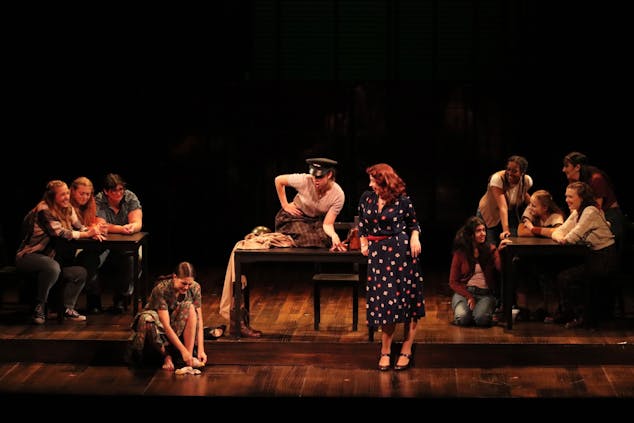
During the post-show talkback, moderator and dramaturg Lindsey R. Barr, playwright and professor of African Diaspora Studies Sybil R. Williams, and ensemble member Laurel Brown, a senior in the College of Arts and Sciences, discussed the significance behind another unique storytelling element: the use of contemporary music.
Songs such as “brutal” by Olivia Rodrigo, “Dog Days Are Over” by Florence + The Machine, “Heads Will Roll” by the Yeah Yeah Yeahs, “NDA” by Billie Eilish and “Hayloft” by Mother Mother punctuated intense, thrilling moments during the story with a sense of humor, offering the audiences both a decompression from upsetting moments and a way to connect with staged history through current music.
The three creatives hope students and audiences will walk away from “Disarming Girls” with a better understanding of how art is both a medium and catalyst for civic dialogue, and why its power leads to the arts being attacked first by oppressive governments.
Williams also noted a critical concept that the community can take with them, both in context of the “Disarming Girls” production and current events.
“History does not repeat — it echoes,” she said.
This article was edited by Sydney Hemmer, Jessica Ackerman and Walker Whalen. Copy editing by Sabine Kanter-Huchting, Arin Burrell, Paige Caron, Ryan Sieve and Andrew Kummeth.
