
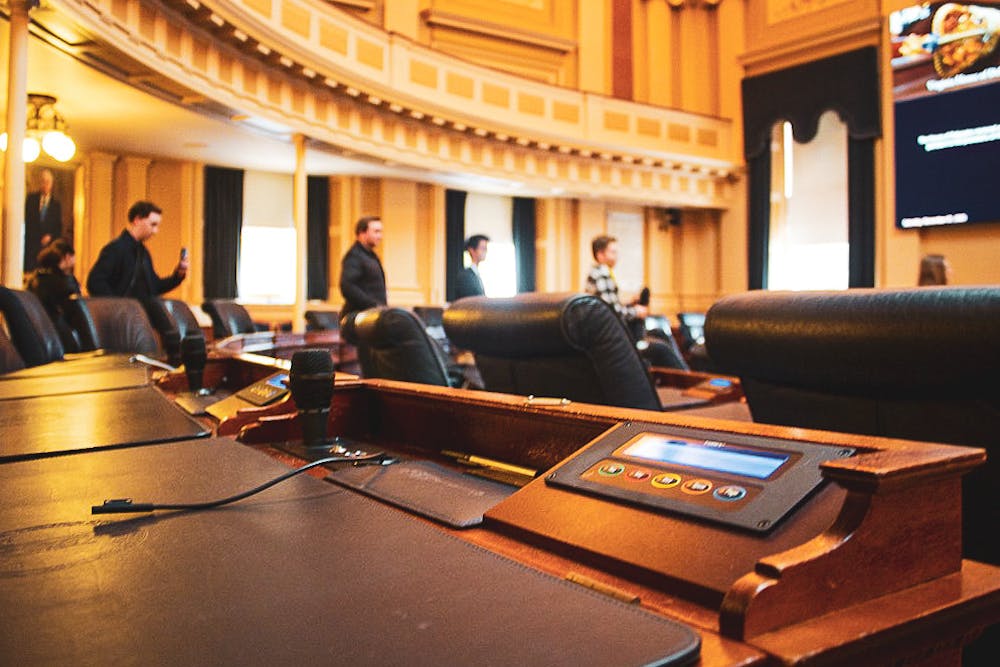
The Nov. 4 Virginia election was highly anticipated, especially by students in American University’s Battleground Virginia (COMM-420 Topics in Mass Media) class who got to watch, report and learn from the campaigns in Richmond, Virginia.
This semester, AU offered a section of its recurring Battleground class with a focus on the gubernatorial, lieutenant governor and attorney general elections in Virginia. Students spent the beginning of the semester learning about the different aspects of a local election in preparation for their on-the-ground reporting during the week leading up to the election.
After the election, students completed a final project with the interviews they conducted in the field. Each story features a voter, their characteristics and what issues they care about most.
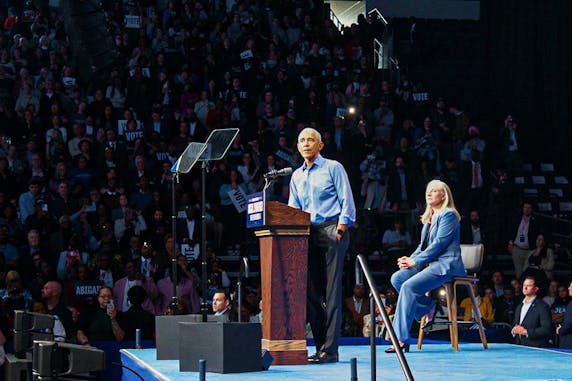
According to Battleground Virginia student Lauren Gersten, a senior in the School of Communications, the trip to Richmond was funded by School of Public Affairs alumnus Adam Stoll, whose donations also provided all accommodations, including travel and food.
“It’s a lot of information to be taking in at once,” Gersten said. “I’m very grateful that we don’t have to worry about fundraising.”
The class focuses on understanding local elections, with an emphasis on those held in Virginia. Students are expected to understand the intricacies of the many topics connected to the upcoming election. Another Battleground student, Grace Manson, a senior in SPA, recalled that the quizzes in the class would often have very specific questions.
“I remember one of the things we had to know was exactly how many bus tours Abigail Spanberger had taken up until this point,” Manson said. “But I kind of understand that because if you’re speaking with a voter, and the voter tries to press you on something niche you need to know the niche things.”

Battleground Virginia has three professors, each with a specific area of expertise. It also has several teacher assistants. Max Morse-deBrier, a senior in SPA, took the class in January 2025 when it focused on the New Hampshire elections and was asked to be a TA for this year's section.
“We do a lot of journalism-focused things, which is a skill that I didn’t have before,” Morse-deBrier said. “I think it is a very valuable thing to be good at because it’s applicable to so many aspects of life.”
Lynne Perri, one of the professors, facilitates the journalism aspect of the class by helping students learn to write short stories about voters along by teaching interviewing skills.
Morse-deBrier explained that each professor benefits the class in different ways. Betsy Fischer Martin, a media skills professor in SPA, focuses on the media side of campaigns. She previously worked as an executive producer for “Meet the Press.”
“I try to maintain an unbiased, nonpartisan approach to teaching. Obviously students have their own political beliefs but we don’t want students applauding certain candidates and booing others while in the field,” Fischer Martin said.
Fischer-Martin explained that although each professor has an expertise — hers being in television journalism — they all work together.
“We’ve done this class together six times so we’ve worked out all the kinks,” she said.
The class started in 2016 for the national primaries and continued in 2020, 2021, 2022 and 2024 in several different states. It requires an application and, according to Fischer Martin, demand has been high for all six years.
The class often hosts guest speakers from various professional backgrounds and positions to teach the class about different aspects of elections.
Manson said that the class teaches a variety of topics that appeal to several majors. Gersten is one of the few public relations majors in the class, but said she was drawn to the course anyway.
“I interned on the hill when I was a sophomore, but since then I kind of stayed away from politics,” Gersten said. “But, I thought being a senior in a place where people live and breathe politics, I should try it out one more time.”
While doing fieldwork in Richmond, students were expected to produce three stories for The Wash, an online publication composed of work by graduate and other advanced-level journalism students at the SOC. Battleground students interviewed voters in Richmond for their articles.
“This class is a great way to get to know more people in D.C.,” Gersten said.
Gersten said the schedule for the week was unpredictable, as the election was a close call and students had to do a lot of their reporting on the fly and adapt to surprises.
With a background in journalism, Fischer Martin said she can appreciate a lot about the class and what it offers students.
“Students are able to get a front row seat to the campaign. Talking to a voter face-to-face gives you a much better sense of what people care about than watching the news or scrolling on social media,” Fischer Martin said.
Abigail Spanberger, D-V.A., won the gubernatorial election with 57.58 percent of the vote. Ghazala F. Hashmi,D-V.A., won the lieutenant governor election with 55.65 percent of the vote. And Jay C. Jones,D-V.A., took 53.14 percent of the vote in the attorney general elections.
“Even after the elections are over, the results are just the beginning,” Manson said.
This article was edited by Samantha Skolnick, Gabrielle McNamee and Payton Anderson. Copy editing done by Sabine Kanter-Huchting, Avery Grossman and Ava Stuzin.
