
From the Newsstands: This article appeared in The Eagle’s December 2025 print edition which can be viewed here.
Students at American University have been labeled as some of the most politically active in the nation. But how informed are they?
The Eagle conducted a survey this semester on news consumption habits — the “news diet” of American University students.
Major findings from 114 student respondents included:
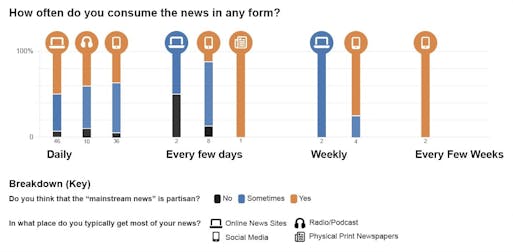
Eighty-one percent of students said they consume news daily, with online news sites and social media as the top two preferred platforms.
Forty-eight percent of students sometimes read The Eagle, 25 percent have read The Eagle at least once, 12 percent of students have never read it and 12 percent have never heard of it.
Nearly all, 94 percent, students said news was biased or partisan “always” or “sometimes.”
“It’s just the nature of most media these days,” Emma Spath, a junior in the College of Arts and Sciences, said. That’s why Spath said her go-to outlet is Straight Arrow News, a platform with the tagline: “Unbiased. Straight. Facts.”


Other students said they too see news bias, but don’t view it as innately negative.
Julia Lewis, a senior in the School of Public Affairs, works at a lobbying firm and said she has closely followed news updates on the government shutdown and listens to “The Headlines” from The New York Times each morning to prepare for work.
“I think bias is inherent in every single person and therefore every single reporter and every single news outlet,” Lewis said.
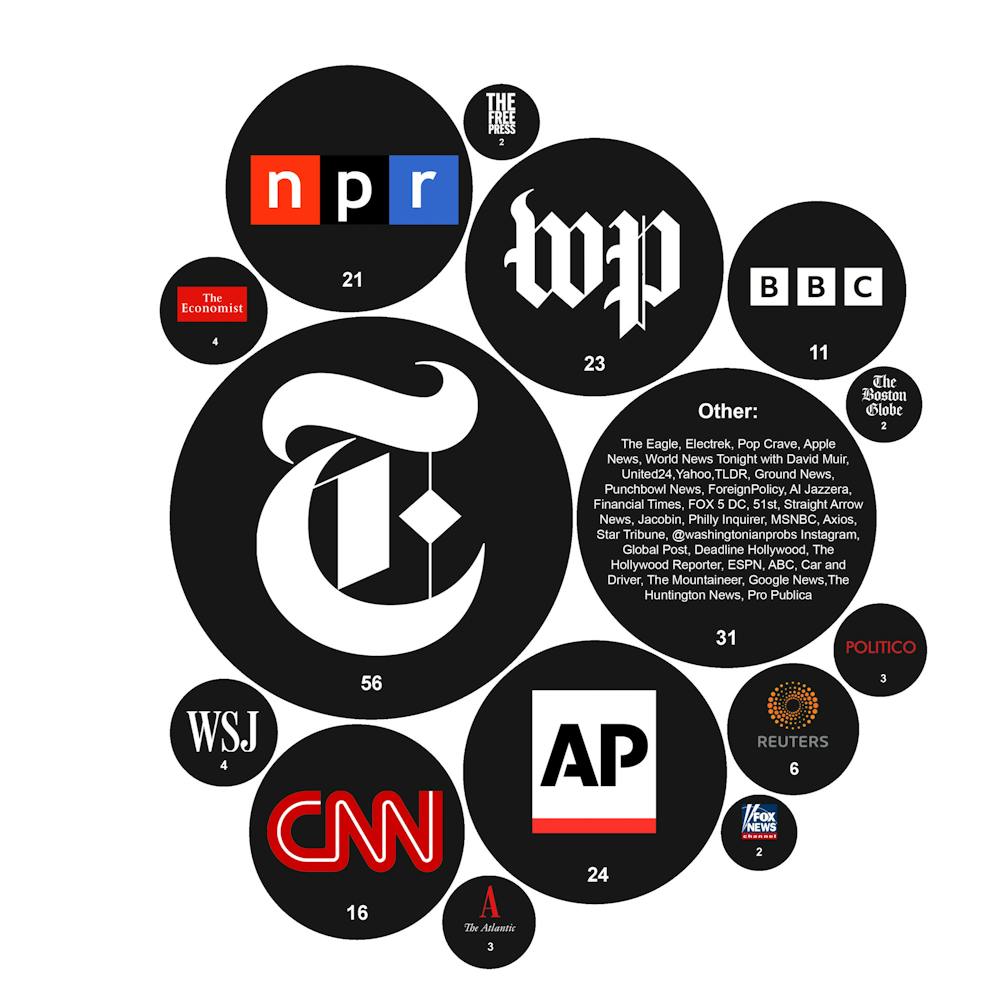
Students rely most on The New York Times for news, with 36 percent noting it as their most consumed source. The Washington Post came in second at 21 percent, and NPR followed at 15 percent.
Chinwe Okonkwo, a sophomore in the School of Communication, said she consumes news so she’s updated on the humanitarian crises she cares about in Gaza, Congo and Sudan.
Answers addressing the Israel-Hamas war were most common in response to the question of which news topics most interest students, with 20 percent of respondents mentioning “Palestine” or “Gaza.”
Okonkwo said she reads Al Jazeera and watches independent Palestinian journalists like Bisan Owda and Plestia Alaqad, who post content on Instagram.
“She seems pretty young, maybe around my age, so it was a really emotional journey to watch her through all these years,” Chinwe said of Bisan.
While emotions drive news consumption for some, news anxiety means avoidance for others.
“I’ve actually been trying to take a break recently,” Emily McKay, a sophomore in SPA, said. “Mental health is important.”
Spath said while she has also avoided news lately, she’s hopeful a media shift away from pessimism may re-engage people.
“I think the role that media plays in society, it can’t really be underestimated,” Spath said. “And it really has to be rethought.”
This article was edited by Samantha Skolnick, Abigail Hatting and Walker Whalen. Copy editing done by Sabine Kanter-Huchting, Emma Brown, Avery Grossman, Ariana Kavoossi, Audrey Smith and Ava Stuzin.
