
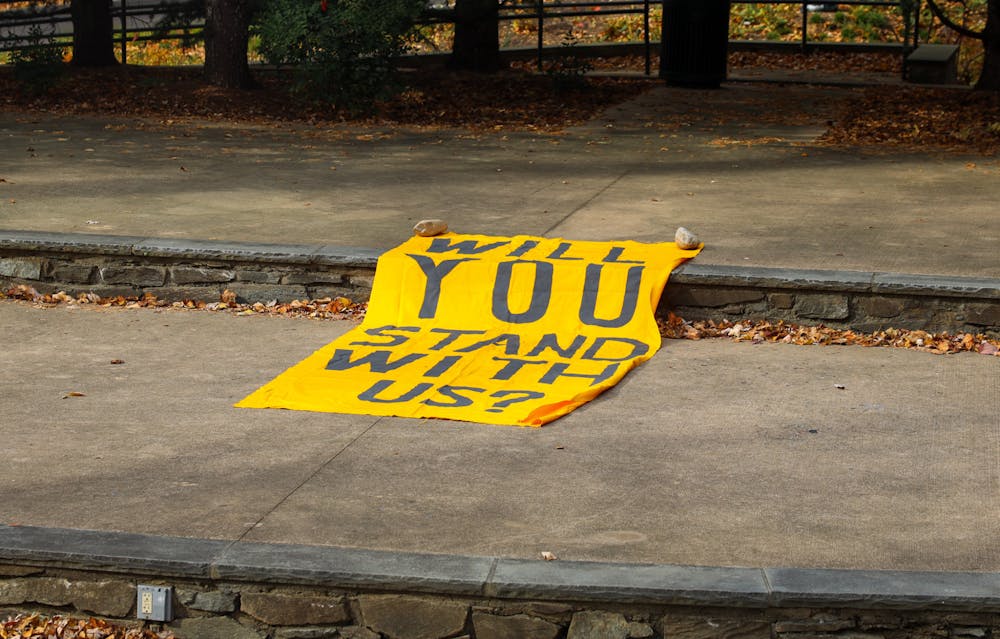
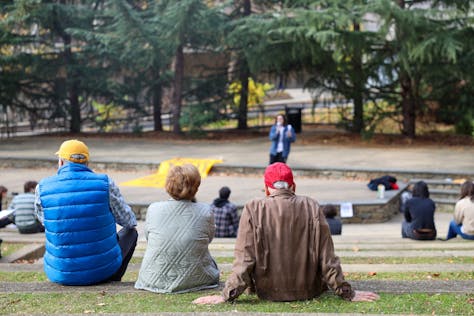
A group of around 20 students rallied at the Woods-Brown Amphitheater on Nov. 7 to participate in a nationwide effort to push back against President Donald Trump’s policies targeting higher education.
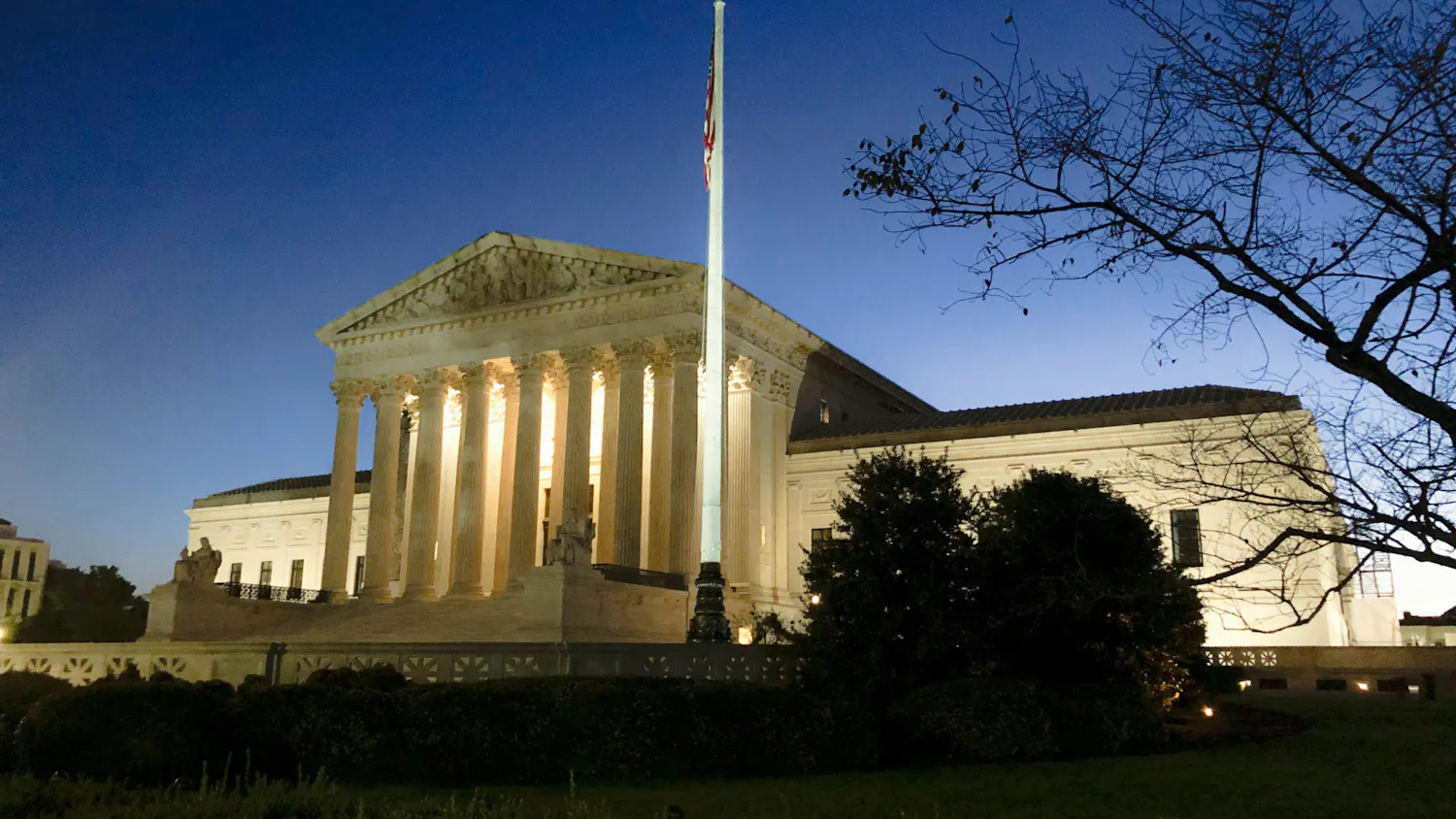
The Department of Education sent a “Loyalty Oath” compact on Oct. 1 to nine colleges, which would mandate standardized tests, limit free speech, define man and woman by one’s biology, restrict international student enrollment and prohibit institutional units considered harmful to conservative ideas. On Oct. 12, Trump informally extended the offer on Truth Social for any college or university in the United States to sign. A university’s violation or negligence if they signed the agreement could lead to loss of federal funding, according to the compact’s “Enforcement” section.
American University has neither signed the compact nor addressed it publicly to indicate its intention to do so.
AU Rise Up created a petition ahead of the protest to discourage the University from signing the compact. As of Nov. 13, the petition had just under 200 signatures.
The amphitheater rally was an open-mic event part of a wider effort by Students Rise Up, a network of students part of national organizations such as the Sunrise Movement and Campus Climate Network. Over 100 college campuses across the U.S. participated in the protest.
Charlie Murphy and Jake Nims, co-presidents of Sunrise AU, organized the event in collaboration with AU Rise Up, Latinos en Acción, the American Civil Liberties Union at AU and AU’s chapter of Young Democratic Socialists of America.
“We wanted to put a big emphasis on bringing a lot of organizations together in order to do this kind of action,” Nims said. “This is a very diverse city, and there’s so many different people who are being affected by what’s going on in the Trump administration.”

The event was open to all students to listen to the speakers talk about the state of the administration and call on University President Jonathan Alger to reject the compact. Students were allowed to sign up to speak at the event.
There was also a letter-writing station where the organizers provided a copy of the compact and a template for students to write letters and hand-deliver them to Alger, urging him to “take a stand against fascism and publicly reject the Federal Administration's Compact.”
Nims and Murphy said that the compact would affect the way professors teach their classes due to the “Marketplace of Ideas & Civil Discourse” section, which they think will require political science and international relations classes to emphasize “democratic points of view.”
According to Murphy, the University would be required to change its teaching methods.
“[AU students] look at so many things that would put America in a bad light,” Murphy said. “That stuff would just be gutted.”
Murphy also added how the vague language used in the compact creates room for the Trump administration to abolish institutional units that are against conservative ideas.
“They’re going to use that ‘it’s belittling conservative ideology’ to justify shutting it down, like, that is not okay, fundamentally,” Murphy said.
Kevin Gomez-Salazar, a freshman in the School of International Service, said he learned about the compact in a meeting and then tabled in front of the Mary Graydon Student Center to educate students and sign the petition. He said this issue is important to him because it hinders freedom of expression.
“The University should be a place that is, in my opinion, independent of party politics,” Gomez-Salazar said. “I’m not saying that the University should be a place where no political expression is allowed, but a place where true ideas can be expressed [and] political rights can be demonstrated.”
Becca Delbos, a senior in the School of Public Affairs and the College of Arts and Sciences, is president of ACLU-DC at AU and made a speech at the event. Delbos also supplied pocket Constitutions, Know Your Rights red cards and guides to attendees.
In their speech at the amphitheater rally, Delbos spoke about how the compact would affect queer and transgender students.
“The truth is, it was never just about bathrooms and it was never just about sports,” Delbos said. “It was about control.”
Delbos said that, as an American Studies major, they would be personally affected if AU signed the compact.
“Educational freedom is really important,” Delbos said. “And we’ve seen in public universities how there’s been so much more censorship of the humanities.”
This article was edited by Payton Anderson, Abigail Hatting and Walker Whalen. Copy editing done by Sabine Kanter-Huchting, Ariana Kavoossi, Emma Brown, Avery Grossman, Audrey Smith and Ava Stuzin.
