
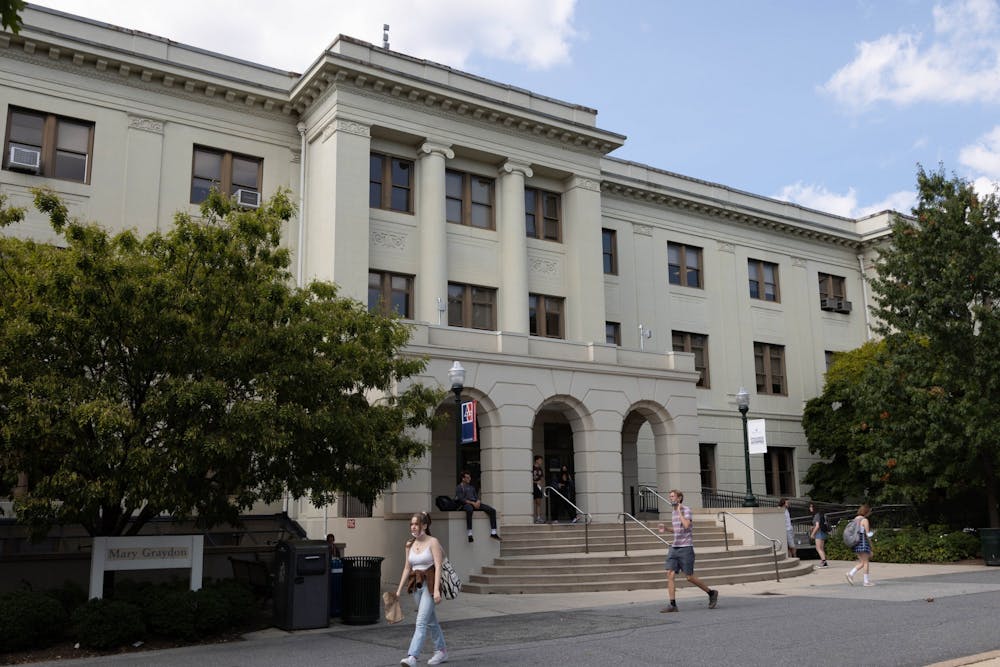
A referendum that asked American University administrators not to share community members' information with the federal government failed to get the 400 student signatures needed to appear on the Student Government ballot.
The referendum, “Firewall for Freedom,” was written by the national chapters of Amnesty International and American Civil Liberties Union. It had until Oct. 2 to get enough signatures to appear on this semester's ballot.
The referendum would have called on administrators to prohibit employees from providing information about community members if requested by federal authorities, specifically inquiries into activities protected by the First Amendment, immigration status, gender, or sex.
Steven Mendell, a junior in the School of International Service, is the president and founder of AU’s chapter of Amnesty International and said he had a few theories as to why the referendum failed to get on the ballot.
“One: It’s a very busy time of the year for students,” Mendell said. “Two: A week and a half is not a lot of time to get 400 signatures.”
Mendell said much of the work that he and his organization did involved reaching out to other advocacy groups on campus and in the D.C. area. The group received support from various organizations, including Free DC and Sunrise AU. He also said his team was on campus in the days leading up to the deadline, spreading the word by tabling and distributing flyers. Despite their work, the referendum fell short by a little over a hundred signatures, Mendell said.
The University would not be the first to adopt new policies in response to the Trump administration. In spring, faculty at Rutgers University and faculty at over a dozen other universities approved and adopted resolutions to establish a mutual defense compact between Big Ten schools and others outside the Big Ten, which asked all participating universities to establish a defense fund to help pay for possible legal costs resulting from the Trump administration’s actions against higher education.
Mendell wanted to make clear that the purpose of this campaign is to demonstrate student support for the policies, which can be done in many ways, such as petitions, which he intends to use.

“I definitely think that it’s something students support, it's just a matter of getting them to sign,” Mendell said. “There’s always going to be that gap between someone believing or wanting something and actually getting them to act on it.”
Mendell led a successful campaign, leading to the passage of a Firewall for Freedom resolution by the SG Senate in March.
Mendell says he was interested in starting a referendum campaign to collect data on student support for the firewall. Students vote directly on referendums as opposed to resolutions, which are voted on by SG senators.
The language used in the resolution and the referendum was sent by Amnesty International and ACLU to their chapters last spring, along with a 23-page document detailing how student activists could get this passed on their campuses. The document outlined the specific steps to take, including a draft of a letter to send to the editor of a campus newspaper and social media templates to help further spread the word online.
Becca Delbos, a senior in the School of Public Affairs, is the president of ACLU-DC at AU, and echoed a similar sentiment to Mendell when it came to the support shown by students.
“There will still be more protesting on campus, like what happened a couple of weeks ago with the Free DC protests; it had like 500 attendees, which speaks to how much students care,” Delbos said.
Mendell said he also believes that University policy is leaving students vulnerable, whether they realize it or not.
“Nothing really prevents professors, faculty, or in some cases the school from giving that information to the federal government if they’re pressured enough,” Mendell said.
In March, the Department of Education opened a civil investigation into the University in response to antisemitism complaints filed by The Louis D. Brandeis Center last year. It’s unclear what specific information the University was required to turn over to federal investigators as part of the investigation.
Mendell said he hopes the University will communicate more frequently about these issues, as it shows that they understand it's a problem and care enough to say something.
Regardless of what the University does, Delbos believes the priority needs to be student safety.
“When we don’t have the administration promising that they’re going to protect students, we need to set up ways to protect each other,” Delbos said.
This article was edited by Payton Anderson, Abigail Hatting and Walker Whalen. Copy editing done by Sabine Kanter-Huchting, Emma Brown, Ariana Kavoossi, Avery Grossman, Audrey Smith and Ava Stuzin. Fact checking done by Aidan Crowe.
