
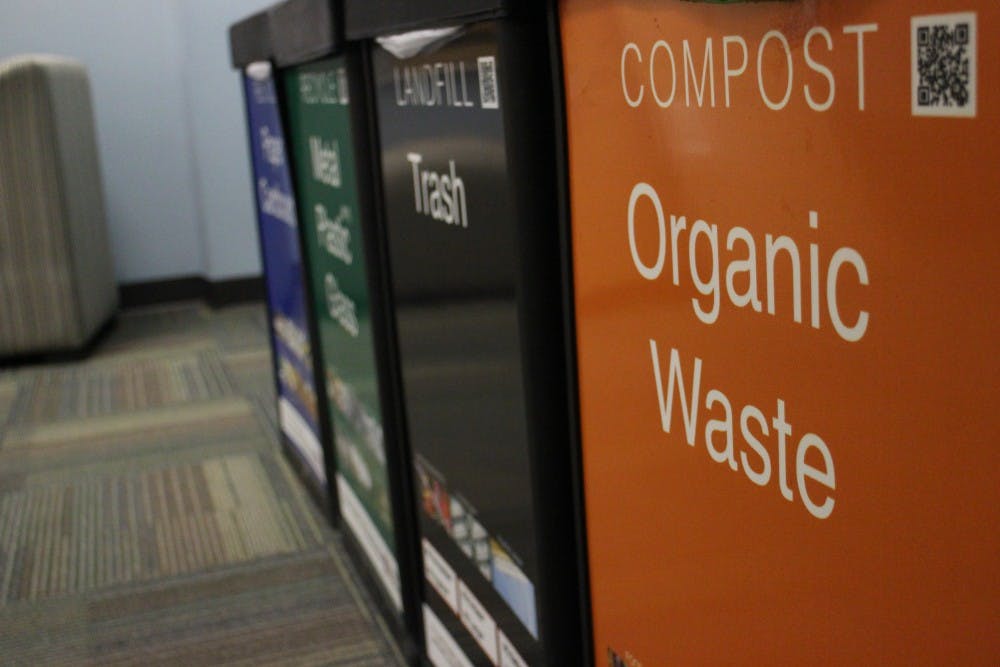
Despite the labeled orange bins all over campus, AU has not been composting for more than a year.
The University has been sending compostable waste to landfills since the Prince George’s County composting facility suspended its contract with AU in November 2014 after receiving contaminated waste.
That will change in April, however. AU renewed its contract and will begin composting again, but only from bins in select locations on campus.
The Eagle welcomes this renewal. Composting turns waste into a useful product and reduces the waste we send to overcrowded landfills, among numerous environmental benefits. The world faces immense environmental challenges, but compost initiatives like this one are a simple and effective step in the right direction.
While the renewed contact helps improve environmental efforts on campus, we regret that AU lost the composting contract in the first place. An institution that prides itself on being a leader on sustainability issues should be composting at bare minimum, if not considering more aggressive steps.
But the facility we use in Prince George’s County does not have the technology to separate glass, plastic, and other contaminants from compostable waste. If we send tainted waste to the facility again, we will probably not get another chance.
AU will be returning to composting gradually by starting with waste from TDR and the Davenport Coffee Lounge, and the Editorial Board fully supports this decision. The workers at both of these dining locations have been trained and are knowledgeable about what constitutes organic waste and therefore can help ensure that non-compostable items are not sent to the facilities from these bins.
But for composting to expand campus-wide, the AU community will have to step up composting efforts and take this program seriously. For the Office of Sustainability, educating faculty, staff, and students about composting is critical to the program’s success.
We understand composting may sometimes seem tedious and the benefits not immediately visible. The Eagle believes the University sometimes creates situations likely to cause composting contamination with its requests. One such example is making paper towels-only trash cans the only dry waste disposal mechanism in residence hall bathrooms, a situation that practically encourages contamination.



But at the end of the day, composting is worthwhile and not especially complex. The simple rule holds: if the waste was at one point alive, it can be composted. If not, it belongs in recycling or the garbage.
--E
edpage@theeagleonline.com
