
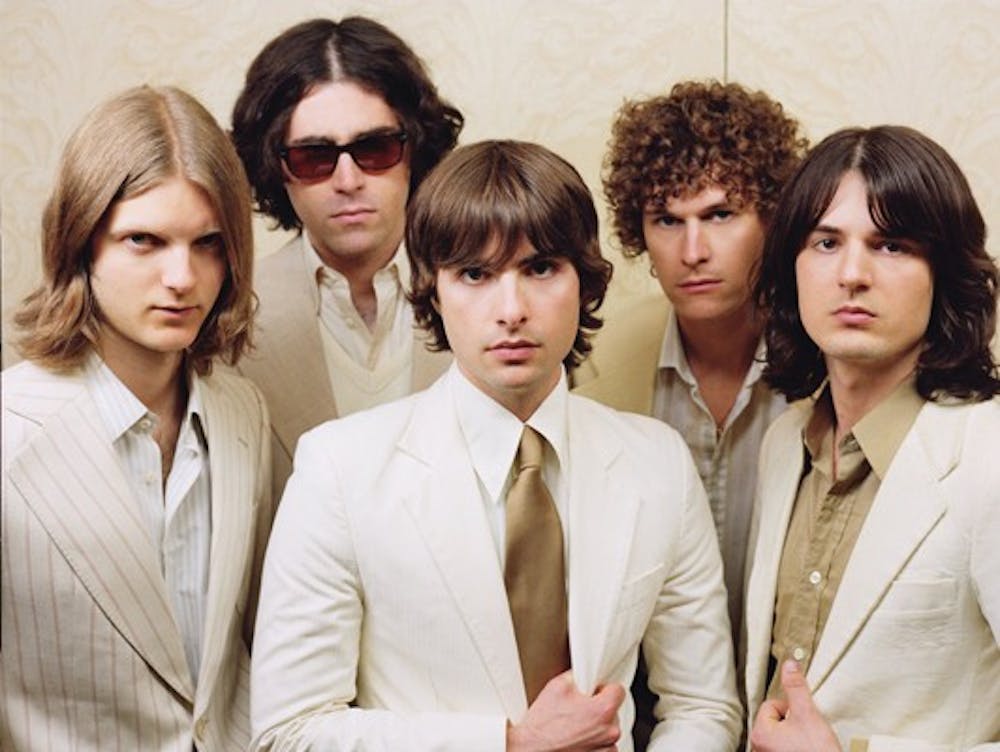
“Anyone studying music business?” asked Robert Schwartzman, lead singer of the band Rooney, to a packed club one cold Boston night in December. Several shouts from college students in the midst of finals responded in the affirmative. Schwartzman paused, smiling at the crowd before continuing on to say, “You should switch majors.”
While Schwartzman went on to take back his previous statement and call it a “new and exciting time in music,” his general sentiments are echoed by his band’s experience. Rooney, a five-piece group hailing from sunny California, signed a recording contract with Geffen Records in the early 2000s, but the band recently parted ways with the major label to venture out on their own again.
Ned Brower, drummer and backup singer for the band, shared his thoughts on the separation in an interview with The Eagle.
“It was cool for us being on a major for us while we did it, and Geffen provided us with a lot of opportunities and things but they also provided us with some setbacks, so I think we feel like we’re excited to kind of get back to where we started,” Brower said. “It’s kind of exciting to sink or swim by your own hand.”
While there is certainly risk involved in the move to independence, in some ways it is safer than staying on a label. Although Rooney began opening for groups similar to their own style, later years featured the band on tour with such acts as Kelly Clarkson and the Jonas Brothers.
“We really like headlining, then we can bring out bands that we like and play to our crowd,” Brower said of their touring history. “There was a couple funny tours on the last cycle and part of that was being on a major and having pressure ... ‘take this tour and we’ll put out the record’ type stuff ... we’re not going to do anymore tours of that nature.”
But once bands make the move to independence, they are required to take on the responsibilities of a record label, such as creating their own publicity.
“We had a Web site early on when that wasn’t really a thing bands necessarily did that much,” Brower said.


He said the new Web site (at the same address, rooney-band.com) is a product of a partnership with Miranda Harke, the longtime runner of Rooney fan site, mastedonia.com.
Harke, who said she jumped at the chance to help the band with the official Web site, has been a fan since early 2003. In addition to her site, she also heads up the Rooney Street Team, which she described in an Eagle interview as “grassroots” promotion.
“I feel like [independence is] a positive move for the band, especially with the way the music industry is headed,” Harke said. “The Internet is such a powerful marketing tool ... you can do yourself what only the major labels used to be able to do.”
This is an especially crucial time for the band, as they are on the cusp of releasing their first full-length record without the help of a major label. With what she called a “strong online following,” Harke said she is confident in the band’s abilities to capture the attention of listeners.
“The next little while leading up to the album release will be all about fine-tuning the online presence and making it as strong as possible,” she said. “That will be the most important thing.”
Rooney is just one example of a growing trend in the music industry. As more and more bands are left unsigned, dropped or separated from the major labels, the success of independents begins to rise. And with programs like Autotune, the music label giants are able to pick the artists who fit the mold they’re looking for and make them sound however they want. Such technological advances also make it easier for bands like Rooney to make a record on their own. But while Rooney is on a quest for independence, newcomers are harnessing these tools, as well as the power of the Internet, in the hopes of landing a contract with a major record label.
A perfect example of the other side of this issue is Adam Young, better known to the masses as the popular pop/alternative band, Owl City.
Young, who suffered from insomnia, took to making music in his parents’ basement late at night — an upstart story that has been paraded over the radio as his single, “Fireflies,” climbs the music charts.
In an interview with The Eagle, Young discussed his sudden fame and the Internet’s role in his discovery and success.
Signed to Universal Records in early 2009, Young could have never predicted the effect the Web would have on both his life and his music.
“I owe a lot of my success to the Internet and social networks like Myspace,” Young said. “I never expected Owl City to gain the success and attention it has, and I owe a great deal of it to Myspace and the word spreading online virally.”
For Young, everything is still new and shiny, and nothing is to be taken for granted on this wild ride. A self-described “shy guy from Minnesota,” he called the video shoot for “Fireflies” a “brand new experience.” When asked what he enjoys most about performing live, he simply replied, “I kind of love it all.”
Owl City, who will perform to a sold-out Ram’s Head Live on Jan. 29 and is returning to the D.C. area to play D.A.R. Constitution Hall on April 22, continues to utilize the Internet to build support.
Since face-to-face contact with fans is limited to meet and greets while on tour, Young tries “to stay as connected as possible with Myspace, Facebook, Twitter — all the social networking sites.”
“I think it’s a huge blessing to be able to connect with fans in such a progressive way,” he said. “Because ... the Internet is the new ... TV. Or radio. Or something sweet like that.”
At opposite ends of the music business spectrum in many ways, the difference between Rooney and Owl City can not only be seen, but also heard.
Owl City’s “Ocean Eyes” utilizes all the tools that a computer can offer, creating ear-pleasing music filled with little beeps, vocal alterations and other unidentifiable sources. “Meteor Shower,” a song that Young said, “says a lot about who I am and what I believe in a few words,” unfortunately loses some of its beauty to such conventions.
Rooney, however, has taken all the bells and whistles of modern recording and the standards held by major record labels and tossed them aside, revealing a glimpse at the past while looking towards the future. Their EP, “Wild One,” is a taste at what their new album, to be released in early 2010, will sound like: a polished band loosening up, revealing harmonies and instrumental skill galore.
While Rooney and Owl City are just two bands out there right now, they each provide a glimpse into the future of music as a new year begins. The Internet allows bands to be more available to the world than ever before, but whether that leads to signing a record deal with a major label or building a following and going independent is hard to predict. One thing is certain: the music industry is changing rapidly. To keep up, key players on both the creative and the business sides of the industry will need to adapt to the new conditions or fall behind their peers.
You can reach this staff writer at mhollander@theeagleonline.com.
