
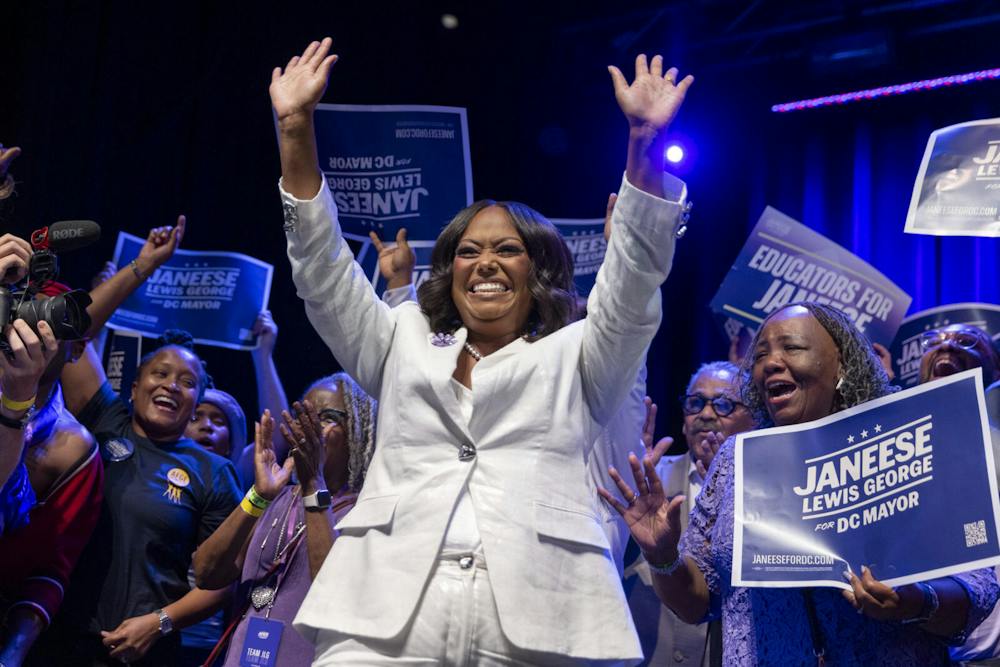
Janeese Lewis George, self-proclaimed democratic socialist, came out on top as D.C.’s probable next mayor in the district’s first ever roll-out of ranked-choice voting for the democratic primary elections on June 16.
Lewis George, currently a city councilmember for Ward 4, was announced as the projected winner after former Councilmember Kenyan McDuffie, the second leading candidate, conceded on June 18. If she wins in November’s general election, she will replace Muriel Bowser, who served as D.C.’s mayor for over a decade.
Lewis George campaigned on making housing and childcare more affordable. She’s been compared to Zohran Mamdani, the mayor of New York City, who gained international notoriety for implementing progressive policies when he entered office earlier this year. Mamdani was also elected in a ranked-choice election.
Both New York and D.C. exemplify what experts are calling a national rise in democratic socialism, born out of a disillusionment with the traditional Democratic Party.
The foundations for this election were laid long before Lewis George’s victory, as a ranked-choice election in DC is over two years in the making.
In the November 2024 election, nearly 73 percent of voters said yes to Initiative 83, which opened up the District to ranked-choice voting (RCV). This means that voters rank up to five candidates on their ballot based on preference, instead of choosing just one. Maine, Alaska, New York City and Minneapolis are some states and cities that have implemented RCV.
Will Mantell is a D.C. resident and the communications director for FairVote, which advocates for democratic voting reform on the state and national level. Mantell said D.C.’s implementation of RCV can lead to “more collaborative and positive campaigns.”
RCV can de-incentivize partisan competition because candidates seek second-place rankings from their opponents’ supporters, according to Washingtonian magazine. In the District, U.S. shadow representative — a non-voting, symbolic position in Congress — Oye Owolewa asked his base to rank his opponents in a certain order, and Ward 1 Council candidates Rashida Brown and Miguel Trandade Deramo endorsed each other.



“We saw different campaigns, we saw candidates getting into the race saying that ranked choice voting allowed them to run, we saw candidates in some races cross endorsing, encouraging voters to rank both of them on their ballots,” Mantell said.
Mantell also expressed gratitude for the voter outreach campaigns run by the D.C. Board of Elections and Rank the District.
“In terms of voter education, there was a really strong effort in D.C,” he said. Ninety-five percent of voters said they understood RCV, according to a FairVote poll.
Lewis George wasn’t the only progressive to succeed in the democratic primary. Robert White Jr., who won D.C.’s delegate seat in Congress to replace Eleanor Holmes Norton, campaigned on fighting for the District’s autonomy from federal overreach. Other progressive winners included Aparna Raj in the Ward 1 race and Owolewa for an at-large seat in the D.C. Council.
A week before the race, President Donald Trump threatened to take over D.C. if Lewis George won. Lewis George told reporters on election night that this threat only motivated voters.
Colin Johnson, a junior in the School of Public Affairs, first looked into Lewis George when he heard her referred to as the “Mamdani of D.C.”
Once Lewis George announced her mayoral candidacy, Johnson joined the campaign. He knocked on doors across Wards 3, 4 and 5, and said he rarely encountered someone averse to hearing more about Lewis George.
Johnson felt drawn to Lewis George for her views on crime, an increasingly relevant topic in the district since Trump’s deployment of the National Guard last August.
“I do believe her victory will help the crime in the nation’s capital, because she wants to go after the root causes, such as poverty,” Johnson said.
Although he’s originally from Louisville, KY, Johnson chose to vote in D.C., and said other college students should do the same, “Because the water you’re drinking is in D.C., the roads you’re riding on, driving on, are in D.C., everything that directly affects you is in D.C., locally.”
Ward 3, where AU is located, was the only ward where McDuffie won the majority of votes, according to NBC News. With Ward 3’s exemption, Lewis George’s 16-percent lead spanned city-wide.
Still, Johnson saw the bright side: “[Ward] 3, she was supposed to get slaughtered in, but she only lost it by two points,” he said.
Mariah Nell-Nieves, a junior in the School of International Service, also said she wanted to be involved in local politics because she spends most of her time in D.C. and is considering moving to the District full time after she graduates.
Nell-Nieves found out about Lewis George through a friend and first attended an event back in January. Walking into the Howard Theater, she said she was immediately drawn to the “inviting,” “welcoming” and “refreshing” energy Lewis George facilitated. She remained in communication with the campaign’s volunteer circles and went to more events for Lewis George over the past six months.
Leading up to the election, Nell-Nieves never let go of that excitement.
“Just seeing what D.C. has gone through in the past year, seeing what the community had to say when I was at these types of events, it didn’t seem like anyone else was going to win,” she said.
Despite her captivation with the energy of the campaign, Nell-Nieves’ said that such energy relies on tangible action by Lewis George if she is to become D.C.’s next mayor.
“My major hopes would be just for her to stick with her word,” Nell-Nieves said.
This article was edited by Sophie Milner-Gorvine, Cara Halford and Gabrielle McNamee. Copy editing done by Avery Grossman, Nicole Kariuki and Mattie Lupo.
