
The following piece is an opinion and does not reflect the views of The Eagle and its staff. All opinions are edited for grammar, style and argument structure and fact-checked, but the opinions are the writer’s own.
David Marchick, the former Dean of the Kogod School of Business, was announced as interim president of American University on May 27.
He assumed the position following former president Jonathan Alger’s late June departure. On Sept. 17, the Board of Trustees announced via a university-wide email that Marchick would hold the interim president position for at least the next two years.
These changes have unsettled community members — Alger’s formal inauguration was only two years prior. Marchick makes for the University’s third figurehead in less than three years.
A turbulent state of affairs in the nation and world backdrop this leadership commotion, leaving students, faculty and staff wondering what’s in store for our community.
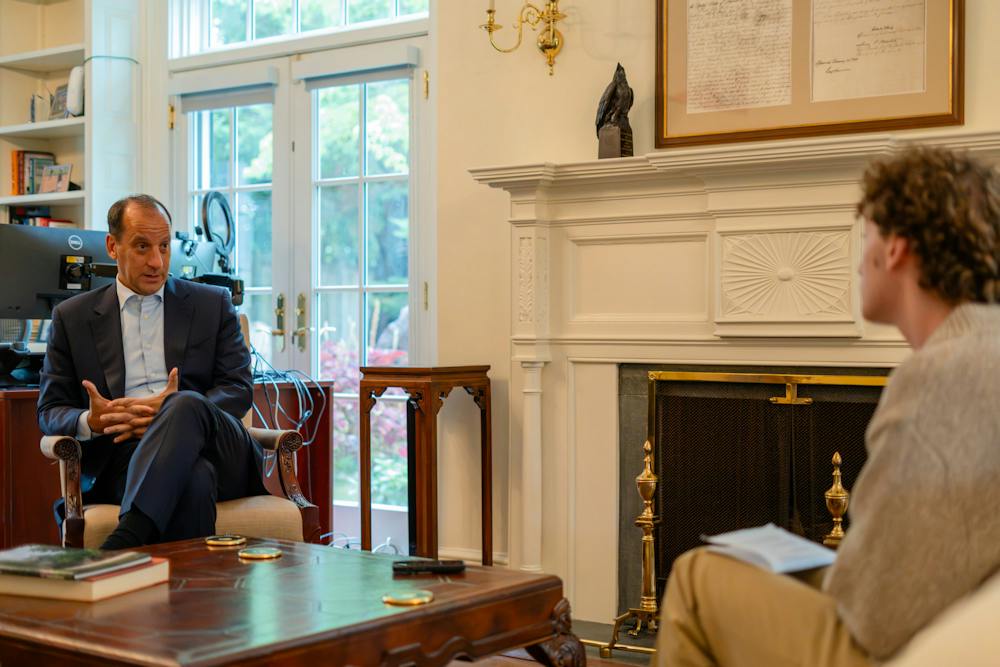
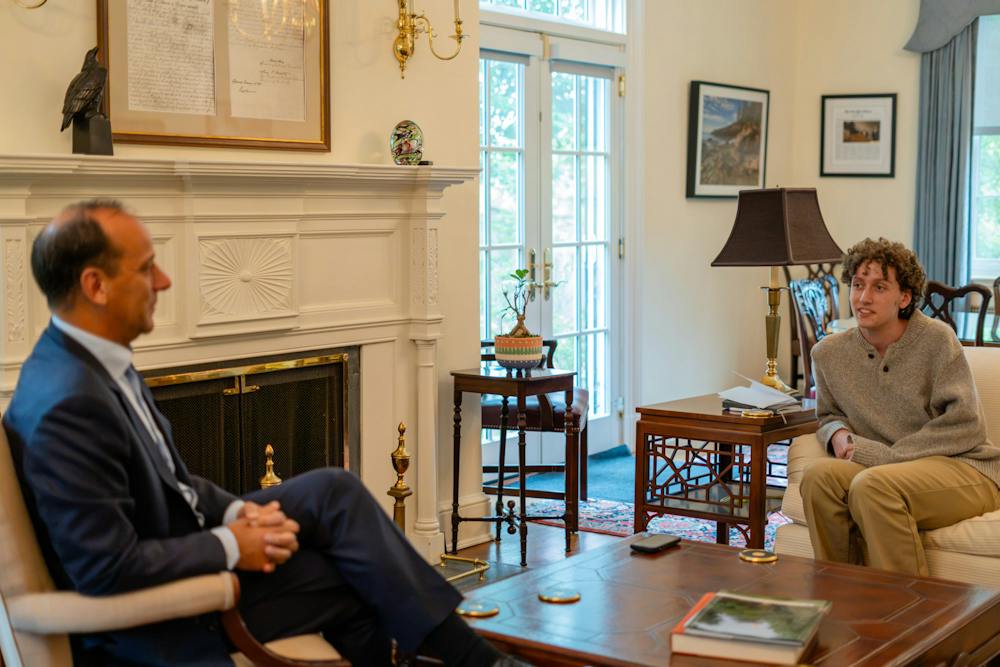
I sat down with the interim president to discuss. The following questions are the result of conversations with students and Eagle staffers.
Alright, we’ll start with AI. In a previous statement made to The Eagle for an op-ed titled “Weighing AU’s climate reputation with Kogod’s AI obsession,” the University stated that environmental effects of AI are an “academic and operational imperative,” but not easily measured. At the time of the article, existing sustainability metrics did not factor in environmental costs of AI usage. How do you understand AU’s climate commitment with the growing necessity of AI proficiency?


Great question. When I was at Kogod, we openly embraced the tension between AI and sustainability. In fact, there is a student-led publication called the Kogod Sustainability Review, which did a whole issue on it.
AI uses energy, and the growing demands of AI are dramatically increasing energy usage. AI has become much more efficient in the past few years, so using AI for an hour (depending on what you’re using it for) can be the equivalent of watching Netflix for an hour, or scrolling through TikTok for an hour.
So, we worked with our sustainability office to offset the energy usage, the climate impact associated with the use of Perplexity. The contract between Kogod and Perplexity provides Kogod students with that. So we’ve offset that from a climate impact.
Does that fold into the University’s existing climate metrics?
I believe it does. You’d have to ask the Office of Sustainability. I focus on my time as Dean.
Makes sense.
I also think that there’s a lot of misinformation out there. For example, water usage. There is, in all the data centers combined — this maybe is 6 months old, I’d have to look at the new data — but I remember all the energy usage combined for all the data centers in the United States use less water than the golf courses in Palm Beach County on a regular basis.
So the final thing I would say is that AI can be a tool for improvement of sustainability goals. And in fact, at Kogod, our Sustainability Management students are using AI tools to find solutions to the climate crisis to improve efficiency of water use. We partnered with companies to use AI to identify new solutions to climate problems. AI can also be a tool to address our climate crisis in positive ways. So I think there’s definite tension, and the way we’ve approached it at Kogod was to embrace that tension, and to talk about it, and then to address what we could.
In the same vein of misinformation and fear around AI, a lot of students outside of Kogod voice concerns that AI will be pushed into their programs without them wanting it. Adding to the fluster and misinformation, there’s no uniform AI policy. Every professor seems to have a different policy which overall makes it difficult terrain to traverse. And so my question for you is, how does the University balance those ethical questions and fears with, again, the growing necessity of AI proficiency?
So first thing is, there’s no policy to require AI usage across the University. This would be a decision that would be led by the Provost, she’s the chief academic officer, in conjunction with deans and faculty. At Kogod, there was a decision to embrace AI because of the feeling that business students should be equipped with skills to responsibly and ethically use AI when they graduate. And in fact, a Kogod survey showed that almost 50 percent of the students who were interviewed for jobs last year, seniors, or graduate students, were asked about their AI skills. And that was up three and a half times over the previous three years.
So my own personal view is that students should learn how to ethically and responsibly use AI in whatever subject they study. So if you’re gonna be a physician, and want to go to med school, if you graduate [undergrad] in 2028, for example, you graduate med school in 2032 or 2033. By the time you finish your residency and are actually practicing medicine, it’s going to be 2037 or 2038. And AI is gonna be infused in all aspects of healthcare. And so in my own view, someone who goes to med school should get their bio or whatever their STEM degree is; have their labs, have their internships, have good grades, but also have some understanding of ethical and responsible AI use. That will not only help them be a better doctor, it’ll also help them get into a better med school.
I think if you’re a poetry professor, you have a very different view on AI than if you are a marketing professor. If you go into marketing or PR today, you can’t do your job without AI. But if you’re a poet, probably most poetry professors or literature professors have a very different view than the average marketing professor.
Yeah, absolutely. And that’s precisely the heart of my next question. People still have this fear. They see the necessity and how it can help them in the job market. But they don’t like that. So, again, they fear AI being pushed into their programs when they don’t want it. I think that underscores the need for some kind of centralized AI policy, I would argue, so that people know how to operate. And so, would you see value in a centralized AI policy?
I think that I would defer to the Provost. She’s the chief academic officer. She is the person in charge of all the programs, and so I would be happy to work with her, but ultimately, it’s gonna be up to the Provost and to the Deans and to the department chairs.
We’ll move now to student thriving and community life on campus. Something you hear from undergrads, regardless of where they go to school, is that it’s very difficult but important to find ‘your people.’ What do you think makes our community special? And what do you see as your role in fostering that sense of community on campus?
I think this is an incredible community. Our students come to school in the most beautiful campus in the most important city in the world — in my view. They benefit from the best; coming to a research university with the essential heart of liberal arts, small classes, attention to teaching. My daughter went to Berkeley — wonderful university, very prestigious from a research perspective. In four years, she met one professor that knows her name. Okay, so that’s a one to four ratio. At AU, you have a four to one ratio. You have four professors who know your name in your first week of class, and I think that’s wonderful.
And then we have a very diverse community of students that are interested in politics, or the arts, or theater, or literature, or sports. And we offer it all. And I think that the best of AU is the fact that we offer different options for students with different interests. And that you have the ability to meet like minded students, and you also have the ability to meet students who are very, very different than you. And that’s what makes our university community so rich.
Couldn’t agree more.
I love our students, I love going on [the] quad and talking to students. I know a lot of their names. When the [Kogod] students graduate[d], I probably knew a third of their [names]. I gave a third of them a hug because I knew them. And that’s one of the best parts of this job, is to engage with students across the campus.
I want to focus on what you said in the last part of your first answer. I think engaging with difference is absolutely crucial. You highlighted that in your convocation speech — the incredibly diverse backgrounds of our incoming class. And so, I want to launch off of that and ask you about the University’s commitment to civic responsibility. Your predecessor Jon Alger, he unveiled The Civic Life for this purpose, right? To instill a set of civic values on campus, engage with difference. Today, those web pages are blank. And so my question to you — coinciding with the AI/business focus — students are left wondering where the University is headed. What do you say to students that wonder about AU’s civic commitment presently?
President Alger had Civic Life as his signature initiative. I think it’s a wonderful initiative. And I think one of the things that I learned from President Alger was that it’s really important to be able to disagree agreeably with students who have different views, or faculty or people in the community. It remains part of our strategic plan. We continue to have work done in our curriculum on aspects of civic life. This was part of his DNA, and it was his signature program, and it remains an important part of our university. It’s just, I’m a different person with different priorities. But I think that in this polarized political environment, those issues are more important than ever. I hope that we can drive the campus community to ensure that we foster ways that people with differences can disagree in an agreeable way, and that we learn from each other.
It goes back to what makes this community so special is that ability, but I would press you still on this. Absent Civic Life, which seems like it has gone by the wayside, people wonder what our tangible commitment to civic dialogue is. Do you see the necessity of those programs? Do you see yourself implementing something in your style?
The strategic plan includes a large element of civic engagement, and that strategic plan continues to be in place. Okay. So I didn’t change the strategic plan when I came in.
Okay. Related to engaging with difference and expression on campus, a contentious topic on campus and the world has been Gaza. And amid ongoing debate on campus, many students find the University to be particularly hostile to their specific viewpoint, specifically pro-Palestinian activism. My question for you, as the figurehead of the University, how do you respond to that? How does that communicate with your stated belief that difference is important and free expression is important?
So I love the fact that AU students are passionate about these issues, and they’re passionate about injustice in the world. I think the University welcomes those passions. The University doesn’t have a viewpoint on the issues. I think every university has struggled with finding the right balance between supporting and empowering student[s], staff and faculty to express their viewpoints, including protests. I grew up protesting. With balancing the needs of the University to continue to operate and not have classes interrupted, to not have events interrupted, to allow people with different viewpoints to be able to speak on campus and to allow people that want to hear a particular viewpoint to enjoy that; universities have struggled to find the right spot where to land. And I think that we need to continue to work on that. So, I’m committed to working with our Student Affairs Division with student organizations to ensure that we are a community that embraces diverse viewpoints, supports passionate expression of speech. And AU also has a long history of protest and fighting for change.
So for example, one of the most famous alums was a suffragist, and was involved with the first protest ever at the White House and was arrested for fighting for women’s right to vote — went on a hunger strike and then was force-fed by the police. In the ‘70s, AU students protested along Mass Ave to fight a war they didn’t believe they should be called to fight [in] or drafted [to fight]. That element of our community is really important, and I think that every university struggles with finding the right balance. And we hopefully can work to get that right.
Like you say, the University has a long history of this positive activism and has embraced it and marketed it. However, it also does have a recent history of fraught expression. I’m thinking specifically of the graduate student Elaf Hasan, who was prosecuted and suspended for displaying a Palestinian flag at Alger’s inauguration. In the face of this, people want solutions. As you say, it’s hard to strike the balance. But in the course of striking that balance, there are real consequences for student speech and whether or not students feel like they can openly express themselves in a place that is ‘committed to open and respectful dialogue.’ I’ll give you a material change offered by the AU Student Government* in the wake of Hasan’s judgment: They asked the University, in a letter, to implement an Independent Policy Oversight Committee, safeguarding expression and civil liberties on campus, [calling it] a measure that the University should undertake. Do you see that measure as something worth considering?
*[Clarification: The mentioned letter was reposted by AUSG on their Instagram, endorsed by AUSG’s Executive Board. The letter — and the call for an Independent Policy Oversight Committee — originated from the AU chapter of AAUP.]
I’m open to considering any ideas that can help the University find the right balance between embracing and fostering and supporting free expression, but also ensuring that the University can operate effectively. And that students also don’t feel like they’re targeted. So, I look forward to working with faculty, staff [and] students to try to find that right balance. That includes any work looking forward [and] has to include work looking back to see what we got right and what we got wrong. I’m open to looking at that.
Gonna shift back to student thriving. The Meltzer Sports Center opened earlier this year as part of a multimillion dollar investment in “student thriving.” Concurrently, key programs in SPA have slid down national rankings. People with on-campus jobs report less available hours, and laundry costs have risen. Students worry about affordability and wonder about the University’s priorities. What do you say to students who feel like the University could be doing more?
Universities, for my entire lifetime, have raised tuition at a rate higher than inflation. That has led to, I think, deep skepticism in the country about the affordability and value of education. My own view is that the two biggest investments most Americans will ever make are in their education and in their house — those are the largest financial decisions they’ll make in their lifetime. I think that our strategic plan directly addresses the issues related to why Americans have become more skeptical of higher ed. We allocated, for example, more financial aid this year than in the history of the University to first year students. We also allocated more financial aid to transfer students than ever before. Universities across the country are facing huge challenges for a variety of reasons: democratic drift, government policy, AI. And that’s forcing universities to make difficult choices on resource allocations. So the days of rapid growth up into the right are over for universities, and that’s making it more and more difficult for universities to allocate resources effectively.
I think at AU, what we want to do is to prioritize and continue to invest heavily in the areas where we’re truly unique, which includes the School of Public Affairs. And that also means that there will be some challenging choices elsewhere. But affordability is a huge concern at all universities, not just AU, and we are doing our best to address it.
Alright, final question. There’s broader distrust of institutions in America. And we see that on our campus; it feels like admin doesn’t care about what we care about, for lack of more articulate phrasing. From what I’ve heard from you, there are things that the University is doing to address the problems that students communicate. So my question for you, drawing on this kind of broad distrust of institutions, what do you think is driving that disconnect? Is it messaging? Unamplified voice? Is there opportunity for the University to do more?
It’s a great question. If you look at the data, Americans’ confidence in institutions has eroded significantly over the last 20 years. Part of that is, I think, the increased polarization of our country. Americans who support whoever is in power have a rosier view of institutions and the economy than those who are not [supporting those] in power, okay? You saw that under President Obama. You saw that under the first President Trump, you saw it under President Biden and you are seeing it under Trump’s second term. I don’t think that we should have a romantic outlook on ‘if only things were the way that they used to be,’ because the way they used to be, actually, was not as good as it is today, because we’re much more focused on equality, equity, justice, differences and embracing all of our differences.
So overall, we’re a much better society today — notwithstanding our problems — than we were 20, 30, 40, 50 years ago. I guess my own particular approach while I’m in this job is to be one of a servant leader. So I’m not teaching a class, I’m not coaching a sport, I’m not an RA. I’m not delivering what we deliver to our students. My job is to make sure that our institution responds as well as possible, and as quickly as possible, to the concerns of those whom we are serving, which are students. And so the way I’ve tried to approach that job is to — I did this as Dean, too — get to know our students, understand their concerns and understand what’s going on. Support them. Help them solve problems and then also help adjust to issues where institutions have not delivered. And so that will be my approach in this role. Will I be perfect? No, I’ll make a lot of mistakes, but I’m here for the students. And I feel like my role is to serve them and to support them and to make this the best university it can as long as I’m in this job.
Harry Walton is a senior in the School of Public Affairs and the managing editor of The Eagle’s Opinion section.
This article was edited by Cara Halford and Gabrielle McNamee. Copy editing done by Avery Grossman, Mattie Lupo and Ryan Sieve. Fact-checking done by Luca Palma Poth.
opinion@theeagleonline.com
