
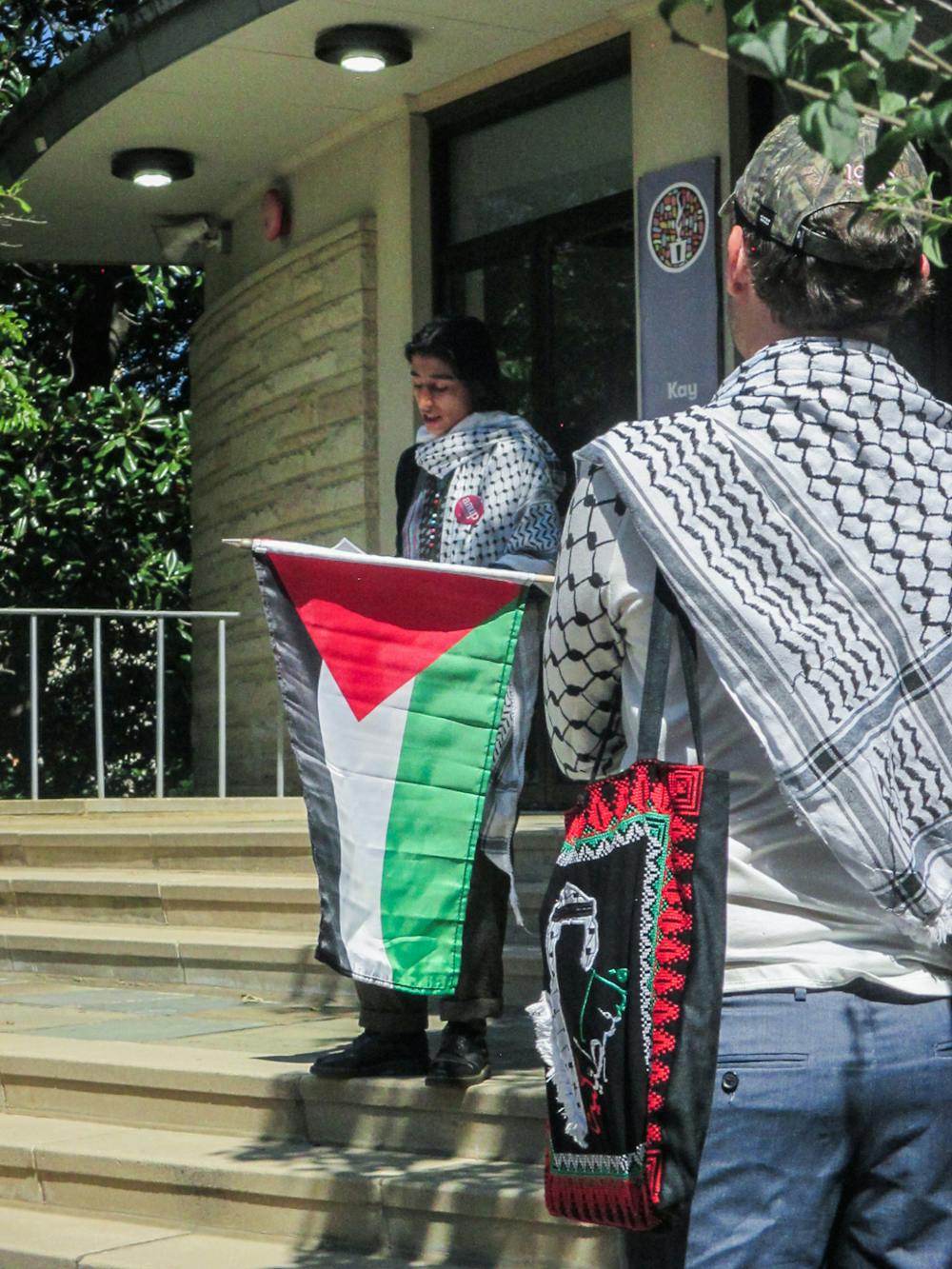
On Sept. 9, Students and faculty gathered on the steps of the Kay Spiritual Life Center to protest the University’s treatment of Elaf Hasan, a School of International Service graduate student charged for her silent protest at the inauguration of former American University President John Alger.
Hasan said that the inauguration was a test to see where the state of the University truly lied. After hearing former AU President Jonathon Alger’s speech on the importance of inclusion, civic dialogue and pluralism, Hasan wanted to see if the University would make good on its promise.
As a student studying international peace and conflict, Hasan said speaking up for the lives lost in Gaza is what her coursework has been training her for. Hasan’s behavior was typical of a non-violent protest: she stood silently, making a statement, and as a result, she said she was met with forceful silencing.
“This is an academic setting,” Hasan said. “This is where you speak about anything and everything you want without being censored, without being thrown in jail, without being suspended, without being sanctioned or put on probation; all these happened here at AU. This is the reality we live in.”
The protest was primarily organized by the American University chapter of the American Association for University Professors (AAUP), with help from AU Rise Up, AU Young Democratic Socialists of America and other campus allies.
John Brock, chapter president of AAUP and associate professor in the College of Arts and Sciences, said that the Sept. 9 protest sought to hold the University accountable for its behavior towards Hasan.
“We’re doing it because the administration is abusing power,” he said.
Students attending the protest chanted as they made their way around the quad and toward the president’s house. Protesters displayed Palestinian imagery pinned onto backpacks, shirts and hats. Supporters were draped with keffiyehs around their necks and heads.

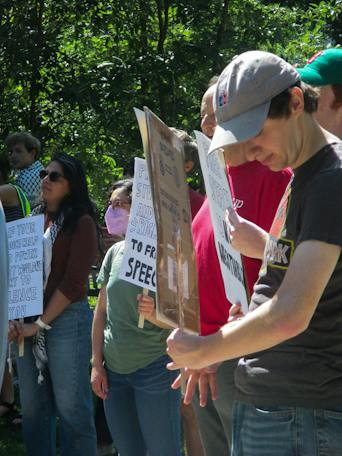
Many marched with signs with statements expressing solidarity with Hasan against the University administration. Some read, “Admin grow a spine, Protect students”; “Stop silencing the changemakers!” and “If your voice held no power, they wouldn’t try to silence you.”
Malini Ranganathan, an associate professor in SIS and one of the speakers at the event, said that one of her most cherished rights as a professor is academic freedom. American University has had a long history of protecting civil and political rights, but right now, Ranganathan said, the University is betraying itself.
“Without freedom of expression, we have no freedom of thought,” Ranganathan said. “Without freedom of thought, we aren’t fully human. So I truly believe that this gets to what it means to be a human being and to be a citizen in this world.”
The University, however, states that it remains committed to dialogue from opposing perspectives.
“American University supports the rights of our students, faculty and staff to express their views, including criticism of the university and its leadership,” Katya Popova, interim vice president of marketing and communication, told The Eagle in a statement, “We recognize that members of our community have strong views about this matter, and university leadership is ready to engage in dialogue about these important issues.”
According to previous coverage by AWOL, Hasan was charged with unlawful entry on private property for attending the inauguration, and attempted threats towards Phil Morse, assistant vice president of the University Police Services, and Donnell Bullock, a University police officer. According to Hasan’s legal counsel, the University held her in prosecution for over a year on these charges.
The Superior Court of the District of Columbia dismissed the case due to the University’s violations of Hasan’s right to due process, according to AWOL.
When asked about the University’s treatment toward Hasan, Popova said the University is still reviewing evidence and will proceed with the appropriate changes. However, the University continues to monitor communications about the event carefully.
The Sept. 9 protest was responding to the University’s continued behavior regarding viewpoint discrimination on campus, according to Brock. Viewpoint discrimination is when “the government targets and restricts speech based on the specific ideology, opinion, or perspective of the speaker,” according to The Free Speech Center, a nonpartisan think tank focused on strengthening the public’s understanding of First Amendment protections. In his speech, Brock said that Hasan and other students have borne the brunt of the University’s harshest actions.
In the past, the University has been criticized for its response to pro-Palestinian protests on campus, including the suspension of the University’s chapter of Students for Justice in Palestine. For Brock, Hasan’s removal felt like another way the University has gone against their mandates toward free speech and expression.
“AAUP’s mandate is academic freedom, shared governance, and freedom of expression is a part of both those things,” Brock said. “What they did when they brought the police to Elof, and then had her arrested and sent to downtown D.C. was to basically take away her freedom of expression and to criminalize it.”
Carol Gallaher, vice president of AAUP and another professor in SIS, emceed the event and echoed Brock’s sentiments. Gallaher and Brock believe that they have an active responsibility to protect student freedoms on campus.
“You have to fight for [free speech] constantly,” Gallaher said. “You have to make sure the administration understands that we are not giving up on this. That this is right, and we’re going to keep demanding that we have it, and defending people that engage in it and are punished for doing that.”
During the event, AAUP members and lead campus organizers shared speeches discussing how Hasan’s story reflects a larger trend on college campuses: the “Palestinian Exception” in free speech and expression.
The Palestinian Exception, coined by a joint project from The Center for Constitutional Rights and Palestinian Legal, is the phenomenon of suppression of Palestinian human rights advocacy across university campuses. Palestinian Legal, an organization committed to increasing Palestinian solidarity through research and litigation, reported how methods such as event cancellations, baseless legal complaints, inflammatory accusations and administrative disciplinary actions violated academic freedom and free expression.
That exception continues to permeate college campuses. According to the Boston Bar Journal’s legal analysis, the numbers of universities that undermine student activism toward the Palestinian-Israel conflict continue to grow. According to Ranganthan, the University continues to participate in the “Palestinian Exception.”
“Over the last few years, [AU] has not lived up to these professed standards,” Ranganathan said. “It has taken some steps that have very explicitly silenced free speech when it concerns protesting Israel and America’s genocidal actions against Palestinians.”
Mara Verheyden-Hillard, legal counsel to Hasan and a speaker at the rally, echoed the sentiments of Ranganathan, and criticized the University’s decision to bring charges against a student.
“AU, like institutions all across the United States, made a decision that they were going to serve up their students, they were going to serve up academic freedom, they were going to throw it all out the window in service to viewpoint discrimination,” Verheyden-Hillard said. “They want to send a message that if you stand for Palestine, you will be crushed.”
Verheyden-Hillard is a constitutional rights litigator, and the co-founder of the Partnership for Civil Justice Fund, a nonprofit which focuses on defending social justice movements and democracy through challenging the government’s attempts to erode constitutional rights.
To her, student activism is needed now more than ever. The world’s social response toward inequality has changed because of the current generation’s relentless toward holding institutions of power accountable, according to Verheyden-Hillard.
“The students have changed consciousness in the United States because they stood up against incredible odds. They stood up and were met with extreme repression by their institutions, including AU, and they didn’t back down,” Verheyden-Hillard said.
The rally concluded with Brock, Gallaher and Hasan marching to the president’s house to deliver a 14-page petition on how the University can rectify its actions toward the students on campus.
The petition detailed four explicit actions that the University must take:
- It must recommit itself to freedom of expression and to protecting civil liberties for every member of its community.
- It must clear Elaf Hasan’s disciplinary record, provide restitution for the costs that Hasan incurred and acknowledge what happened to her was wrong.
- They must reinstate Students for Justice in Palestine.
- They must create an independent policy oversight committee composed of faculty, staff and students. This committee must have the power to review unjust administration actions and sanctions, with the power to stop the University when they’ve acted incorrectly.
According to Hasan, the University will praise the same actions it once suppressed, under the banner of civic action and discourse. The important thing, she says, is to remain vigilant and to keep fighting.
“Speak out, be out there, protest, teach and whatever action you think is going to pull AU admin from the bloody road that they’re taking,” Hasan said, “because at the end of the day, they represent us and we represent them.”
This article was edited by Sophie Milner-Gorvine, Cara Halford, Jessica Ackerman, Isabella Polak and Gabrielle McNamee. Copy editing done by Avery Grossman, Mattie Lupo and Jaden Maitland Anderson.
