
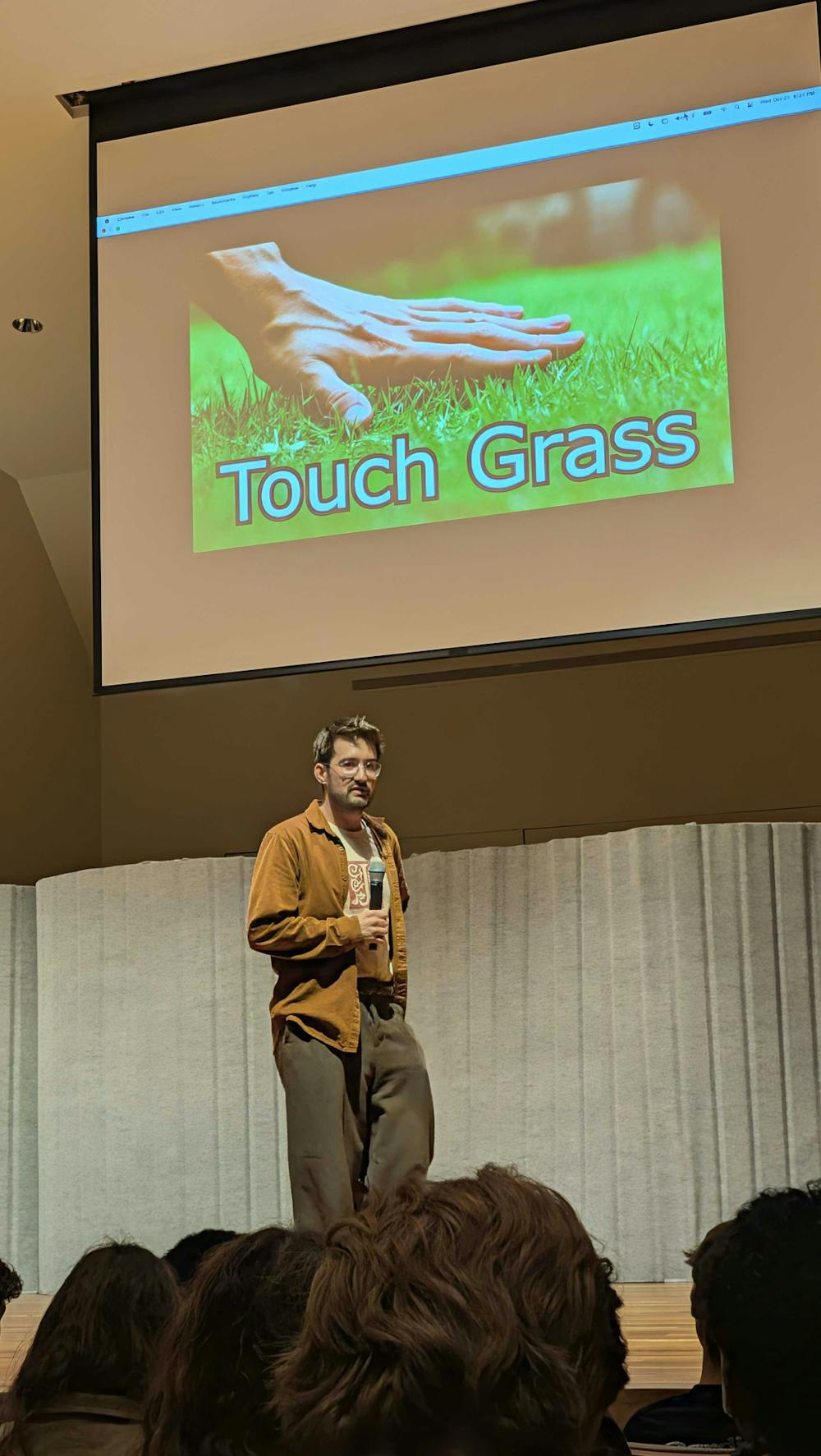
The American University College of Arts and Sciences hosted influencer and linguist Adam Aleksic to discuss the growing evolution of internet “slop” content and explain why this social phenomenon continues to spread rapidly online.
Aleksic, better known as the linguistics-teaching content creator @etymologynerd across TikTok and Instagram, presented his keynote lecture “The Semantics of Slop” for the Hugo J. Mueller Linguistics Lecture Series at the Katzen Art Center on Oct. 21.
The Mueller Lecture hosts scholars to discuss relevant social issues that can be applied through a linguistic lens. Amelia Tseng, director of the linguistics department and associate professor in the World Cultures and Languages department, emphasized how important student input was to creating this event.
“We appreciate all the support we’ve gotten across campus, from co-sponsors and from AU Media and from professors and students,” Tseng said.
With over 10 campus co-sponsors and 250 attendees for the event, Katzen was packed from wall to wall, and a television livestreaming the lecture was set up outside for those that couldn’t get in the packed theater.
Before Aleksic stepped on stage, he was already taking photos and talking to attendees. Aleksic said it was nice knowing that students were eager to critically analyze something as absurd as “internet slop.”
“I think it’s been an overwhelming positive response. I’m very glad to see such incredible turnout, and that willingness to engage,” Aleksic said.
Aleksic’s “Semantics of Slop” led the audience through the linguistic beginnings and evolution of the concept of slop, starting in 16th-century England with the word “sloppe,” referring to waste that is consumed by pigs, to our current usage.


Internet slop today is defined as “digital content of low quality that is produced usually in quantity by means of artificial intelligence.”
Aleksic referred to images like Fruit Love Island, Ballerina Cappuccina and Tung Tung Tung Sahur as popular examples of this kind of internet content. However, these funny, nonsensical videos aren’t the only type of internet slop that exists. “Slopaganda,” “political slop,” “AI slop,” “slopulism,” and “slop bowls” are other examples of how the word “slop” is being used as a verb rather than a static noun.
Rabbana Bari, a junior in CAS with a minor in linguistics, saw this as an opportunity to better understand her 13-year-old brother by hearing a professional explain his much-used phrase “skibbi-toilet.”
“That’s the only thing I don’t know; everything else I pretty much understand. I’m really excited to see how this is because it’s a different perspective, or a professional perspective, of today’s lingo,” Bari said.
Bari’s curiosity reflects the hopes of Tseng and Aleksic, who both praised the current generation’s hunger for discussion and interdisciplinary analysis.
“I love engaging with students. I think that they’re so willing to engage critically with topics that we dismiss as frivolous, like brain rot and slop,” Aleksic said. “I see the way people are asking questions here, and I think it’s fantastic and I love being around people who both know the culture and are willing to think about it.”
“Brain rot,” which was Oxford’s Word of the Year in 2024, is defined as “the supposed deterioration of a person’s mental or intellectual state, especially viewed as the result of overconsumption of material (now particularly online content) considered to be trivial or unchallenging.”
Aleksic hoped his talk inspired students to reconsider their media consumption habits and push back against the narrative that short-form media doesn’t have an impact on our psyche compared to other media like classical literature, unprecedented historical moments or critically-acclaimed films.
“There’s a tendency to write off social media as low culture, as low art, and then not think critically about it, and my hope here is to challenge that mentality,” Aleksic said.
Beneath the initial laughter, the core of Aleksic’s lecture centered on two key points: slop acting as metacognitive critique of performance and quality and how slop content is optimized for emotion-based social media engagement.
Aleksic emphasized that “slop” is mass-produced, engineered content that is rapidly shared across short-form content platforms like TikTok or Instagram reels. Aleksic pointed out that poorly-made “slop” products can be produced in any industry, and he cited the oversaturation of Christmas Hallmark movies and cheaply made socks with Vincent Van Gogh’s “The Starry Night” as a spectrum of slop that can exist.
Aleksic’s presentation was footnoted with scholars such as Sophie Publig, who examined the broader social, political and philosophical ramifications of artificial intelligence, and a joint research paper by Tina Kendall and Markelj Jernej, who studied how brainrot AI slop contributes to the “enshitification” of the internet.
Enshitification, coined by journalist and digital rights activist Cory Doctorow, describes, “how online platforms and services lose quality over time as they prioritize profits for shareholders and executives over users and business customers.”
Aleskic’s lecture pointed to this phenomena as a component of how social media companies continue to degrade their platforms and by proxy users’ emotional relationships with their sites, by allowing internet slop content to permeate people’s feeds.
But not all hope is lost. After laying out his understanding of the changing social media landscape and its effect on the current cultural psyche, Aleskic presented a simple solution: touch grass.
After the audience’s laughter subsided, Aleskic outlined four steps that everyone can incorporate in their media diet:
- Remove the incentive to degrade products. This means pushing for serious regulation on private corporations and their metric algorithms for what type of viral content gets circulated on their platform.
- Produce intentionally. No more “taste-maxxing”: think critically about what you’re making and who you’re making it for
- Change the mode of consumption. Healthily detox from the digital world from time to time: take the knowledge of “touching grass” and apply it to your life online.
- Change the mode of looking. Think about why you’re looking at something, and examine the emotions you feel while consuming social media content.
There’s still hope to reclaim our agency and combat against internet slop, brainrot humor and doomscrolling, according to Aleksic.
“It’s just very difficult to have your brain turned on all the time when you’re scrolling through social media and I, myself, have been guilty of just letting yourself be carried away by the algorithm, but it’s a process, and something you learn to negotiate with yourself,” Aleksic said.
This article was edited by Sophie Milner-Gorvine, Cara Halford and Gabrielle McNamee. Copy editing done by Avery Grossman, Abigail Jose and Mattie Lupo. Fact-checking done by Josie Burnette.
