
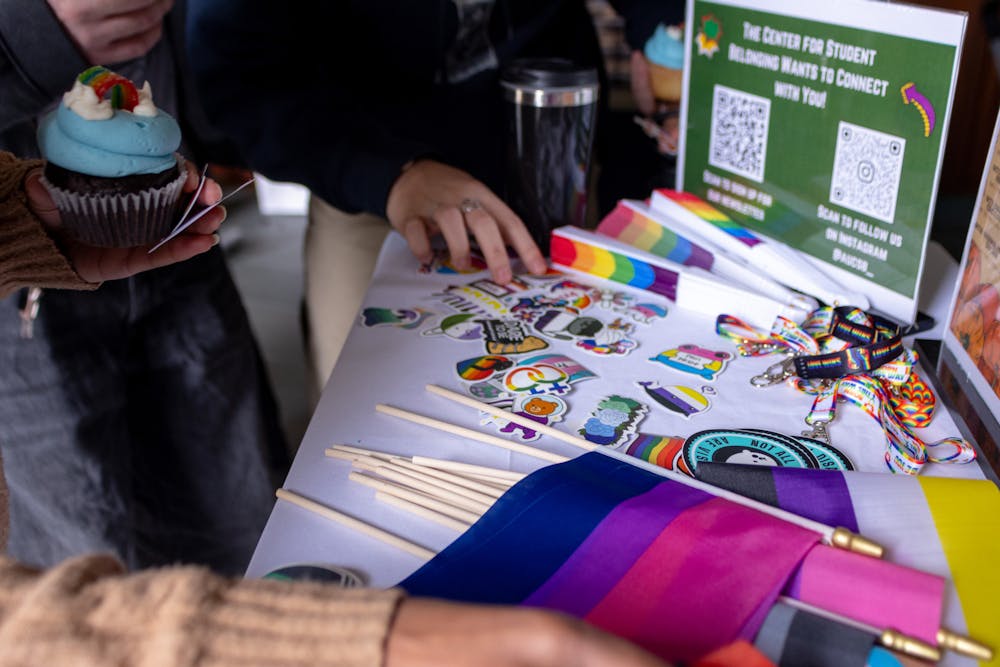
Walk across American University’s quad long enough, and you’ll hear it — half a joke and half a point of pride — “Gay-U.” The nickname continues to envelop the University’s identity, a campus-wide shorthand that lands differently depending on who’s saying it — and who’s listening.
For some, it’s a slogan. For others, it’s a mirror that reflects a broader campus culture that celebrates queerness loudly in some spaces, while subtly leaving others behind.
The University has said it “prides itself” on offering affirmation to the LGBTQ+ community and its allies. Its resource center within the Center for Student Belonging offers programming, resources and on-campus spaces for queer students such as the Trans and Queer Cooperative (“TQ Co-Op”), which provides free clothing, makeup and other gender-affirming materials.
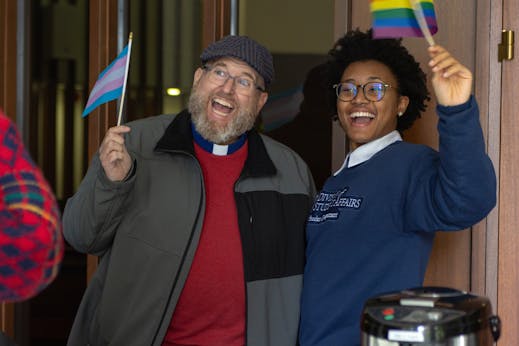
However, “Gay-U,” as a cultural artifact is more complicated than it appears. Several queer BIPOC students said there is a gap between what the University’s resource centers promise and what they experience in residence halls, bathrooms and administrative offices.
Mercy Asamoah, a recent graduate of the College of Arts and Sciences and former president of BraveSpaces, said certain associations and stereotypes are invoked when people use the term “Gay-U.”
“People that are associated with the term of being at ‘Gay-U’ are usually white and queer, as opposed to Black and queer folks,” Asamoah said.
As a result, the University’s programming is often surface level, Asamoah said.
“I know people want to delve even further into aspects of queerness, what queerness means to them and how interacting with other people kind of influences perceptions of their own queerness; stuff like that,” Asamoah said.
Joshua Lee, a rising senior in the College of Arts and Sciences who uses he/they pronouns, has worked to build Black and queer community on campus by working on a seminar series with the Center of Belonging and hosts weekly screenings of Rupal’s Drag Race, bridging drag and queer culture and entertainment with education.
Lee said it is crucial to note that the nickname was coined by the campus’s heterosexual student population.


“Straightness is the norm,” Lee said. “There’s a need to point out when it’s not a norm in a space, and therefore straight people started calling AU ‘Gay-U’ because they’ve noticed so many gay people here.”
Lee said the nickname reinforces social “othering,” a concept that refers to the structural marginalization of certain identities. The nickname, although seen as a joke to most, reinforces the hierarchical divide between the heterosexual and queer students, he said.
Lee said he also finds something personal in what the label hints at. Although most spaces are heteronormative, he said the University’s queer culture is more visible than others. It’s casual and normalized in a way that he said still feels meaningful to him.
“I think it goes to show the culture on campus allows for queerness to be safe enough to be casual,” Lee said.
Noah Chen Green, a rising senior in the School of International Service and CAS who goes by they/them and he/him pronouns, said he feels the term was originally introduced with a negative connotation but was later reappropriated by other non-queer spaces. Green said his frustration is less about the nickname and more about the lack of meaningful, queer-specific programming the University hosts.
“I was talking with a few friends, and they were like ‘Oh I’m tired of: for Pride Month, we’re just throwing around rainbows,’” Green said.
While the University has fostered a progressive environment through its student body, Green said that modernized programming from the administration is necessary to adequately reflect the values and goals of the LGBTQ+ community.
“I’ve often been left unsatisfied with a lot of the programming,” Green said. “It doesn’t feel reflective. Our struggle has moved. The material struggle that queer people go through, that trans people go through now, is far greater than what a rainbow could represent.”
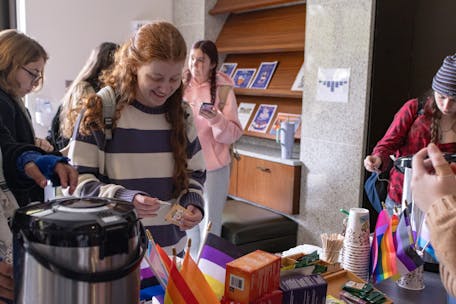
Green, like many students, felt that the administration needs to be held accountable for the public image of openness and acceptance of queer identities — which has only been possible through the actions of the student body.
“I think in showing ourselves grace, we must also shine light and be lovingly critical of what isn’t working,” Green said.
The tension between programming and genuine community runs deeper for queer BIPOC students who find themselves navigating multiple marginalized identities at once.
Other students have complained about the University’s retraction of gender-inclusive bathrooms around campus, and how that altered their perception of the University’s broader support of its transgender students on campus.
Zo Wofford, a recent graduate from CAS who goes by they/them pronouns, said there’s a gap between the University’s queer-friendly reputation and the realities that transgender students face on campus.
“It feels like AU is trying to capitalize on the fact that there are so many queer students here without actually doing anything to really help us,” Wofford said.
Wofford called their experience a “string of inconveniences” when it came to getting support on preferred names being used in official communication from the administration, having a place to dispose of menstrual products in the men’s bathroom and with professors fumbling to use the correct pronouns.
“The liberalism or progressivism comes from the student body,” Wofford said. “The administration doesn’t really do anything to support that.”
Gabe Michelangelo, a recent graduate from the School of Public Affairs and CAS and former president of Pride@AU, said accessing the gender-neutral bathrooms in the residence halls was a hassle and the process wasn’t publicly advertised.
“When I was in Anderson, you had to request access,” Michelangelo said. “I have to request access to use the gender neutral bathroom, which I never did. I didn’t know how to do that.”
Previous reporting from The Eagle documented how the University’s changes to gender-based bathroom signage affected the transgender student community on campus. Although the University has implemented LGBTQ+ Affinity Housing, that doesn’t solve the problem many students are concerned with: clearly defined support and public branding.
Michelangelo continued to press that the University should be more outspoken about its support toward queer students on campus and stop being so ambiguous.
“I’d love if we had more vocal or direct support from different departments,” Michelangelo said. “Maybe they should explicitly say AU is a safe space for queer and trans students.”
As these students have found, the “Gay-U” label, at its most generous, captures something real: a campus where queerness does not have to hide. However, for BIPOC students, trans students and others whose identities fall outside predominantly white and cisgender norms, the label highlights the lacking support systems and proper representation on campus.
“Is your goal to build community, or is your goal to maintain programming? And are those things compatible?” Green asked.
This article was edited by Olive Redd, Sophie Milner-Gorvine, Payton Anderson and Gabrielle McNamee. Copy editing done by Avery Grossman, Arin Burrell and Mattie Lupo.
