
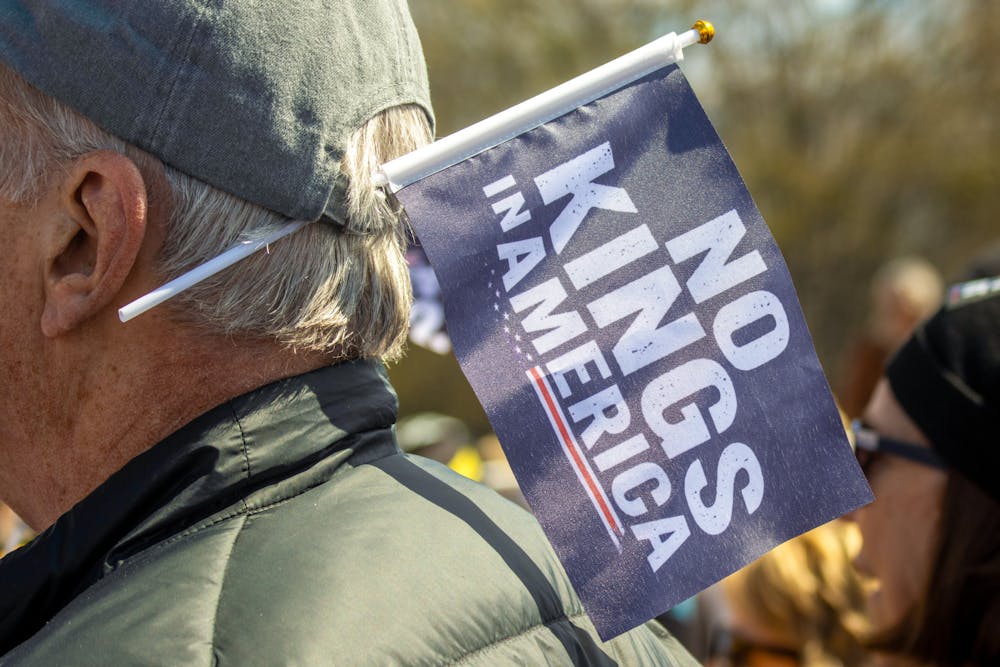
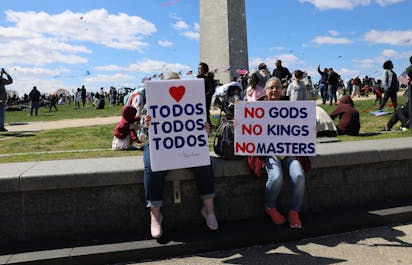
The third national No Kings Day brought numerous protests to the greater Washington, D.C. area. From the Frederick Douglass Bridge to Fort McNair, protestors came together with family members, pets, street bands and dancing frogs alike, carrying cries to free D.C. and fight back against authoritarianism.
The protest concluded outside of Fort McNair, an army base and residence for senior military and government officials, which became home to White House Deputy Chief of Staff and Homeland Security Advisor Stephen Miller in October 2025. The march was organized by Free D.C. and a contingent of Black organizations in D.C. known as the Chocolate City contingent. Protest advertisements read that although Trump is the president, Stephen Miller holds the power in the administration.
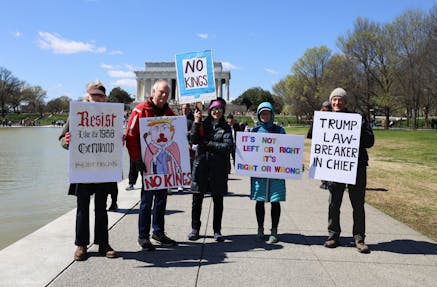
Demonstrators outside the fort called for Miller's removal from office, claiming his responsibility for the National Guard’s deployment in D.C. and the Immigration and Customs Enforcement raids across the nation.
Keya Chatterjee, the executive director of Free D.C., credited the Trump administration’s local and national impact to Miller, claiming he is the one with agency.
“No one elected Stephen Miller, nobody confirmed Stephen Miller, but he’s the one treating us as enemies of the state,” Chatterjee said. “And we have to be honest, Trump has been falling asleep in meetings recently, and Miller is the one who is directing all of this.”
As protestors marched, they occasionally shouted chants including, “Money for jobs and education, not for mass incarceration,” and “Hey ho, hey ho, Stephen Miller’s got to go.”
The crowd called for Miller’s removal, arguing that his policy decisions are motivated by a push to expand federal power.


“What we are witnessing in our city, in our nation, it ain’t just policy,” Reverend Anika Wilson-Brown said to the crowd. “It is power trying to reposition itself over the people, and D.C. does not need a king.”
D.C. activist and journalist Poet Taylor said commenting on social media or sharing information in group chats is not enough. Instead, Taylor encouraged the crowd to think about a plan of action, asking how uncomfortable they were willing to become to make a difference.
“It is time to get active in the community, because we are the change that we’ve been waiting for,” Taylor said. “What is the plan of how to use your superpower in these times, when some of the worst parts of history are already starting to repeat themselves?”
Many protestors raised concerns about the economic state of the nation under Trump’s second term. The Department of Government Efficiency, once run by South African tech mogul Elon Musk and now defunct, eliminated tens of thousands of federal jobs in the name of efficiency and eliminating fraudulent spending. In 2025, 260,000 workers left federal service.
The One Big Beautiful Bill Act cut over $1 trillion in funding for health insurance and $120 billion in funding for the Supplemental Nutrition Assistance Program. Despite these cuts, the law is projected to add at least $3.4 trillion to the national debt.
“They’re spending so much money on stuff that the American people do not want and do not need,” protestor and Free D.C. member Katie Henke said. “Instead, we need housing, we need food, we need jobs, we need health care for our neighbors.”
Naveed Shah is the political director for Common Defense, a national grassroots veterans organization fighting for democracy. He spoke to the crowd about the war the Trump administration started in Iran, which is seen as illegal under both U.S. and international law.
Having served in Iraq, Shah warned about the dangers of entering another long-term war, the price of which is shouldered by everyday Americans. Now, he said, this war is giving the American people another bill they cannot afford, while civil services and organizations that benefit the people, like the Corporation for Public Broadcasting, are shut down.
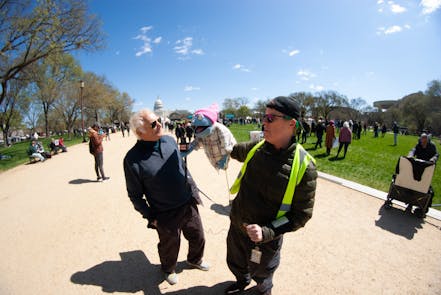
“We didn’t have money for food stamps or for Sesame Street,” he said. “But now we have a billion dollars a day to spend on missiles to launch.”
Manu Parakala, a freshman in the School of Public Affairs, held a sign that read “Bombing for peace is like f—king for virginity.” She said she came to protest the violence that the federal government is using against immigrants in America and Iranians in the war.
“There’s this false narrative [that] in order to create safety, you need violence … that’s just not true,” she said.
As speakers took the stage, Dan Mariano, who attended the march, made his way to the front of the crowd holding a sign that read “My president calls me vermin.”
“I’m out here to show solidarity with my fellow Americans who feel like our liberties and rights are a threat right now,” he said. “Especially the people that are the most marginalized and historically repressed in our communities and in our country.”
Mariano said that he also enjoyed the frivolity of the No Kings protestors, which contradicts the assumption that protestors are violent extremists. To him, it was important to see people having fun at times of intense stress.
Henke agreed and said she was inspired by the diversity of people who showed up to fight for one another.
“It’s nice to see the labor groups out. It’s nice to see some young artists who are expressing themselves and fighting for their neighborhoods,” she said.
Some protestors gathered immediately outside of the Anacostia metro station, chanting with megaphones and banging drums. Others walked 10 minutes further, joining the growing crowd at the Frederick Douglass Bridge. The sidewalks and streets began to fill with people carrying creative signs like “Colonizers don’t get to say who is illegal,” “Mind your own uterus” and “The only ICE I like is the ice my two gay hockey boyfriends skate on.”
Gathered around a truck functioning as a mobile stage parked beside the bridge, protesters listened to speeches and watched performances. Behind the truck, a group of marchers dressed in inflatable frog costumes joined the crowd, words of protest written on their stomachs and keffiyahs tied around their necks. They formed a circle in the rapidly growing crowd and began doing choreography to viral songs like “Golden” from the Netflix hit film K-Pop Demon Hunters (2025).
Thirty minutes into the rally, local grassroots organization Freedom Futures Collective performed songs from their new mixtape, “Free D.C.” Artist Ohnaj John described the band’s members as urban reporters sharing local news through music.
“We want to represent people of all walks of life,” he said. “To give everybody the power and encouragement to use their voice to fight back against the powers that be.”
As the rally came to a close, protestors began their march across the Frederick Douglass Bridge to confront Miller. The D.C. Street Activist Band joined in the demonstration, playing “Bella Ciao,” an Italian anti-fascist anthem, as the march reached the fort.
There was a pause for people to chalk messages on the street. A child sat on the edge of the road with a red piece of chalk, scribbling on the ground across from the fort. Behind him, Henke wrote “Stephen Miller sucks” on a brick wall.
Down the street, Mariano raised his sign high above his head as he walked to the Waterfront metro station.
“History only affords you a few opportunities to stand on the right side of it, and this is a critical moment in which all of us will be judged by history,” he said.
This article was edited by Gabrielle McNamee, Payton Anderson and Walker Whalen. Copy editing done by Avery Grossman, Paige Caron, Mattie Lupo and Ava Stuzin. Fact-checking done by Andrew Kummeth and Luca Palma Poth.
