
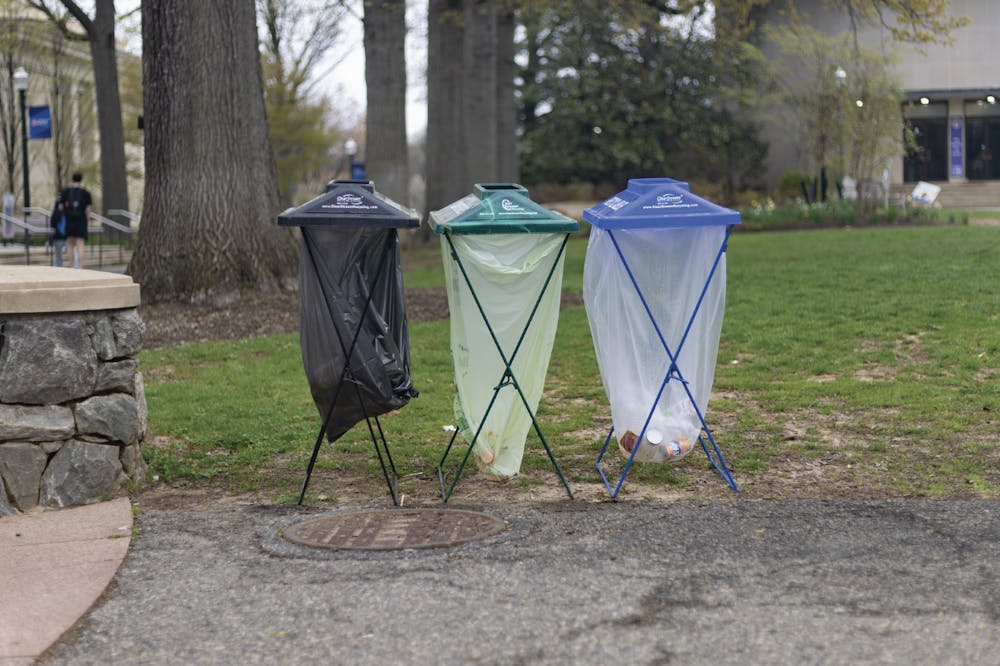
Before 2024, American University averaged about 50 tons of compost each year. In 2025, that number surged to 214 tons.
Behind that increase is the Zero Waste Department, which has expanded its composting initiatives and sustainability programs during the 2025-2026 school year.
Zero Waste is responsible for the operational side of sustainability management on campus. In practice, this often looks like waste and facility handling. There are around 20 different waste streams at American University, including trash, batteries, electronic waste, leaves and compost.
Zero Waste is a separate department from the Office of Sustainability, which focuses on University policy. Zero Waste’s labor is completed by only 10 full-time staff and 20 student employees who work a combined 250 hours a week.
“It wouldn’t happen without them,” Caroline Boone, the manager of Zero Waste, said.
Boone started as the manager in January 2024, working to improve operations and logistics. This work included an initiative to increase the composting program, expand plastic film disposal, adopt American University’s Food Recovery Network and engage with residence halls.
Plastic film disposal is not new to American University, but until the 2025-2026 school year, it had not been a major focus of Zero Waste, according to Zero Waste management.
Grocery bags, plastic bags and bubble wrap are all made of plastic film. This material is very recyclable, but not in most single-stream recycling receptacles because it tends to clog machines. Thus, it can not be recycled in the recycling bins found in residence hall lounges.


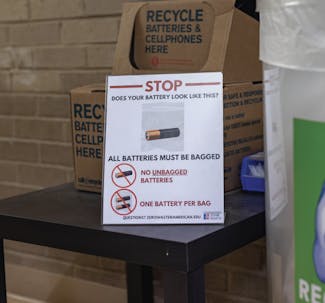
Zero Waste has expanded the number of specific plastic film disposal bins around campus. Boone said ease is one of the most valuable aspects of Zero Waste.
“The way to make something more convenient is to make bins for that thing everywhere,” Boone said.
Thus, plastic film disposal bins are now located in the lobbies of each residence building, the first floor of Mary Graydon Student Center, the basement of Bender Arena, the lobby of the Spring Valley Building, in mail rooms and in athletic training facilities
With an increase in bins around campus and promotions such as signage and social media posts, American University’s output of plastic film has greatly increased, according to Boone.
“It has been super successful,” Boone said, “I’m extremely proud.”
Where it used to be picked up once every three months, it is now collected every three weeks, reflecting the increase in recycled plastic film output.
The University’s plastic film goes to Trex, a company that uses it to produce synthetic timber for park benches and decking boards. Typically, institutions contract with a waste management company that collects their waste for them, but the University self-hauls its waste to ensure its destination is compliant with Zero Waste’s goals, according to Boone.
“We have confidence, and can guarantee where our waste is going,” Boone said. “We can figure out what the most reliable recycling facility is. We can distinguish where we want it to go.”
The destinations of food waste, in particular, have been a recent focus for Zero Waste. The Terrace Dining Room, along with other campus restaurants, aims to produce a little bit more than enough food each day, according to Boone. Responsibly handling that food waste has been a goal for many years.
In continuing to expand that effort, Zero Waste recently adopted American University’s student-run chapter of the Food Recovery Network, a nationwide movement that recovers surplus food and redistributes it to local communities.
“I’ve essentially absorbed the food recovery program into official university-run programs,” Boone said.
In the Fall 2025 semester, 6,700 pounds of food were recovered from TDR and delivered directly to local organizations, including Friendship Place, James Creek Residence Council, So Others Might Eat and Northwest Community Food. So far, in the Spring 2026 semester, 2,300 pounds have been redistributed.
“Expansion isn’t necessarily the goal,” Boone said. “The ideal is for the amount of food we donate to eventually plateau.”
Addy Plummer, a freshman in the School of Public Affairs eats at TDR frequently.
“I usually eat dinner pretty late, and I have noticed that there are usually a lot of leftovers,” she said.
Plummer noted that there was always extra food and that she had never seen TDR run out of options.
“I wasn’t aware of that program, but that sounds amazing,” Plummer said. “I’m sure there are many people in the D.C. area who really rely on that food, so that’s great that AU can be a source that provides it for them.”
Boone noted a similar purpose found in the food redistribution programs.
“You’re not just looking at aluminum cans,” Boone said. “You’re looking at edible food being given to people who need it in our community.”
These programs have generated great success that Zero Waste is very proud of, according to Zero Waste management. Now, the focus must shift to student and faculty engagement and behavior.
“You can have a perfect system on the back-of-house side, but if people aren’t contributing on the front-of-house side, it doesn’t matter,” Boone said.
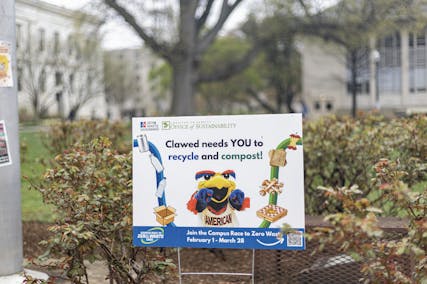
Successful community engagement, according to Boone, depends on three steps: letting people know that their actions have a sizable impact, getting them to care about sorting things correctly and educating them on how to do it.
Vivian Osborne is a first-year American University student in the School of Public Affairs living in Letts Hall, one of the residence halls included in Zero Waste’s most recent waste audits. Osborne was surprised to learn the statistics from the most recent waste audit. Before sorting, 72% of waste was trash, 15% was recycling and 14% was compost. After, 25% truly belonged in the garbage, while 32% belonged in recycling and 43% belonged in compost. Osborne said if she had known it made that much of a difference, she would sort more of her compost.
“I find that if I don’t know where something goes, I err on the side of throwing it away,” Osborne said. “It feels worse to put trash in the compost than it does to put compost in the trash.”
This sentiment aligns with what Boone has noted in waste audits from buildings all over campus. Compost and recycling bins aren’t commonly contaminated with trash, but trash is frequently found with compost and recycling that wasn’t sorted.
Over 70 percent of campus waste comes from sorting bins, according to Zero Waste management, so encouraging people to correctly sort their waste will have a sizable impact on American University’s environmental footprint. This often comes down to education, Boone said, which is why Zero Waste has made efforts to improve signage on the bins themselves, around campus and on social media.
“People come from all over the country, and are used to all different waste sorting programs,” Boone said, and getting everyone on the same page is one of the department’s main goals.
Zero Waste is currently focused on the nationwide Race to Zero Campus Waste, where American University placed fourth in the 2024-2025 school year. However, the University was only 0.05 percent away from first place, and this year, Boone said she hopes to place even higher.
Zero Waste works hard to ensure that the back-of-house side does their part to meet this goal, but a large part of their success depends on the actions of individuals around campus.
“I really hope people are able to learn, believe, and trust that their actions matter as individuals,” Boone said.
This article was edited by Conor Gillingham, Jessica Ackerman and Walker Whalen. Copy editing done by Avery Grossman, Ryan Sieve and Ava Stuzin.
