
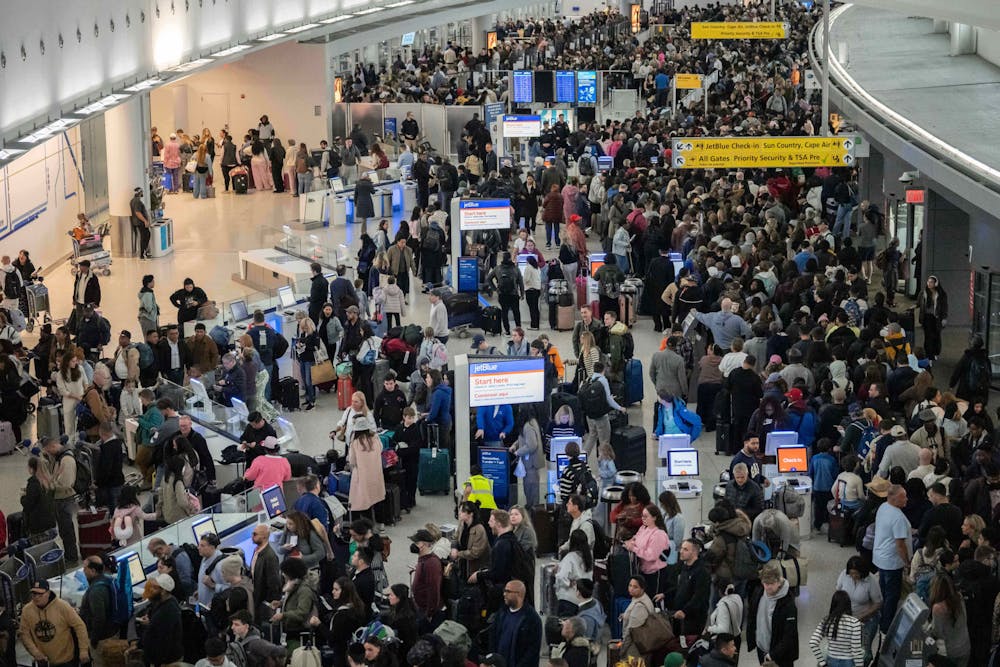
When she went home to Oklahoma for spring break, Valery Gutierrez, a freshman in American University’s School of International Service and School of Communication, couldn’t have predicted her return to Washington, D.C. would take much longer than usual.
However, lines at Transportation Security Administration would force Gutierrez to miss her flight back. To make matters worse, her ticket was nonrefundable, forcing her to purchase a second ticket.
Gutierrez wasn’t alone: a partial government shutdown that began Feb. 14 has rendered the Department of Homeland Security and its agencies, like TSA, unfunded and inoperational. As weeks pass with seemingly no deal in sight, travelers like Gutierrez wonder when normalcy will return to American airports.
In November 2025, the government entirely shut down for 43 days — the longest period in history. Disagreement over funding put Congress in a stalemate until six Democrats signed onto the Continuing Appropriations, Agriculture, Legislative Branch, Military Construction and Veterans Affairs and Extensions Act.
Lawmakers’ record-breaking streak has continued in 2026: What began as a February funding lapse for DHS has since manifested into the longest government shutdown in history, partial or full. Still, House Republicans continue to reject legislation their Senate counterparts attempt to pass.
From Feb. 14 until March 30, TSA workers went without a paycheck.
Airports across the country reported longer wait times and delays, raising concerns about staffing shortages nationwide. This directly affects students who rely on strict academic schedules, especially international students who book flights months in advance on limited budgets, as uncertainty like this can disrupt summer and personal travel plans.
“The prices are going to keep surging and the insecurity over traveling is going to keep rising,” Gutierrez said.


Nonetheless, she said the combination of delays and rising costs makes her feel like flying has become less reliable when she moves off-campus for summer break.
“I’m still in between my travel plans,” Gutierrez said. “I’m pretty sure I’m just going to drive back.”
Though Gutierrez may have found an alternative solution for unreliable travel, not all students have the same luxury.
Hoai Gia Han Nguyen, a freshman in the Kogod School of Business, said she had already booked her flight back to Vietnam but became anxious about possible cancellations.
“We have the exact day for finals and I plan for the day to return which makes it hard for me to change something,” Nguyen said.
Nguyen added that if delays or safety concerns worsen, canceling may be the only option.
For Washington College of Law student Ruth Chi, hindrances to travel aren’t the only concern.
“I don’t think anybody should have to show up to work and work for free,” Chi said.
During spring break, Chi traveled to Puerto Rico. To her, delays were noticeably different in comparison to her previous travel experiences. Chi added that the extended wait times combined with additional security procedures made her more hesitant to fly in the near future.
Chi also said the financial strain of working for an uncertain, irregular paycheck could have broader implications for airport operations and morale.
“People are choosing between showing up to work and working another job so they can feed their family,” Chi said.
Nguyen said the TSA complications and their relation to the government shutdown leave him concerned with how politicians from both sides of the aisle are acting without considering how everyday people are impacted.
“It feels like people are playing politics at the expense of ordinary travel,” Nguyen said.
This article was edited by Gabrielle McNamee, Payton Anderson and Walker Whalen. Copy editing done by Avery Grossman, Paige Caron, Mattie Lupo and Ava Stuzin. Fact-checking done by Andrew Kummeth and Luca Palma Poth.
localnews@theeagleonline.com
